




European regulators have steadily tightened the framework around persistent chelating agents. The EU Detergents Regulation amendments restrict phosphates, and EDTA faces increasing scrutiny for its environmental persistence—degradation rates below 10% under OECD 301B testing . NTA carries a GHS Category 2 carcinogen classification, placing it under even tighter restrictions. For formulators across home care and personal care, the challenge is practical: maintain hard water performance, preservative efficacy, and formulation stability while transitioning to readily biodegradable alternatives that meet EU Ecolabel criteria.
Trisodium methylglycine diacetate (MGDA-Na3)—derived from alanine, a naturally occurring amino acid—offers a technical path through this transition. Its molecular architecture provides effective chelation for calcium, magnesium, iron, and copper across a broad pH range, while its biodegradability profile (OECD 301B >60% in 28 days) distinguishes it from legacy chelates that persist in aquatic environments.
1. Regulatory Drivers in Modern Home and Personal Care Chemistry
The regulatory pressure on persistent aminocarboxylates has been building for years. The EU Chemicals Strategy for Sustainability, part of the broader Green Deal, explicitly targets persistent substances for restriction. ECHA's ongoing reviews of EDTA and NTA have accelerated substitution across multiple sectors.
Key constraints affecting chelate selection:
-
EU Detergents Regulation (EC 648/2004) — phosphorus limits; persistent chelates face substitution pressure
-
EU Ecolabel criteria — explicitly prohibit EDTA and NTA in certified products
-
REACH authorisation and restriction processes — ongoing assessments of EDTA and NTA under SVHC pathways
-
Retailer procurement policies — major European supermarket chains increasingly require "EDTA-free" and "readily biodegradable" claims on product packaging
-
Circular Economy Action Plan — the "zero pollution" ambition drives demand for raw materials that do not accumulate in water systems
The shift toward bio-based feedstocks is not merely regulatory—it reflects a broader industrial realignment toward sustainable carbon sources. MGDA-Na3, synthesised from plant-derived alanine, sits at the intersection of both trends.
2. Physico-Chemical Profile and Sequestration Kinetics of MGDA-Na3
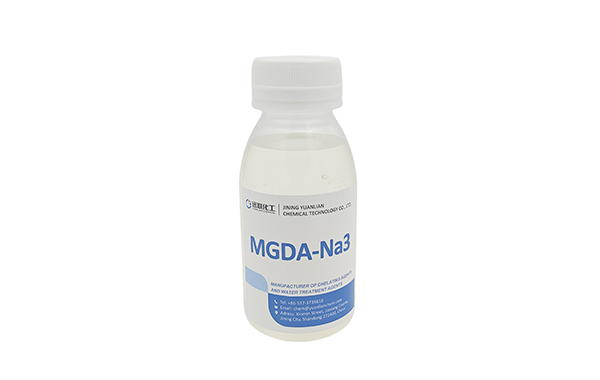
Core Parameters
| Parameter | Specification |
|---|---|
| CAS number | 164462-16-2 |
| Molecular formula | C₇H₈NNa₃O₆ |
| Molecular weight | 271.1 g/mol |
| Active content (standard liquid grade) | 40% |
| pH (1% solution) | 10.0–12.5 |
| Density (40% grade, 20°C) | 1.29–1.33 g/cm³ |
| Crystallisation point | < -15°C |
Chelation Mechanism
The spatial configuration of the three carboxyl groups in MGDA-Na3 allows for rapid multi-dentate coordination with divalent ions, preventing hard water scale maturation under alkaline stress. As a multidentate ligand, it coordinates with metal centres through three carboxylate groups and one tertiary amine, forming 1:1 metal-to-ligand complexes .
Chelation performance:
-
Calcium binding capacity: approximately 406 mg CaCO₃/g active substance at pH 11
-
Effectively binds Ca²⁺, Mg²⁺, Fe³⁺, Cu²⁺ across pH 4–13
-
Stability constants (log K at 25°C): Ca²⁺ 7.0, Mg²⁺ 5.8
High Alkalinity and High-Salt Stability
MGDA-Na3 maintains chelation performance across pH 2–13, with no precipitation of metal complexes under alkaline conditions. This distinguishes it from citrate, which loses chelation efficiency above pH 8 as carboxylic acid groups become deprotonated . In high-electrolyte systems—concentrated liquid detergents and unit-dose formats—MGDA remains clear and stable without crystallisation.
Thermal and Hydrolytic Stability
MGDA complexes remain stable at process temperatures up to 100°C . For automatic dishwashing applications—where wash temperatures reach 60–70°C and drying cycles run hotter—and for industrial cleaning operations requiring elevated temperatures, this thermal stability translates directly to sustained performance.
3. Strategic Application Matrices in Home Care Formulations
A. Automated Dishwashing (ADW) & Rinse Aids
In automatic dishwashing, hard water calcium and magnesium ions cause spotting, filming, and scale deposition on glassware and cutlery. MGDA-Na3 prevents these effects by sequestering hardness ions throughout the wash and rinse cycles. Typical use levels range from 2–8% of total formulation, often combined with polymers and enzymes to achieve scale-free, spot-free results .
Key characteristics for ADW formulations:
-
Phosphorus-free—addresses discharge restrictions and EU Ecolabel criteria
-
Readily biodegradable—supports green certification
-
Effective calcium binding at alkaline pH where citrate fails
-
Excellent rinsing performance with minimal filming on glassware
MGDA has been demonstrated to provide efficient rinsing and stain removal in commercial phosphate-free dishwashing formulations, with particular effectiveness against tea stains .
B. Concentrated Liquid Detergents & High-Electrolyte Systems
Concentrated liquid detergents and unit-dose pod formats demand ingredients that remain soluble at high active levels. MGDA-Na3 demonstrates complete miscibility with water at any ratio and remains stable in high-electrolyte systems without crystallisation or phase separation .
-
The 40% liquid grade remains fluid below -15°C, facilitating handling across diverse climatic conditions
-
No crystallisation or clouding occurs during low-temperature storage
-
Compatible with anionic, non-ionic, and amphoteric surfactant systems
4. Strategic Application Matrices in Personal Care Formulations
A. Preservative Efficacy Enhancement
In shampoos, body washes, and liquid soaps, MGDA-Na3 functions as a mild preservative booster. By sequestering divalent metal ions that microorganisms require for cellular membrane integrity, it disrupts the bacterial cell wall barrier. This mechanism contributes to microbial control while enabling formulators to reduce the load of conventional preservatives—such as phenoxyethanol—in finished products .
Relevant for mild formulations:
-
Non-irritating to skin and eyes
-
No sensitisation observed
-
Biodegradable profile supports natural/organic product positioning
-
INCI-compatible for transparent ingredient declarations
B. Stabilisation of Oxidation-Sensitive Ingredients
Trace transition metals—iron and copper introduced through process water or raw material impurities—catalyse oxidative degradation of unsaturated fatty acids, natural plant extracts, and fragrance components. This results in colour change, rancidity, and loss of sensory properties .
MGDA-Na3 addresses this by sequestering these catalytic metal ions, effectively inhibiting metal-catalysed oxidation kinetics. For formulations containing botanical oils, plant-based actives, or encapsulated fragrance systems, this stabilisation effect extends shelf life and preserves product aesthetics .
5. Analytical Evaluation: Technical Specifications Overview
| Characterisation Parameter | MGDA-Na3 | EDTA-Na4 | Sodium/Zinc Citrate |
|---|---|---|---|
| Origin / Baseline Feedstock | Amino acid analog (alanine base) | Fossil-fuel derived | Plant-derived organic acid |
| Ultimate Biodegradability (OECD 301B) | Readily biodegradable (>60% in 28 days) | Persistent in environment (<1% degradation) | Biodegradable but lower stability |
| Stability Constant (log K for Ca²⁺) | Medium-High (~7.0) | High (~10.7) | Low (~3.5, fragile under heat) |
| High Alkaline Stability (pH 10.0–12.0) | Excellent | Excellent | Poor (prone to structural cleavage) |
| Thermal Stability | Stable to 100°C | Stable to 80°C | Limited above 70°C |
| Ecotoxicological Hazards (GHS) | Non-hazardous / Eco-safe | Category 2 Carcinogen Suspect | Safe but performance restricted |
| EU Ecolabel Compliance | Yes | No | Yes |
What the comparison demonstrates: Citrate works in mildly acidic to neutral systems but fails under alkaline and thermal stress. EDTA works across a broad range—but its environmental persistence makes it increasingly unacceptable. MGDA bridges this gap: it matches EDTA's performance in alkaline, high-temperature systems while delivering the readily biodegradable profile required by EU Ecolabel criteria.
6. Securing Supply Chain Stability
For formulators making the transition from EDTA to MGDA-based chelates, supply chain consistency is a practical concern. Batch-to-batch variation in active content, free amino acid residuals, or colour clarity can disrupt formulation performance.
Quality Specifications for the 40% Liquid Grade
| Parameter | Specification |
|---|---|
| Appearance | Clear to light yellow liquid |
| Active content | 39–41% |
| Colour | ≤250 APHA |
| pH (1% solution) | 10.0–12.5 |
| Density (20°C) | 1.29–1.33 g/cm³ |
| NTA content | <0.10% |
| Heavy metals (as Pb) | ≤10 ppm |
Supply Chain Considerations
The liquid grade eliminates dusting hazards in compounding facilities and simplifies pumping and blending—no pre-dissolution step is required. For solid formulations—tablets, granules, or dry blends—powder grades (≥85% active) are also available.
Traceability and compliance documentation:
-
REACH registration confirmation
-
OECD 301 biodegradability test results
-
Certificate of analysis with heavy metal limits
-
Safety Data Sheet (SDS)
-
Batch-to-batch consistency records
7. Collaborative Formulation Optimization and Sample Verification
MGDA-Na3 represents a practical path for formulators navigating the transition away from phosphates, EDTA, and NTA. It offers the chelation performance required for hard water applications—particularly in alkaline and high-temperature systems—while meeting the environmental standards now expected by European regulators and retailers.
The technical case for MGDA-Na3:
-
Readily biodegradable under OECD 301B—meets EU Ecolabel criteria
-
Stable across pH 2–13—outperforms citrate and matches EDTA in alkaline conditions
-
Thermal stability to 100°C for automatic dishwashing and industrial cleaning
-
Preservative synergy reduces biocide loads in personal care formulations
-
Prevents metal-catalysed oxidation—extends shelf life of sensitive ingredients
-
Complete water miscibility enables high-concentration liquid formulations
-
Plant-derived from alanine—renewable carbon source
-
Non-irritating to skin and eyes—suitable for sensitive-skin applications
To confirm the specific coordination stabilisation thresholds or preservative boost ratios of MGDA-Na3 within your trial formulations, standard evaluation materials, comprehensive Technical Data Sheets (TDS), and Safety Data Sheets (SDS) are accessible through our application engineering group. The technical team provides compatibility assessments tailored to specific surfactant systems, water chemistry profiles, and formulation conditions.

Contact us