




1. Legislative Pressures and Formulation Evolution in European Fabric Care
The European detergent industry has undergone a fundamental restructuring over the past decade. Regulatory pressure from the European Chemicals Agency (ECHA) has steadily tightened the framework around persistent aminopolycarboxylates such as EDTA—which exhibits degradation rates below 10% under OECD 301B testing—and NTA, which carries a GHS Category 2 carcinogen classification . The EU Ecolabel for detergents explicitly prohibits both compounds in certified products, and major retailers across Germany, France, and the Nordic countries now refuse to accept new EDTA-based formulations .
This regulatory adaptation coincides with two parallel shifts in consumer behaviour and product engineering: the transition toward low-temperature washing (20–30°C) and the concentration of liquid detergent formats. Both trends impose specific demands on builder systems. Cold-water performance requires chelating agents with rapid coordination kinetics—the ability to sequester hardness ions quickly at reduced thermal energy input. Concentrated liquid formats demand builders that remain soluble and phase-stable in high-surfactant matrices without precipitating or causing salting-out effects.
The industry has responded by moving away from traditional inorganic builders and persistent aminocarboxylates toward bio-derived, readily biodegradable alternatives. Among these, MGDA-Na3—a chelate synthesised from alanine, a naturally occurring amino acid—has emerged as the preferred option for formulators needing to maintain hard water performance while meeting eco-label compliance and cold-water efficacy targets .
2. Physico-Chemical Profile and Coordination Kinetics of MGDA-Na3
MGDA-Na3 (methylglycine diacetic acid, trisodium salt; CAS 164462-16-2) is a low molecular weight aminopolycarboxylate chelate with a molecular formula of C₇H₈NNa₃O₆ and a molecular weight of 271.11 g/mol . Commercial liquid grades typically contain 39–41% active content with a pH of 10.0–12.0 (1% solution) and density of approximately 1.30 g/cm³ . Powder grades are available at ≥85% active content for solid formulations .
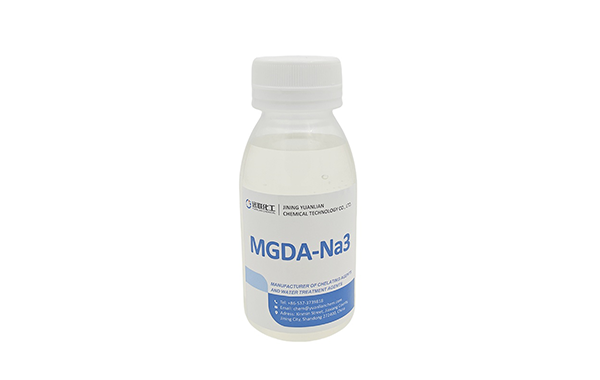
The chelation mechanism operates through the coordination of metal ions by three carboxylate groups and one tertiary amine nitrogen. The spatial configuration of the carboxylic arms yields conditional stability constants with a metal affinity order: Cu²⁺ > Fe³⁺ > Zn²⁺ > Mn²⁺ > Ca²⁺ > Mg²⁺ across pH 3–11 . The calcium binding capacity reaches approximately 60 mg Ca/g active , nearly matching EDTA's performance while maintaining ready biodegradability—a distinction that, for EU Ecolabel compliance, effectively replaces the environmental persistence of legacy chelates with a degradable alternative .
Under low-temperature wash profiles (20°C), MGDA's small molecular size enables rapid coordination kinetics—it sequesters calcium and magnesium ions quickly, preventing them from complexing with anionic surfactants before the wash cycle completes . This fast action is particularly relevant for cold-water programmes, where reduced thermal energy otherwise slows conventional builder kinetics. In concentrated surfactant matrixes, MGDA's high water solubility and broad pH stability (effective from pH 7.0 to 11.0 and beyond) maintain single-phase clarity without precipitation, even at high surfactant loads where citrates and other organic builders may salt out .
3. Application Performance Profiles in Liquid Laundry Detergents
Calcium Scale Control and Surfactant Efficiency Booster
In European hard water regions—where calcium and magnesium concentrations in tap water can exceed 250 mg/L as CaCO₃—metal ions compete with anionic surfactants (LAS, AES) for binding sites. Without effective sequestration, these ions form insoluble calcium-surfactant complexes that precipitate onto fabric surfaces, reducing detergency and causing the "incrustation" that leaves fabrics stiff and gray .
MGDA-Na3 captures hardness ions before they can interact with surfactant molecules, effectively releasing surfactant micelle formation capacity and preventing the deposition of mineral salts onto fabric fibres . The practical outcome is improved whiteness maintenance and colour preservation, particularly in repeated wash cycles where calcium accumulation would otherwise accelerate fabric dulling .
Bleach System and Peroxide Stabilisation
In liquid formulations containing peroxide-based bleaching agents or in powder detergents with sodium percarbonate, trace transition metals (iron, copper, manganese) introduced through production water or clothing metal fasteners catalyse peroxide decomposition. This reduces bleaching efficiency and can lead to premature oxygen release, shortening product shelf life.
MGDA-Na3 complexes these transition metal ions, sequestering them from the bleach system and preventing catalytic decomposition . The stabilisation effect extends to sodium perborate and percarbonate systems, maintaining oxidative activity throughout the product's intended shelf life while protecting fabric fibres from metal-catalysed oxidative degradation .
Enzymatic Compatibility in Heavy-Duty Liquids
Heavy-duty liquid (HDL) detergents commonly contain protease, amylase, and lipase enzymes to address protein, starch, and fat stains. These enzymes are sensitive to metal ions—particularly calcium, which stabilises their tertiary structure—but also to chelants that strip essential metals from enzyme active sites.
MGDA-Na3 demonstrates good compatibility with enzyme systems in HDL formulations. It maintains sufficient calcium in solution to preserve enzyme stability while removing enough hardness to prevent surfactant deactivation, without causing enzyme protein denaturation or precipitation . This balance is critical for preserving enzymatic stain removal performance over the product's shelf life.
4. Technical Comparison Matrix: MGDA-Na3 vs. Legacy Detergent Builders
| Characterisation Vector | MGDA-Na3 | EDTA-Na4 | Sodium Citrate |
|---|---|---|---|
| Primary material base | Alanine derivative (bio-based option) | Fossil-fuel / petrochemical | Plant-derived organic acid |
| Ultimate biodegradability (OECD 301B) | Readily biodegradable (>60% in 28 days) | Persistent in environment (<10% degradation) | Readily biodegradable |
| Calcium binding capacity (mg CaCO₃/g) | ~280–300 | ~300–320 | ~120–150 |
| Low-temperature wash kinetics (20°C) | Fast coordination | Moderate | Slow |
| Concentrated liquid compatibility | High (clear single phase) | Moderate | Prone to precipitation/salting-out |
| High alkaline stability (pH 10–12) | Excellent | Excellent | Poor |
| Thermal stability | Stable above 100°C | Stable to 80°C | Limited above 70°C |
| EU Ecolabel compliance | Yes | No | Yes |
5. Aligning Global Supply Chains with Yuanlian Chemical Engineering Standards
European liquid detergent manufacturers advancing builder upgrades are, in practice, evaluating two factors beyond basic performance: lot-to-lot reliability of active molecule structure and control of environmental trace impurities—particularly free NTA content, which is restricted under EU Ecolabel criteria .
Yuanlian Chemical operates as an upstream synthesis innovator in the green chelate space, with documented production capacity for MGDA-Na3 in liquid (40–42% active), powder (≥85%), and granular (≥78%) forms . The company's manufacturing process achieves consistent analytical profiles with NTA-Na3 content specified at ≤0.10%, meeting the purity requirements of major European detergent manufacturers . Batch-specific Certificates of Analysis and full REACH registration documentation are available, supporting the supply chain traceability required for multinational procurement audits . The availability of multiple physical forms—particularly the 40% liquid grade, which remains fluid down to -15°C—aligns with the logistics requirements of large-scale liquid detergent production across seasonally varying European climates .
6. Collaborative Formulation Support and Verification
Adopting a biodegradable chelate builder is not solely a compliance measure—it is a pathway to establishing ecological differentiation as a technical barrier to competition in the premium liquid detergent segment.
To evaluate the phase compatibility, cold-water stain removal profiles, or peroxide stability of MGDA-Na3 within your trial liquid detergent systems, standard evaluation samples, comprehensive Technical Data Sheets (TDS), and Safety Data Sheets (SDS) are accessible through our application engineering group.

Contact us