


-

- 2026-07-23
Polyaspartic Acid (PASP): A Sustainable Solution for Scale Inhibition and Dispersion
As industries face increasing pressure to reduce environmental impact without compromising operational efficiency, the search for effective, eco-friendly chemical solutions has intensified. Polyaspartic acid (PASP) has emerged as a notable candidate in this space—a biodegradable, phosphorus-free polymer that addresses scale formation challenges across water treatment, agriculture, and cleaning applications. This article examines the technical properties, performance characteristics, and practical considerations for formulating with PASP, supported by recent research findings and industry data.
What is Polyaspartic Acid (PASP)?
Molecular Structure and Mechanism
Polyaspartic acid is a water-soluble, synthetic polyamino acid composed of aspartic acid monomer units linked by amide bonds. Its molecular structure features a polypeptide backbone with pendant carboxyl groups (-COOH) that serve as the primary active sites for metal ion interaction .
The scale inhibition mechanism operates through two complementary pathways. First, the carboxyl groups exhibit strong chelating affinity for divalent metal ions—particularly calcium (Ca²⁺) and magnesium (Mg²⁺)—forming soluble complexes that prevent these ions from precipitating as crystalline scale deposits . Second, PASP acts as a crystal modifier: when scale formation does occur, the polymer adsorbs onto growing crystal faces, distorting lattice development and producing less adherent, more easily dispersible particles .
Recent molecular dynamics simulations have elucidated this mechanism at the atomic level. Studies show that PASP-Na disrupts ion-particle binding through its carboxyl groups, effectively hindering the formation of large clusters and reducing both the frequency and strength of ion adsorption onto particle surfaces . This dual action—chelation and crystal distortion—accounts for its effectiveness across a range of challenging water conditions.
Physical and Chemical Specifications
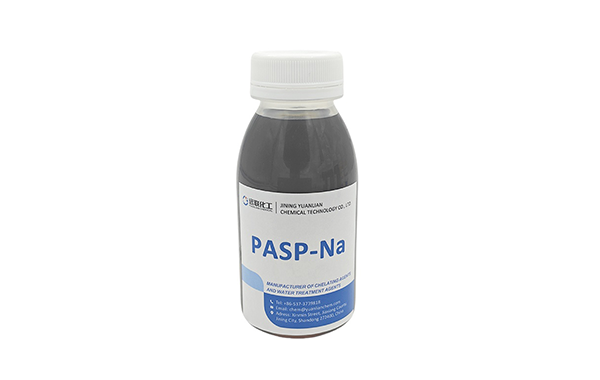
Commercial PASP products are typically supplied as sodium salts in liquid form. The following specifications represent standard industrial grades:
| Parameter | Typical Value | Test Method |
|---|---|---|
| Appearance | Yellow to reddish-brown liquid | Visual |
| Solid content | ≥ 40.0% | Gravimetric |
| Density (20°C) | ≥ 1.20 g/cm³ | Hydrometer |
| pH (1% aqueous solution) | 9.0 – 11.0 | Electrochemical |
| Relative molecular weight | 1,000 – 5,000 Da | GPC |
The molecular weight distribution significantly influences performance characteristics. Lower molecular weight fractions (< 2,000 Da) tend to exhibit superior chelation efficiency, while higher fractions offer enhanced dispersion and crystal modification effects. Formulators should select grades based on the specific application requirements.
Environmental Profile and Biodegradability
PASP is classified as a green polymer due to its phosphorus-free composition and documented biodegradability. Standardised testing under OECD 301B guidelines (ISO 9439) confirms that PASP undergoes biodegradation under aerobic conditions, with ultimate breakdown products comprising water, carbon dioxide, and inorganic nitrogen compounds .
The biodegradation pathway involves enzymatic hydrolysis by hydrolases present in natural microbial communities. Research has identified specific enzymes—such as PahZ1KT-1 and PahZ1KP-2 from Sphingomonas and Pedobacter species—that cleave the polymer backbone into oligopeptides and ultimately into L-aspartic acid monomers . This multi-step process underscores that biodegradability depends on the presence of appropriate microbial consortia and environmental conditions, rather than being an intrinsic property of the polymer itself.
It should be noted that the 28-day ready biodegradability test (OECD 301F) has limitations for polymers, as the standard inoculum pretreatment can remove extracellular enzymes essential for initial polymer breakdown. Supplementation studies have demonstrated that reintroducing appropriate hydrolases significantly accelerates degradation, achieving 71% mineralisation within 28 days when preincubated with enzyme mixtures .
Primary Industrial Applications of PASP
Industrial Water Treatment and Cooling Systems
Scale deposition in industrial cooling systems remains a persistent operational challenge, reducing heat transfer efficiency, accelerating corrosion, and increasing maintenance costs. PASP addresses this through several mechanisms.
For calcium carbonate (CaCO₃) scale—the most common deposit in cooling water—PASP derivatives have demonstrated inhibition rates of up to 96% at concentrations of 30 mg/L, representing a 41% improvement over unmodified PASP . Performance extends to other scale-forming salts including calcium sulfate, barium sulfate, and calcium phosphate .
The polymer shows particular utility in challenging water conditions: high hardness, high alkalinity, high pH, and high concentration ratio systems where traditional inhibitors often underperform . Field experience indicates that PASP performs effectively in systems with concentration ratios exceeding 4.0, where the ionic strength would typically accelerate scale formation.
Synergistic Formulations: PASP exhibits beneficial synergy when combined with other water treatment chemistries. Blending with PBTCA (2-phosphonobutane-1,2,4-tricarboxylic acid) has been shown to enhance overall scale inhibition performance, allowing reduced total dosage while maintaining or improving effectiveness . Similarly, combinations with zinc salts can provide corrosion inhibition benefits alongside scale control, addressing multiple water quality parameters simultaneously.
Recent research has also explored modified PASP derivatives with enhanced functionality. Derivatives incorporating meta-substituted phenyl groups and semi-ethylenediaminetetraacetic acid structures have shown not only superior scale inhibition but also antibacterial activity against E. coli and intrinsic fluorescence properties that enable real-time monitoring of residual agent concentration in cooling systems .
Agriculture and Fertiliser Synergists
In agricultural applications, PASP functions as a nutrient absorption enhancer. The polymer's chelating properties help maintain micronutrients (such as iron, zinc, and manganese) in plant-available forms by preventing precipitation with phosphates and other soil anions .
Research on potato cultivation demonstrates that PASP-calcium complexes (PASP-Ca) significantly boost plant growth, yield components, and photosynthetic efficiency. The effect is particularly pronounced when applied to nitrogen-efficient genotypes, highlighting the importance of integrated crop management strategies . The complex enhances root system architecture, expanding root dimensions and improving nutrient acquisition capacity, especially under nitrogen-deficient conditions—a finding with significant implications for reducing fertiliser requirements while maintaining productivity.
From a soil health perspective, PASP application has been associated with improved rhizosphere nutrient availability and modulation of soil microbial communities, further contributing to overall soil fertility .
Detergents and Institutional Cleaning
The shift toward phosphorus-free detergent formulations has created demand for alternative builders and anti-redeposition agents. PASP addresses this requirement through multiple mechanisms:
-
Water softening: Chelation of calcium and magnesium ions reduces the effective hardness of wash water, improving surfactant performance and reducing the risk of fabric graying.
-
Anti-redeposition: Dispersion properties keep removed soil particles suspended in the wash liquor, preventing them from redepositing on fabric surfaces.
-
Scale prevention: Inhibition of carbonate scale formation protects heating elements and improves machine efficiency over time.
PASP's biodegradability profile makes it particularly suitable for formulations marketed as environmentally preferable—provided that the product literature correctly characterises its environmental fate rather than overstating claims .
Performance Comparison: PASP vs. Conventional Chelates and Scale Inhibitors
The following comparison examines PASP against established products across several performance dimensions. Data are drawn from standard test methods and published literature.
| Parameter | PASP | EDTA | PMA | ATMP |
|---|---|---|---|---|
| Biodegradability (OECD 301B) | Readily biodegradable (54-71% in 28 days) | Poor | Low | Limited |
| Phosphorus content | None | None | None | High (contains P) |
| Calcium carbonate inhibition (30 mg/L) | 55-96% depending on grade | Moderate | Good | Very good |
| Calcium dispersion | Excellent | Moderate | Good | Poor |
| Thermal stability (≥80°C) | Good | Moderate | Good | Excellent |
| Alkaline stability (pH > 10) | Good | Moderate | Good | Good |
| Eutrophication risk | None | None | None | Significant |
Data sources:
Key Observations:
PASP offers a favourable combination of environmental acceptability and scale inhibition performance. Its phosphorus-free nature eliminates regulatory concerns regarding total phosphorus discharge limits, a growing compliance issue in many regions. While ATMP exhibits superior calcium carbonate inhibition at elevated temperatures, its phosphorus content and limited biodegradability present sustainability disadvantages that increasingly influence purchasing decisions.
Formulating with PASP: Key Technical Considerations
Optimal pH Range
PASP performs effectively across a broad pH spectrum, with maximum activity typically observed in the pH range of 8.0 to 10.5 . Within this range, the carboxyl groups remain sufficiently deprotonated to engage in metal ion chelation, while the polymer maintains structural integrity.
At pH values below 7.0, protonation of carboxyl groups reduces chelating capacity, potentially necessitating increased dosage. Conversely, at pH above 11.0, competitive interactions with hydroxide ions may affect performance, although PASP shows better alkaline stability than many alternative scale inhibitors.
Compatibility with Co-formulants
Surfactants: PASP demonstrates general compatibility with non-ionic and anionic surfactants commonly used in detergent and cleaning formulations. Cationic surfactants may precipitate the polymer through ionic interactions; pre-formulation compatibility testing is recommended if cationic materials are required.
Corrosion inhibitors: Synergy has been documented with several inorganic and organic corrosion inhibitors. The combination of PASP with zinc salts or phosphonates can provide both scale and corrosion control in a single treatment protocol .
Biocides: When oxidative biocides (chlorine, bromine) are used in water treatment systems, PASP degradation potential should be evaluated. Non-oxidative biocides typically present fewer compatibility concerns.
Recommended Dosage Guidelines
Effective concentrations vary substantially by application:
| Application | Typical Dosage Range | Remarks |
|---|---|---|
| Cooling water systems | 5 – 50 mg/L | Higher dosage for severe scaling conditions |
| Boiler water treatment | 10 – 30 mg/L | Depends on feedwater quality |
| Reverse osmosis pretreatment | 2 – 10 mg/L | Combined with antiscalants |
| Detergents and cleaners | 0.5 – 5% (formulation weight) | Varies by product type |
| Agricultural fertiliser blends | 0.1 – 1% of fertiliser weight | Dependent on crop and soil conditions |
Frequently Asked Questions
Is Polyaspartic Acid fully biodegradable?
Based on OECD 301B test protocols, PASP is classified as readily biodegradable, achieving > 60% degradation within 28 days under standard conditions. The ultimate degradation products are water, carbon dioxide, and inorganic nitrogen compounds. It should be noted that biodegradation rate depends on the presence of appropriate microbial consortia and environmental conditions; actual performance in the field may vary from standard laboratory test results .
Can PASP be used in high-temperature water systems?
PASP maintains thermal stability up to approximately 80–90°C. At higher temperatures, hydrolysis of the amide backbone can occur, potentially reducing molecular weight and chelating capacity. For systems operating above 100°C—such as high-pressure boiler applications—modified derivatives with enhanced thermal stability are available . Compatibility testing at actual operating conditions is always recommended.
How does PASP perform as a phosphorus-free scale inhibitor?
PASP provides effective scale inhibition across a range of challenging water conditions, with calcium carbonate inhibition rates reaching 96% at 30 mg/L for certain derivatives. Its phosphorus-free composition eliminates the risk of eutrophication associated with phosphorus-containing alternatives and helps facilities comply with increasingly stringent discharge regulations. While some phosphorus-based inhibitors may exceed PASP performance in specific extreme conditions, the environmental advantages often justify the selection of PASP where performance requirements are met .
Conclusion
Polyaspartic acid represents a practical, environmentally compatible solution for scale inhibition across multiple industrial sectors. Its biodegradability and phosphorus-free composition address pressing environmental concerns, while its chelating, dispersing, and crystal-modifying properties deliver effective performance in challenging water conditions. Recent research continues to expand the capabilities of PASP through chemical modification, introducing additional functionalities such as corrosion inhibition and antibacterial activity without compromising its sustainability credentials.
For formulators and process engineers, PASP offers a versatile building block for developing greener products and processes. As with any technical material, optimal results depend on careful selection of grade, appropriate dosage, and consideration of the specific application conditions.
Need detailed technical documentation or formulation guidance for your project? Our technical team can provide product specifications, safety data sheets, and customised support for your application. Contact us to request a TDS, MSDS, or formulation consultation.
Yuanlian Chemical specializes in the production of polyaspartic acid (PASP),tetrasodium iminodisuccinate(IDS), GLDA, MGDA etc. with stable quality and excellent quantity!

Contact us