




If you work in detergent formulation, industrial cleaning, or personal care R&D, you have probably noticed a shift. The chelating agents that have been industry standards for decades—EDTA, NTA, DTPA—are facing increasing scrutiny. Not because they stop working, but because they do not go away after use.
EDTA degrades slowly in the environment. NTA carries a toxicity classification that makes regulators uncomfortable. Meanwhile, end-user brands are making public commitments to biodegradable ingredients, and retailers are tightening their green chemistry requirements.
GLDA-Na₄ (tetrasodium glutamate diacetate) has emerged as one of the more practical alternatives. It chelates calcium, magnesium, iron, and other transition metals as effectively as EDTA in most applications. But it breaks down in the environment, it is derived from plant-based L-glutamic acid, and it carries a cleaner toxicological profile.
This article walks through the chemistry, performance data, application areas, and supply considerations for GLDA-Na₄—written for formulators and procurement professionals who need to evaluate whether this is the right move for their products.
Regulatory Pressure: Why the Shift Away from Traditional Chelators Is Accelerating
EDTA has an environmental persistence problem
EDTA does not degrade readily in wastewater treatment or in the environment. Its half-life in surface water can extend to weeks or months, and it forms stable complexes with heavy metals that can remobilize them from sediments. The ecological concern is not acute toxicity—it is the long-term presence and the potential for metal redistribution.
NTA carries a toxicity classification
NTA (nitrilotriacetic acid) is classified as a Category 2 suspected carcinogen under the GHS system. Its use is already restricted in several markets, and major brands have been phasing it out for years. Formulators who still use it are looking for replacements.
Regulatory signals are getting stronger
The EU Ecolabel criteria for detergents now prioritize readily biodegradable chelating agents. The EU Detergents Regulation has been tightening restrictions on problematic substances. Major multinational brands—Procter & Gamble, Unilever, Henkel—have all made public commitments to move away from persistent chelators and toward biodegradable alternatives. This is not a future trend; it is happening now.
GLDA-Na₄ fits this regulatory trajectory. It is derived from L-glutamic acid (a plant-based amino acid), it degrades readily under OECD 301B conditions (>60% over 28 days), and it does not carry the toxicity flags that make NTA problematic.
GLDA-Na₄: Physicochemical Profile and Chelation Mechanism
Molecular structure
GLDA-Na₄ (tetrasodium glutamate diacetate, CAS 51981-21-6, molecular weight 351.13) consists of a glutamate backbone with two acetate groups attached to the amine nitrogen. The result is a molecule with four carboxylate groups capable of forming stable five- and six-membered chelate rings with metal ions.
Coordination chemistry
The chelation mechanism is straightforward: the nitrogen atom and four carboxylate oxygen atoms coordinate with metal ions to form a cage-like structure. The stability constants (log K) for GLDA-Na₄ with key metal ions are:
-
Ca²⁺: ~5.0
-
Mg²⁺: ~5.8
-
Fe³⁺: ~15.3
-
Cu²⁺: ~18.0
-
Mn²⁺: ~10.5
-
Zn²⁺: ~11.0
These values place GLDA-Na₄ in the same performance class as EDTA for most practical applications. For calcium and magnesium—the metals responsible for water hardness—it performs comparably or slightly better in alkaline conditions.
Key physicochemical specifications
-
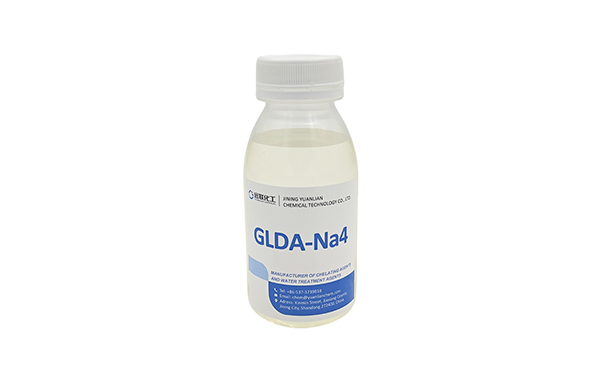
Form: Clear, slightly yellowish liquid
-
Active content: 47% (±1%) standard commercial grade; 38% and solid grades also available
-
pH (1% solution): 11.0–12.0
-
Density (20°C): ~1.30 g/cm³
-
Water solubility: Complete across the full concentration range
Thermal and pH stability
GLDA-Na₄ maintains solubility and chelation activity across a remarkably wide pH range—from 2.0 to 13.0. This exceeds the practical working range of EDTA (pH 4.0–11.0) and NTA (pH 3.0–9.0). For applications like automatic dishwashing tablets, where alkaline builders and high-temperature wash cycles are standard, this stability matters.
The molecule also tolerates elevated temperatures without hydrolysis or precipitation, which makes it suitable for processes that involve hot mixing, spray drying, or high-temperature cleaning.
Application Matrix: Where GLDA-Na₄ Works Best
Automatic Dishwashing (ADW) Detergents
This is probably the largest-volume application for GLDA-Na₄ today. Phosphate builders have been phased out of ADW formulations in most developed markets, and the industry has been searching for replacements that control hardness without compromising performance.
GLDA-Na₄ inhibits calcium carbonate crystal growth. In practical terms, this means fewer white spots on glassware, less filming on dishes, and less scale accumulation inside the machine. The mechanism is straightforward: the chelator binds calcium ions before they can nucleate into insoluble carbonate crystals.
One detail worth noting—in ADW formulations, GLDA-Na₄ works best when paired with a dispersant polymer (typically polyacrylate). The combination provides both sequestration and dispersion, which together deliver the clean, spot-free results that consumers expect.
Laundry Detergents
In liquid and powder laundry formulations, GLDA-Na₄ serves the same core function: hardness control. Hard water calcium and magnesium ions interfere with surfactant performance, reducing foam and cleaning efficiency. They also react with soap to form insoluble lime soap deposits on fabrics, which contribute to stiffness and dullness over time.
Adding GLDA-Na₄ at low levels (0.2–0.3% of the formulation) is often sufficient to stabilize the system, chelate hardness ions, and keep the product clear and physically stable during storage.
Personal Care Products
GLDA-Na₄ finds use in shampoos, body washes, facial cleansers, and skin care products. The drivers here are somewhat different. In personal care, formulators care about:
-
Preservative boosting: GLDA-Na₄ chelates the metal ions that bacteria and fungi need to maintain their cell wall integrity. This weakens microbial cells and makes them more susceptible to preservatives like phenoxyethanol and isothiazolinones. In practice, this allows the formulator to use lower preservative levels while maintaining the same antimicrobial efficacy.
-
Mildness: The toxicological profile is clean. Skin irritation and sensitization data show it is well-tolerated even in leave-on products.
-
Product stability: Chelating trace heavy metals prevents the oxidation of oils, fragrances, and vitamins—which translates to better color stability and longer shelf life.
Industrial Cleaning and Metal Treatment
GLDA-Na₄ is used in industrial formulations for removing calcium carbonate and phosphate scales. In dairy processing equipment, for example, calcium phosphate scale builds up on heat exchanger surfaces and pipelines. EDTA has been the standard treatment for this, but its poor biodegradability makes it increasingly problematic for plants with effluent discharge limits. GLDA-Na₄ offers comparable scale removal with a cleaner environmental profile.
Pulp and Paper / Textile Bleaching
Hydrogen peroxide bleaching is used extensively in pulp and textile processing. The catch is that trace transition metals (iron, manganese, copper) catalyze peroxide decomposition. The bleach breaks down before it can do its job, which forces the mill to use more peroxide or accept lower brightness.
GLDA-Na₄ sequesters these metal ions effectively. The result is better bleach efficiency, lower peroxide consumption, and less fiber damage. In practice, this means lower operating costs and better product quality for the mill.
Performance Comparison: GLDA-Na₄ vs. Traditional Chelators
| Parameter | GLDA-Na₄ | EDTA-Na₄ | NTA-Na₃ |
|---|---|---|---|
| Carbon source | Plant-based (L-glutamic acid) | Petrochemical | Petrochemical |
| Biodegradability (OECD 301B) | Readily (>60% in 28 days) | Poor (<10% in 28 days) | Moderate (limited by toxicity profile) |
| pH stability range | 2.0–13.0 | 4.0–11.0 | 3.0–9.0 |
| Ca²⁺ chelation (log K) | ~5.0 | ~4.6 | ~5.4 |
| Fe³⁺ chelation (log K) | ~15.3 | ~15.4 | ~15.9 |
| Ecotoxicity risk | Low | Moderate (persistence concern) | GHS Category 2 suspected carcinogen |
| Performance in high-electrolyte systems | Good | Limited (salting out risk) | Moderate |
This data shows that GLDA-Na₄ matches or exceeds the performance of EDTA across most relevant measures, while offering a significant advantage on biodegradability and a cleaner regulatory profile.
Supply Chain and Quality Considerations
For formulators switching from EDTA to GLDA-Na₄, batch-to-batch consistency matters more than any single performance parameter. A chelator that varies in active content by more than a percent or two can throw off an entire formulation—hardness control becomes unpredictable, and the product may not meet specifications.
The commercial GLDA-Na₄ liquid is typically supplied at 47% active content (±1%). Solid powder grades at ≥95% purity are also available. The liquid product is simpler to handle in automatic metering systems and requires no dissolution step; the solid grade offers freight savings for long-distance shipping and is preferred in dry blending operations.
Yuanlian Chemical (Shandong) is one of the active producers in the GLDA-Na₄ space. The company operates a fully automated synthesis line with continuous quality monitoring for active content, pH, density, and residual free impurities. The GLDA-Na₄ product is produced via a synthetic route using L-glutamic acid as the starting material, and the company maintains ISO 9001 and ISO 14001 certifications. Technical data sheets (TDS) and safety data sheets (SDS) are available upon request.
Formulation Compatibility and Practical Transition Tips
Direct substitution works in most systems
For many existing EDTA-based formulations, GLDA-Na₄ can be substituted at a 1:1 active-to-active ratio with minimal adjustment. This is not always true—some systems require slight pH adjustment or a change in the order of addition—but the transition is usually smoother than switching to completely different chelator chemistry.
Watch the pH
While GLDA-Na₄ is stable across a wide pH range, its chelation strength for certain metals increases in slightly acidic conditions. If your formulation runs at the low end of the EDTA working range (pH 4–6), you may find that GLDA-Na₄ outperforms the original. At highly alkaline conditions (pH > 11), GLDA-Na₄ remains active, whereas EDTA performance may begin to fall off.
Test preservative interactions
If you are reformulating a personal care product, take advantage of the preservative-boosting effect. Run a preservative efficacy test (PET) with two or three GLDA-Na₄ levels, and check whether the same preservation outcome can be achieved at lower phenoxyethanol or paraben levels. Many formulators have found this trade-off works favorably.
Summary
GLDA-Na₄ offers a practical path forward for formulators and procurement professionals who need to move away from EDTA and NTA. The chelation performance is comparable across most relevant metal ions. The biodegradability advantage is substantial. The safety profile is cleaner. And the plant-based carbon source matters for companies tracking their renewable content metrics.
The product is already in commercial use across automatic dishwashing detergents, laundry formulations, personal care products, and industrial cleaning systems. The supply chain is established, with multiple producers offering consistent quality at commercial scales.
Yuanlian Chemical provides GLDA-Na₄ in standard 47% liquid and high-purity solid grades, backed by ISO-certified quality systems. For formulation support, compatibility testing, or sample evaluation, the technical team can be reached through the company's contact channels. Technical data sheets (TDS) and safety data sheets (SDS) are available for download or upon request.
Data sources: OECD 301B biodegradability test results; published stability constant (log K) data from peer-reviewed literature; product specifications from Yuanlian Chemical and industry standard references. All data current as of 2026.

Contact us