



-

- 2026-08-04
ASDA-Na4 Chelating Agent: A Biodegradable Builder for Water Treatment, Cleaning, and Construction
Formulators who need one chelator that works across multiple product lines often settle for a compromise. They pick EDTA because it handles everything, then face regulatory pressure over its persistence. They pick citrate because it is green, then lose performance in hard water. ASDA-Na4 chelating agent splits the difference. It is biodegradable, works across a broad pH range, and handles the applications that matter most to industrial formulators.
ASDA-Na4 (Tetrasodium Dicarboxymethyl Aspartate, CAS 34612-80-1) comes from L-aspartic acid, the same amino acid your body uses to build proteins. This natural origin gives it two advantages over petrochemical chelators. It biodegrades in the environment, and it carries no toxicity concerns for formulators handling it on the production floor.
What Sets ASDA-Na4 Apart from Other Green Chelators
The biodegradable chelator market has several options. GLDA comes from glutamic acid. MGDA comes from glycine. IDS comes from aspartic acid via a different synthesis route. ASDA-Na4 chelating agent also comes from aspartic acid, but its molecular structure gives it a different chelation profile.
The key difference is how ASDA handles calcium and magnesium in mixed-metal environments. Its stability constants place it between GLDA and MGDA for calcium binding. For magnesium, it performs comparably to both. This balanced profile makes it a practical general-purpose chelator when you do not need the extreme calcium-binding strength of GLDA or the iron selectivity of IDS.
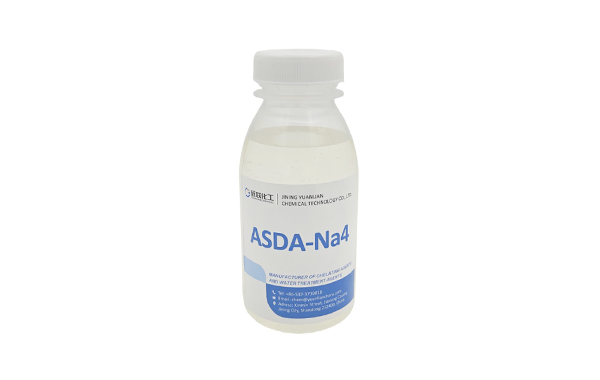
The product is available as a pale yellow clear liquid with 50 per cent minimum solid content. Its pH sits at 8.5 or above, and density measures 1.20 grams per cubic centimetre at 20 degrees Celsius.
Water Treatment: Scale and Corrosion Control
Industrial Cooling Water
Cooling water systems concentrate hardness minerals through evaporation. ASDA-Na4 chelates calcium and magnesium, preventing carbonate and sulphate scale from forming on heat exchanger surfaces. Unlike phosphorus-based scale inhibitors, it adds no phosphorus to the discharge water. This matters for facilities operating under the EU Industrial Emissions Directive and local phosphorus discharge limits.
Boiler Water Treatment
Boilers need clean feed water. Even trace hardness causes scale deposits on boiler tubes, reducing heat transfer and risking tube failure. ASDA-Na4 sequesters hardness ions in the feed water, keeping them in solution until they can be removed by blowdown.
Reverse Osmosis Pre-Treatment
RO membranes foul when scale forms on their surface. Dosing ASDA-Na4 into the feed water prevents calcium and magnesium scale, extending the interval between chemical cleaning cycles and prolonging membrane life.
Cleaning and Detergent Formulations
Hard Surface Cleaners
Hard surface cleaners need chelating agents to handle hard water. Without chelation, calcium and magnesium ions react with surfactants, reducing cleaning effectiveness and leaving residues. ASDA-Na4 keeps these ions bound so the surfactant system can work at full strength.
Laundry and Dishwashing Detergents
In phosphate-free detergent formulations, ASDA-Na4 works as a builder. It softens the wash water, prevents calcium soap scum, and helps surfactants remove particulate soils. Its biodegradability means the wash water entering the treatment plant contains no persistent chelator.
Industrial Degreasing
Industrial degreasing formulations operate at high pH. ASDA-Na4 remains stable and active in strongly alkaline conditions, unlike citrate-based chelators that lose effectiveness above pH 10. This makes it suitable for heavy-duty degreasers used in automotive, manufacturing, and food processing environments.
Learn about chelating agent mechanisms from this Wikipedia resource.
Textile and Pulp Applications
Textile Dyeing
Metal ions in process water interfere with dyes. They shift colours, reduce fastness, and cause batch-to-batch variation. ASDA-Na4 complexes these metals, keeping dye reactions predictable. It also helps remove unfixed dye in post-dye soaping washes, improving colour brightness and fastness properties.
Pulp Bleaching
In peroxide bleaching of pulp, metal ions catalyse peroxide decomposition. ASDA-Na4 sequesters the catalytic metals, stabilising the bleaching agent and improving brightness outcomes. It can be combined with other stabilisers for synergistic effects.
Construction: Concrete Retarding
A less common but valuable application for ASDA-Na4 is concrete retarding. Concrete retarders slow the setting time of cement, which is necessary for large pours, hot weather concreting, and transport over long distances.
Traditional retarders include sugars, lignosulfonates, and phosphates. ASDA-Na4 works by chelating calcium ions in the cement paste, slowing the hydration reaction. Its biodegradability is an advantage in construction projects where runoff water enters the environment.
For ready-mix concrete suppliers, ASDA-Na4 offers consistent setting time control without the variability that natural sugars can introduce. It is compatible with standard concrete admixtures, including superplasticisers and air-entraining agents.
Personal Care and Daily Chemicals
ASDA-Na4 functions as a metal ion control agent in personal care formulations. It prevents metal-catalysed oxidation of oils and fragrances, extending shelf life. It also keeps surfactant systems clear and stable by preventing metal-surfactant complexes that cause cloudiness.
For brands pursuing clean-label positioning, ASDA-Na4 offers a biodegradable alternative to EDTA that does not trigger restricted substance list concerns from major retailers.
Packaging and Storage
Standard packaging includes 25-kilogram, 250-kilogram, and 1,250-kilogram plastic drums. Custom packaging is available on request. Store sealed in a dry, ventilated warehouse. Keep away from acidic materials and strong odours. Prevent exposure to direct sunlight and rain.
As an alkaline product, standard handling precautions apply. Avoid skin and eye contact. Rinse with plenty of clean water if contact occurs.
Evaluate ASDA-Na4 for Your Formulation
Testing should cover your specific conditions. For water treatment, run bottle tests at your actual water chemistry. For detergents, compare cleaning performance against your current builder system. For construction, measure setting time at your typical concrete temperature and mix design.
Request a free 200 to 500 gram sample, the complete technical data sheet, and safety data sheet. The application team can help you determine the right dosing level and compatibility with your existing formulation. Contact [email protected] or call +86-537-3739818 to discuss your requirements.
Yuanlian Chemical specializes in the production of polyaspartic acid (PASP),tetrasodium iminodisuccinate(IDS), GLDA, MGDA etc. with stable quality and excellent quantity!

Contact us