


-

- 2026-08-03
GLDA-Na4 for Industrial Cleaning: What the Lab Data Tells You About Hard Water Performance
Hard water costs cleaning operations more money than most plant managers realise. Every extra degree of water hardness forces surfactants to work harder, leaves scale on equipment, and shortens the life of linens and workwear. GLDA-Na4 for industrial cleaning tackles this problem from the formulation side. You get a chelating agent that binds calcium and magnesium ions fast. It stays stable at process temperatures that break down other options. And it biodegrades once it goes down the drain.
Formulators who make the switch often come back with the same observation: the product lets them cut surfactant loading or reduce rinse cycles without losing results. That matters when you manufacture cleaning products by the tonne and every percentage point of cost reduction shows up on the P&L.
What Makes GLDA-Na4 Different from Standard Chelating Agents
Most cleaning formulations still rely on EDTA, NTA, or phosphonates for hardness control. Each of these has a known downside. EDTA barely breaks down in wastewater treatment. NTA carries carcinogen classification concerns under EU regulations. Phosphonates contribute to eutrophication and face increasing discharge limits.
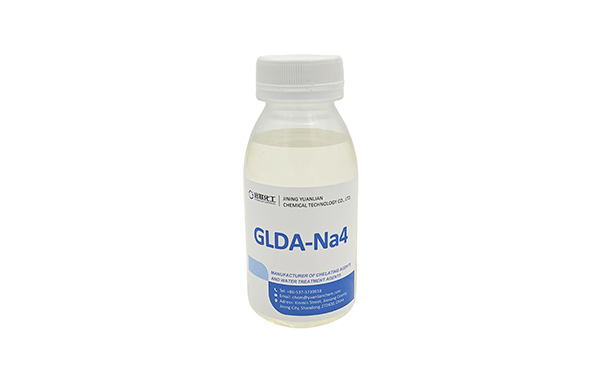
GLDA-Na4 comes from a different starting point. The raw material is L-glutamic acid, an amino acid produced through fermentation of plant sugars. This plant-based origin feeds directly into the finished product's biodegradability profile. Under OECD 301D test conditions, more than 60 per cent mineralises within 28 days. For cleaning product manufacturers trying to meet EU Ecolabel or Nordic Swan criteria, this number opens doors that EDTA leaves closed.
Calcium Chelation at High pH — Where It Counts
The chelating ability of any agent depends heavily on the pH of the working solution. Many chelating agents perform well in neutral conditions but drop off sharply when the system turns alkaline. Industrial cleaners and automatic dishwashing detergents operate at pH 10 to 12, right in the zone where weaker chelators lose effectiveness.
GLDA-Na4 holds its chelating capacity across the full pH range. At pH 11, it still delivers roughly 550 mg of calcium carbonate bound per gram of active chelating agent. That number puts it well ahead of EDTA, which manages about 350 mg per gram under the same conditions. For a formulator, this means using less raw material to achieve the same end result. In a product line that runs hundreds of tonnes per year, the maths adds up quickly.
170 Degrees and Still Going
Industrial cleaning processes run hot. Bottle washers, clean-in-place systems for food processing lines, and commercial laundry tunnels all operate at elevated temperatures. A chelating agent that breaks down at 120 degrees Celsius creates two problems: performance loss mid-cycle and decomposition by-products that can stain surfaces or react with other ingredients.
Thermogravimetric analysis of GLDA-Na4 shows no decomposition after six hours at 170 degrees Celsius. Even after one full week at 150 degrees Celsius, the molecular structure stays intact. When the test team ran side-by-side comparisons against alternative chelating agents at 100 degrees Celsius, GLDA-Na4 showed the best stability of the group. For manufacturers shipping products into hot-climate markets, this thermal headroom also prevents degradation during warehouse storage and transport.
Three Cleaning Applications Where the Data Speaks
Different cleaning tasks put different demands on a chelating agent. The requirements for a dishwashing tablet bear little resemblance to what a CIP system needs during a caustic wash cycle. GLDA-Na4 covers the range well enough that many formulators use it as a single-platform solution across multiple product lines.
Automatic Dishwashing — Spot and Film Free
European consumers judge dishwasher detergents by two things: clean glasses and shiny cutlery. Hard water leaves calcium carbonate films on glassware and silicate deposits on stainless steel. These visual defects drive consumer complaints and product returns, regardless of how well the detergent actually cleans.
The high alkalinity and elevated temperature of a dishwasher cycle create the exact conditions where GLDA-Na4 performs at its peak. It binds calcium and magnesium ions before they can form scale. It works alongside enzymes without degrading them. And it stays active through the full wash and rinse phases. The result shows up in consumer panel tests: fewer spots, less filming, and higher satisfaction scores.
CIP and Food Processing Lines
Food and beverage processing plants clean equipment with strong alkaline solutions, often at 70 to 85 degrees Celsius. Calcium and protein soils bake onto surfaces through repeated heating cycles. A chelating agent in the CIP formulation must survive the caustic environment long enough to loosen these deposits. It also needs to rinse away completely. No residues can remain that might contaminate the next production batch.
GLDA-Na4 handles this combination of high pH and high temperature without losing activity. It dissolves fully in alkaline cleaning solutions, targets calcium in scale deposits, and breaks down in the wastewater treatment step rather than accumulating. For plants operating under ISO 22000 or BRC food safety standards, the degradability profile reduces a compliance headache.
Commercial Laundry — Longer Linen Life
Hard water minerals embed themselves in fabric fibres over repeated wash cycles. This causes greying, stiffening, and premature fibre breakage. Industrial laundries serving hotels and hospitals track linen replacement costs closely because every extra wash cycle they can squeeze out of a sheet or towel drops directly to the bottom line.
Replacing a portion of the traditional builder system with GLDA-Na4 keeps hardness ions in solution throughout the wash. Fabrics come out softer, colours stay brighter through more cycles, and the laundry operation replaces linens less often. The cost of the chelating agent gets paid back several times over through extended textile life.
The Preservative Bonus
Here is a feature of GLDA-Na4 that many formulators discover only after testing. Because it contains natural amino acid components, it binds more tightly to microbial cell walls than purely synthetic chelating agents. This disrupts the electrolyte balance of bacteria and fungi, inhibiting their activity.
The practical outcome shows up clearly in challenge testing. A specific study combined GLDA-Na4 with imidazolidinyl urea and tested against *Pseudomonas aeruginosa*, a common spoilage organism in liquid detergents. The addition of GLDA-Na4 allowed the formulators to cut preservative concentration by 50 per cent while maintaining the same antimicrobial efficacy. For manufacturers wanting shorter INCI lists or lower preservative costs, this opens a real opportunity.
Across different formulation types, the preservative savings typically range from 20 per cent to 80 per cent, depending on the base formula and the target organisms. Your own preservative efficacy testing will confirm the exact number for your product, but the direction of the effect remains consistent across published studies.
For a detailed overview of chelation chemistry and how these agents bind metal ions at the molecular level, the Wikipedia entry on Chelation offers a useful technical reference.
How to Evaluate GLDA-Na4 for Your Formula
A supplier data sheet tells you the headline numbers. Your own bench testing tells you whether the product actually works in your specific formula. Here is a practical evaluation sequence that most industrial cleaning formulators follow.
First, test chelation efficiency at your target water hardness. Use the calcium carbonate titration method with your local water specification, not a generic hard water standard. Your customers use local water, so test with local water.
Second, check compatibility with your surfactant system. Run a simple clarity and foam stability test with your primary surfactants at use concentration. Most nonionic and anionic surfactants show good compatibility, but always verify.
Third, run a full preservative efficacy test. The preservative synergy effect varies by preservative type and target organisms. Your internal microbiology lab or external testing house needs to confirm the exact reduction your formula allows.
Fourth, measure cleaning performance in your standard soil test. Swap GLDA-Na4 into your current formula at equivalent chelating capacity and run a side-by-side comparison using your established test protocols. Stainless steel panels, tea-stained cups, or fabric swatches — whatever your customers judge your product by.
Request a free evaluation sample with full technical support at [email protected] or call +86-537-3739818. Most formulators complete their internal testing within two to three weeks and have performance data ready for their next product development review.
Yuanlian Chemical specializes in the production of polyaspartic acid (PASP),tetrasodium iminodisuccinate(IDS), GLDA, MGDA etc. with stable quality and excellent quantity!

Contact us