


-

- 2026-08-11
Chelating Agent Factory China: Inside Yuanlian's Production and Quality Control
When a procurement team evaluates a new factory, they want to see the floor, not just the brochure. What follows is an honest look at how we make the material.
Production Lines Built for Green Chelators
The plant runs dedicated synthesis lines for each product family. This matters because cross-contamination between GLDA and MGDA batches would throw off the chelation profile of both materials. Separate lines mean separate reactors, separate storage, and separate packaging stations.
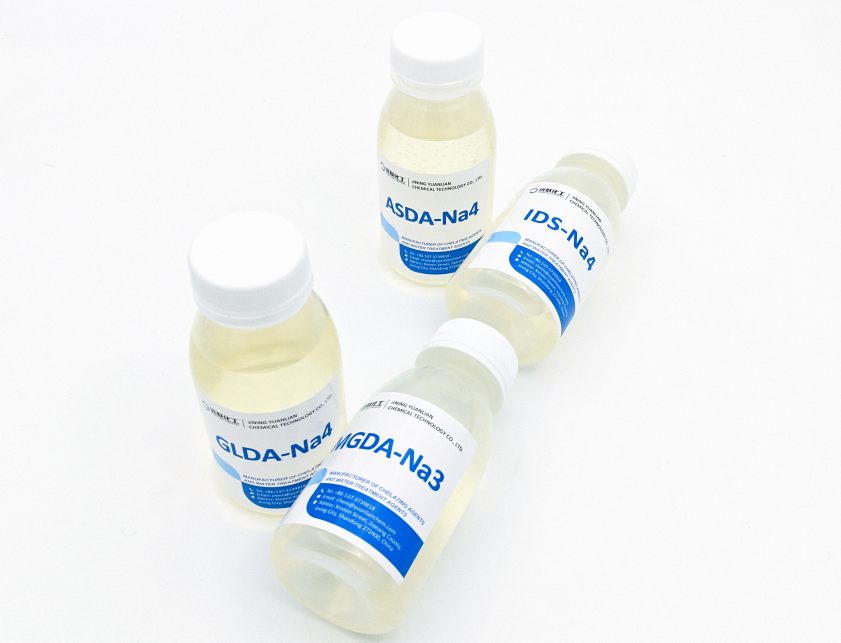
GLDA-Na4 production starts with L-glutamic acid, a plant-based amino acid sourced from verified suppliers. The synthesis runs in stainless steel reactors under controlled temperature and pH, with inline monitoring that tracks the reaction progress in real time. Once the reaction reaches the target active content, the batch moves through filtration and into holding tanks for QC sampling.
MGDA-Na3 follows a similar path but uses glycine as the starting amino acid. The critical difference is the pH window during synthesis. MGDA needs tighter control at higher alkalinity to keep the molecular structure intact. Our process engineers built the MGDA line with this in mind, adding redundant pH probes and automated dosing pumps that hold the setpoint within a fraction of a unit.
PASP-Na is a polymer, not a small molecule, so its production line differs from the amino-acid chelators. Polymerisation runs in a dedicated reactor train with viscosity monitoring that stops the reaction when the molecular weight distribution hits target. The crew runs size-exclusion chromatography on every batch to confirm the chain length before release.
IDS-Na4 and ASDA-Na4 share a flexible production line that switches between products based on the order book. Both come from aspartic acid and use similar synthesis steps, so the shared equipment works without quality risk as long as the cleaning protocol between batches is followed strictly.
Quality Control That Holds Up Under Audit
A chelating agent factory in China that cannot produce batch-level documentation is not worth the freight cost. Our QC laboratory runs every batch through a standard panel before release: active content by titration, pH, density, appearance, and chelation capacity against a reference standard. Results go into the batch record, and a Certificate of Analysis ships with the order.
The lab also runs stability testing on retained samples. A portion of each batch sits in a stability chamber at 40 degrees Celsius and 75 per cent relative humidity for six months, with periodic checks on active content and appearance. If a batch drifts, the root cause investigation starts before the next production run.
Third-party testing backs up the in-house data. We send quarterly samples to an accredited external laboratory for OECD 301 biodegradability confirmation, heavy metal screening, and full compositional analysis. Buyers who want independent verification can request the third-party reports alongside our own COA.
ISO 9001 certification covers the full operation, from raw material receiving through finished goods dispatch. The certification body audits annually, and we keep the audit reports available for buyer review. Most European procurement teams ask for these within the first three emails, so we file them where they are easy to find.
Logistics: From Shandong to Your Warehouse
The plant sits roughly four hours by road from Qingdao port, one of China's busiest container ports. Standard packaging runs in 250 kg HDPE drums and 1,250 kg IBC totes. Both formats stack securely in a 20-foot container, and the loading crew straps and braces every unit to prevent movement during transit.
Delivery to major European ports typically lands within 30 to 45 days, depending on the shipping line and customs clearance at the receiving end. We provide the full shipping documentation set: commercial invoice, packing list, bill of lading, COA, and any regulatory certificates the destination country requires.
For trial orders, we ship 200 to 500 gram samples by air courier. These arrive within 5 to 10 business days to most European addresses. A full drum order for pilot-scale validation follows the sea freight timeline above.
The Numbers That Matter to a Buyer
Every chelating agent factory in China quotes capacity. Fewer can back it up with consistent delivery performance. Here is what our production data shows across the five product lines:
|
Product |
Annual Capacity |
Typical Lead Time |
Shipment Format |
|
GLDA-Na4 |
4,000+ tonnes |
15–25 days |
250 kg drum / IBC |
|
MGDA-Na3 |
3,500+ tonnes |
15–25 days |
250 kg drum / IBC |
|
PASP-Na |
2,500+ tonnes |
15–25 days |
250 kg drum / IBC |
|
IDS-Na4 |
1,500+ tonnes |
15–30 days |
250 kg drum / IBC / 25 kg bag |
|
ASDA-Na4 |
1,000+ tonnes |
15–30 days |
250 kg drum / IBC |
Capacity utilisation sits around 70 to 80 per cent across the year, with headroom for volume growth. Buyers who want guaranteed capacity for multi-year contracts can book dedicated production slots. This locks in both price and availability for the contract term.
Factory Audits: What to Expect When You Visit
We encourage buyer audits. A team from your procurement and technical departments can walk the production floor, review batch records, pull retained samples, and interview the QC staff. Audits typically run one to two days, and we arrange transport from Jinan airport or Qufu East high-speed railway station.
Most visiting buyers focus on three things: raw material traceability, batch-to-batch consistency, and the cleanliness of the packaging area. We walk through all three in detail during the visit. The raw material warehouse keeps inbound lot numbers linked to supplier certificates. The batch record system tracks every production parameter from start to finish. The packaging area runs under positive air pressure to prevent contamination during filling.
For buyers who cannot travel, we offer a video audit via a live walkthrough with a member of the production team. It is not quite the same as being there, but it answers most of the questions a procurement team needs answered before placing a first order.
For more on how chelating agents work at a molecular level, see this overview from the Royal Society of Chemistry.
Contact [email protected] or call +86-537-3739818 to schedule a factory audit or request a free evaluation sample.
Yuanlian Chemical specializes in the production of polyaspartic acid (PASP),tetrasodium iminodisuccinate(IDS), GLDA, MGDA etc. with stable quality and excellent quantity!

Contact us