


-

- 2026-08-17
Tetrasodium Glutamate Diacetate (GLDA-Na4): The Biodegradable Chelating Agent Replacing EDTA
Tetrasodium glutamate diacetate, sold as GLDA-Na4, is a chelating agent that binds calcium, magnesium and other metal ions so they cannot interfere with cleaning or industrial processes. Formulators who move away from EDTA increasingly choose it for one practical reason: it delivers comparable performance while biodegrading quickly in the environment. This article explains what the molecule is, how it works, where it fits in formulations and what to check before you switch.
What Is Tetrasodium Glutamate Diacetate?
GLDA-Na4 is the tetrasodium salt of glutamic acid N,N-diacetic acid. The molecule starts from L-glutamic acid, an amino acid produced on a large scale through fermentation of plant sugars. Two acetic acid groups attach to the nitrogen atom, giving the molecule three binding sites that grip metal ions tightly.
The result is an aminopolycarboxylate chelator in the same chemical family as EDTA, NTA and MGDA. What sets it apart is its origin and its environmental behaviour. Because it comes from a renewable fermentation feedstock and breaks down readily in wastewater treatment, it avoids the persistence problems that have pushed EDTA out of many formulations.
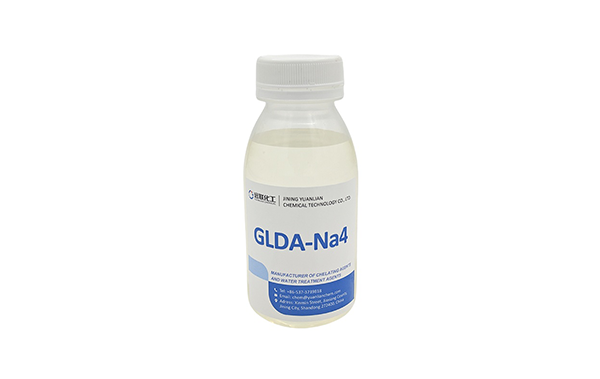
The commercial product ships as a clear to light yellow liquid with roughly 47 per cent active content. The chemical carries CAS number 51981-21-6 and holds an INCI listing, which you will see on cosmetic ingredient labels across Europe.
Why Formulators Replace EDTA with Tetrasodium Glutamate Diacetate
The driving force is regulation. EDTA binds metals well but resists breakdown once it enters rivers and groundwater. European restrictions on persistent chelating agents have tightened steadily, and several retailer restricted substance lists now exclude EDTA from consumer products. Formulators need a substitute that keeps cleaning performance without the environmental liability.
Tetrasodium glutamate diacetate fills that role. It reaches the "readily biodegradable" classification under OECD 301 testing, mineralising beyond 60 per cent within 28 days. Its calcium and magnesium binding strength sits close enough to EDTA that most cleaning applications require only a 1:1 substitution by active content. In practice, a formulator swaps out 5 grams of active EDTA and drops in 5 grams of active GLDA-Na4, then tunes the dose through wash performance testing.
There is a second, quieter benefit. Because it derives from renewable feedstock, it supports sustainability claims and product carbon-footprint reductions that EDTA cannot offer. This matters in B2B tenders where a sustainability score now affects supplier selection.
Applications of Tetrasodium Glutamate Diacetate
Laundry Detergents
In phosphate-free laundry formulations, GLDA-Na4 works as a builder at 2 to 5 per cent of the formulation. It softens the wash water, prevents calcium soap scum and keeps particulate soils suspended so the surfactant system delivers its rated cleaning performance even in hard water.
Automatic Dishwashing
Dishwasher tablets face the toughest chelation challenge: high temperature, strong alkalinity and short cycle time. GLDA-Na4 holds its own here, preventing spots and film on glassware at 3 to 8 per cent of tablet weight. It often combines with citrate or carbonate as co-builders to extend hardness tolerance across European water hardness levels.
Personal Care
In shampoos, body washes and facial cleansers, GLDA-Na4 controls the iron and copper that catalyse colour shifts and fragrance oxidation over shelf life. The typical dose runs 0.3 to 1.0 per cent. Its INCI listing makes it straightforward for cosmetic product notifications in the EU.
Industrial and Institutional Cleaning
Heavy-duty degreasers and parts washers operate at pH 11 to 13, where citrate-based chelators lose effectiveness. GLDA-Na4 stays stable and active across this range, which is why it increasingly appears in industrial cleaning concentrates where a single chelant must survive strongly alkaline conditions.
Tetrasodium Glutamate Diacetate Performance in Hard Water and High pH
Chelation strength is not a single number — it varies with pH and the metal in question. GLDA-Na4 delivers its strongest calcium binding between pH 7 and 11, the window that covers nearly every cleaning and personal care product. Above pH 11, performance holds well enough for industrial alkaline cleaners, though MGDA edges ahead in very high alkalinity.
Magnesium binding follows a similar pattern. The molecule handles the calcium-magnesium mix typical of tap water without difficulty. For iron and copper, it performs adequately but not selectively — formulators who need strong iron-specific chelation pair it with a small amount of EDDS, which targets iron even in calcium-saturated conditions.
A practical note for formulators switching from EDTA: check the active content before comparing. EDTA powder often carries 85 to 90 per cent active content, while liquid GLDA-Na4 carries about 47 per cent. Comparing on a per-kilogram-of-active basis gives you a fair cost picture and a correct substitution ratio.
Biodegradability and Regulatory Status
The environmental case for GLDA-Na4 rests on measured data, not marketing language. Under OECD 301B (modified Sturm) and OECD 301D (closed bottle) test methods, the molecule mineralises beyond the 60 per cent threshold within 28 days, meeting the definition of ready biodegradability.
This performance supports several certification paths. The molecule satisfies the biodegradability requirements of the EU Detergents Regulation and the EU Ecolabel criteria for cleaning products. In personal care, its INCI name is recognised under the EU Cosmetics Regulation, so formulators can use it without the restricted substance concerns that follow EDTA.
For water treatment and industrial discharge, the practical benefit is simpler: the chelant that leaves your plant in wastewater breaks down at the treatment works instead of accumulating in receiving waters. That removes a compliance risk and, in many jurisdictions, a discharge surcharge.
How to Formulate with GLDA-Na4
Start with a 1:1 substitution by active content against your current EDTA dose, then adjust through wash performance testing at your target water hardness. In liquid formulations, the water that comes with the 47 per cent liquid simply replaces part of your formulation water, so the final active concentration stays unchanged.
In powder or tablet formulations, request a powder or granule grade of GLDA-Na4 rather than the standard liquid. The powder handles like EDTA powder on the production floor, avoiding a rework of your mixing process. Whichever form you choose, run a full stability panel — 12 weeks at 40 degrees Celsius — before commercial release, exactly as you would for any formulation change.
One point worth confirming with your supplier is the storage behaviour. Liquid GLDA-Na4 can develop slight colour deepening or sediment over extended storage at low temperatures. This is cosmetic and does not affect performance, but you should know about it before the product arrives looking different from the sample you approved.
The Wikipedia entry on chelation explains the underlying chemistry of how chelating agents bind metal ions.
Frequently Asked Questions
Is tetrasodium glutamate diacetate as strong as EDTA?
For calcium and magnesium in typical cleaning conditions, it comes close enough that a 1:1 substitution by active content works in most formulations. For iron-selective chelation, pair it with EDDS. For very high alkalinity above pH 11, MGDA holds a slight edge.
Does it work in high-pH industrial cleaners?
Yes. Unlike citrate, which fades above pH 10, GLDA-Na4 stays active through pH 13. This makes it suitable as a single chelant across strongly alkaline cleaning lines.
Is it safe for personal care products?
The molecule carries the INCI name Tetrasodium Glutamate Diacetate and is recognised under the EU Cosmetics Regulation. It has a long history of use in shampoos, body washes and cleansers at 0.3 to 1.0 per cent.
How do I evaluate it for my formulation?
Request a free evaluation sample with the batch-specific certificate of analysis. Test it under your actual process conditions — water hardness, temperature, pH and surfactant system. Yuanlian Chemical supplies GLDA-Na4 with full technical data sheets and application support. Contact [email protected] or call +86-537-3739818 to request samples and discuss your requirements.
Yuanlian Chemical specializes in the production of polyaspartic acid (PASP),tetrasodium iminodisuccinate(IDS), GLDA, MGDA etc. with stable quality and excellent quantity!

Contact us