



-

- 2026-08-14
IDS-Na4 Chelating Agent: Copper-Selective, Peroxide-Stable, Fully Biodegradable
An IDS-Na4 chelating agent does what EDTA cannot: it binds copper tightly at low pH, keeps hydrogen peroxide from breaking down, and then biodegrades completely once it reaches the treatment plant. Tetrasodium Iminodisuccinate, CAS 144538-83-0, has become the chelant of choice for pulp bleaching, textile dyeing, and peroxide-based cleaning where metal ions would otherwise ruin the process.
Yuanlian Chemical manufactures IDS-Na4 in liquid and powder forms at our Shandong plant, with ISO 9001 controls and full documentation for European import. This product page covers what the molecule does, the specifications, and where formulators use it.
What an IDS-Na4 Chelating Agent Is
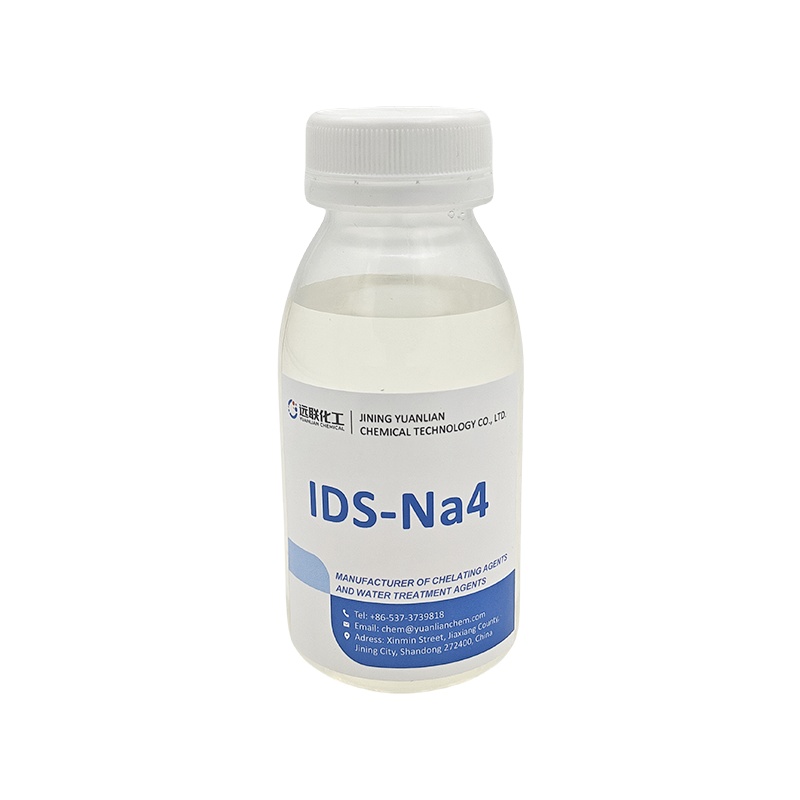
IDS-Na4 belongs to the amino-polycarboxylate family built to replace EDTA, DTPA, and NTA. The molecule derives from aspartic acid and carries the chemical formula C8H7NO8Na4 with a molecular weight of 337.1. Two structural features set it apart from other green chelators.
First, the imino and carboxylate groups form a stable ring around copper ions that holds even at low pH. Most chelators lose their grip on metal under acidic conditions. IDS keeps copper locked up, which matters in processes that run below pH 4.
Second, the same structure gives the molecule a strong affinity for iron. This pairing of copper and iron selectivity makes IDS the right tool where those two metals cause the trouble, rather than a broad-spectrum grab at calcium and magnesium.
Product Specifications
Buyers need firm numbers. Here is what our line produces.
|
Property |
Liquid Grade |
Powder Grade |
|
Appearance |
Colourless to pale yellow |
White solid |
|
Active content |
≥33% |
≥76% |
|
Solid content |
≥42% |
≥92% |
|
pH |
>7 |
>7 (in solution) |
|
Density |
≥1.20 g/cm³ |
0.3 kg/L (bulk) |
|
CAS number |
144538-83-0 |
144538-83-0 |
|
Phosphorus |
None |
None |
The liquid suits ready-to-use formulations where water content is acceptable. The powder works in solid detergent tablets, powder blends, and any application where shipping water adds freight cost. Both grades are free of phosphorus and carry low ecotoxicity, which answers discharge limits at environmentally sensitive sites.
Why Copper Selectivity Matters
Copper causes specific failures that calcium and magnesium do not. It catalyses the decomposition of hydrogen peroxide, turning a bleaching agent into water and oxygen before it can do its job. It shifts dye colours in textile processing. It accelerates oxidation in cosmetic oils, causing rancidity.
An IDS-Na4 chelating agent targets these catalytic metals and removes them from the reaction. Because the binding is selective, the chelant does not strip away calcium and magnesium that other parts of the formula may need. This precision is why IDS often works at a lower dose than a broad-spectrum chelator in copper-driven processes.
The stability constant matters at the working pH. Under acidic conditions where EDTA slips, IDS holds its copper complex. Pulp mills, textile dyers, and pipeline cleaning crews rely on this behaviour every day.
Hydrogen Peroxide Stabilisation
Hydrogen peroxide is the standard bleaching agent in pulp, paper, and textile processing. It is also unstable, and copper and iron make it worse. A small metal contamination can waste a large portion of the peroxide charge.
IDS-Na4 binds those metal catalysts so the peroxide stays intact until it reaches the fibres. The effect is measurable: higher brightness at the same peroxide dose, or the same brightness at a lower dose. Mills that run the comparison usually cut peroxide use by a meaningful margin.
When blended with sodium silicate, IDS also reduces silica scale on bleaching towers and washing equipment. The combination solves the peroxide instability and the equipment fouling at once, cutting both chemical cost and maintenance downtime.
Applications for an IDS-Na4 Chelating Agent
One molecule covers several industries.
Pulp and paper bleaching uses IDS-Na4 as a peroxide stabiliser that lifts brightness and reduces silicate deposits. Textile dyeing uses it to complex trace metals that would shift dye shades, keeping batch colour consistent. Cosmetics and personal care use it to protect oils and fragrances from metal-catalysed oxidation, extending shelf life.
Industrial cleaning uses IDS to remove iron sulphide and rust from pipework, including natural gas lines where acid cleaning risks corrosion. Agriculture uses it to keep micronutrients like iron, zinc, and copper soluble for root uptake. Water treatment uses it as a biodegradable scale inhibitor that handles calcium and magnesium without persistent residue.
Each application sets its own dose and pH. IDS performs across pH 2 to 12, with the strongest effect above pH 4. Start at the low end of the dose range and raise only if the metal load demands it.
Fully Biodegradable, Unlike EDTA
EDTA resists breakdown for years and picks up heavy metals as it moves through waterways. IDS-Na4 biodegrades by more than 90 per cent within 28 days under OECD 301 testing. The difference is the reason many European retailers now list EDTA for phase-out while accepting IDS as a direct replacement.
This biodegradability carries real commercial weight. It lets formulators make environmental claims that survive scrutiny. It keeps products clear of restricted-substance lists. It answers the customer question about what happens to the chelant after the rinse water goes down the drain.
For the chemistry behind how chelating agents bind metal ions, see this overview on Wikipedia.
Sourcing an IDS-Na4 Chelating Agent
Liquid IDS-Na4 ships in 25 kg and 250 kg drums. Powder ships in moisture-proof bags. Store sealed, away from light, at room temperature, and keep liquid above 5 degrees Celsius to avoid crystallisation.
Free evaluation samples of 200 to 500 grams ship by air courier for bench trials. Every commercial shipment comes with a Certificate of Analysis tied to the batch, plus Technical Data Sheet and Safety Data Sheet.
Contact [email protected] or call +86-537-3739818 to request your free sample and discuss your specific process requirements.
Yuanlian Chemical specializes in the production of polyaspartic acid (PASP),tetrasodium iminodisuccinate(IDS), GLDA, MGDA etc. with stable quality and excellent quantity!

Contact us