



-

- 2026-08-18
MGDA-Na3 Chelating Agent: Trisodium Methylglycine Diacetate for Phosphate-Free Cleaning
An MGDA-Na3 chelating agent binds magnesium and calcium in washing products, then breaks down after the rinse water leaves the machine. Trisodium Methylglycine Diacetate, CAS 164462-16-2, has become a common choice in automatic dishwashing and laundry since phosphate builders were restricted in Europe. This article explains what the molecule does, the specifications, and where formulators use it.
Yuanlian Chemical manufactures MGDA-Na3 at its plant in Shandong, with batch-level quality control and documentation for European import.
What an MGDA-Na3 Chelating Agent Is
MGDA-Na3 comes from glycine, the smallest amino acid. The molecule gains two acetate groups during synthesis, and those groups do the chelating work. The INCI name is Trisodium Methylglycine Diacetate.
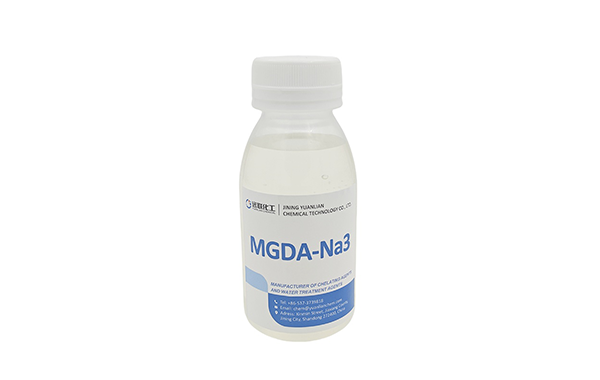
The structure gives MGDA two useful properties. It holds magnesium tightly at high pH, which is what dishwashing and laundry need. And it stays intact under heat and alkalinity, where some chelating agents lose their grip.
The product is readily biodegradable under OECD 301 testing. After use, the molecule degrades through natural microbial action rather than accumulating in waterways. This answers the discharge limits that many European sites now face.
Product Specifications
Here are the typical values from our production line.
|
Property |
Typical Value |
|
Appearance |
Clear, light yellow liquid |
|
Active content |
40–47% (grade dependent) |
|
pH (as supplied) |
10–12 |
|
Density |
~1.25 g/cm³ |
|
INCI name |
Trisodium Methylglycine Diacetate |
|
CAS number |
164462-16-2 |
|
pH stability range |
2–13.5 |
|
Biodegradation |
OECD 301, readily biodegradable |
Grades differ by active content and packaging. We confirm the exact values during the order review and record them on the Certificate of Analysis for every shipment.
Why Formulators Choose MGDA-Na3 for Dishwashing
Automatic dishwashing runs hot and alkaline. The wash cycle sits at pH 11 to 12.5 and 50 to 70 degrees Celsius. Under those conditions, magnesium and calcium from hard water form white film on glass and spots on cutlery. An MGDA-Na3 chelating agent keeps those ions in solution so they cannot deposit.
The molecule holds its magnesium binding across the full dishwashing pH range. This stability is the reason formulators reached for MGDA when sodium tripolyphosphate, or STPP, was restricted in dishwasher tablets from 2017.
A typical dishwasher tablet uses MGDA-Na3 at 15 to 30 per cent of total weight. The dose follows the water hardness the product targets. Soft-water regions use the lower end of the range. Hard-water regions above 300 ppm use the upper end.
MGDA-Na3 in Laundry Detergents
Laundry runs cooler than dishwashing, but magnesium still causes grey filming on fabrics. MGDA-Na3 prevents that deposit while supporting the detergent's cleaning action.
Many laundry formulators blend MGDA with GLDA rather than using either alone. The blend covers magnesium from MGDA and calcium from GLDA across the wash pH range. In liquid laundry, the dose runs 1 to 3 per cent. In powder, it runs 2 to 4 per cent.
The enzyme compatibility is worth noting. Modern laundry detergents carry protease, amylase, and lipase enzymes for stain removal. Some builders interfere with these enzymes by removing the calcium ions they need. MGDA-Na3 shows less interference than older chelators, so the enzymes keep working alongside the builder.
Industrial and Institutional Cleaning
Factories, kitchens, and hospitals need scale and film control at volume. MGDA-Na3 supports descalers, floor cleaners, and degreasers while keeping effluent phosphorus low. Pairing it with a dispersant such as PASP-Na stops scale and holds particles suspended, which extends equipment life.
The thermal stability helps here too. Industrial wash lines run hotter than consumer machines, and a chelating agent that holds up under that heat keeps the cleaning performance steady across the shift.
Replacing Phosphate Builders
Formulators switching from STPP to MGDA-Na3 ask about the substitution ratio. The answer is one to one by builder function, not by weight.
STPP typically ran at 20 to 35 per cent in a phosphate-era tablet. MGDA-Na3 runs at 15 to 30 per cent because it binds more metal per gram. The exact ratio depends on water hardness and the rest of the formula. A bench trial with a 50-cycle dishwasher test settles it within two or three rounds.
The per-kilogram price of MGDA sits above STPP, but the dose is lower and the phosphate surcharges disappear. Formulators who run the total-cost calculation often find the difference manageable.
Biodegradability and the Environmental Claim
MGDA-Na3 is readily biodegradable under OECD 301 testing. After the wash water leaves the machine, the molecule breaks down rather than persisting. This matters for two reasons.
First, it keeps the product clear of phosphate restrictions and supports a defensible environmental claim. Second, it answers the customer question about what happens to the chelant after use. Formulators who can document biodegradability have a stronger answer for both regulators and retailers.
When a customer asks for the environmental data, you forward the OECD 301 report from your supplier. A recognised test method carries more weight than a general claim on the label.
For the chemistry behind how chelating agents bind metal ions, see this overview on Wikipedia.
Sourcing an MGDA-Na3 Chelating Agent
Liquid MGDA-Na3 ships in 250 kg drums and 1,250 kg IBC totes. Delivery to major European ports typically lands within 30 to 45 days.
Free evaluation samples of 200 to 500 grams ship by air courier for bench trials. Every commercial shipment comes with a Certificate of Analysis, Technical Data Sheet, and Safety Data Sheet.
Contact [email protected] or call +86-537-3739818 to request a sample and discuss your formulation requirements.
Yuanlian Chemical specializes in the production of polyaspartic acid (PASP),tetrasodium iminodisuccinate(IDS), GLDA, MGDA etc. with stable quality and excellent quantity!

Contact us