


-

- 2026-08-25
Safety of Biodegradable Chelating Agents: A Formulator View
A formulator who moves a product from EDTA to a biodegradable chelant changes more than the chemistry. The switch also rewrites the safety story of the whole formula — for the operator who handles the drum, the consumer who touches the finished product, and the water that receives the rinse. Before a specification change reaches the bench, the toxicology and environmental profile of the new active needs a clear read. This article walks through how GLDA, MGDA, PASP, IDS, ASDA and EDDS behave on the hazard scales that European regulators and buyers use, and what that means for your documentation.
Three questions "safe" has to answer
A chelant's safety record splits into three parts. Human toxicity covers what happens if the material is swallowed, touches the skin or reaches the eye. Ecotoxicity covers what happens to fish, algae and microbes when the rinse reaches a river. Regulatory classification pulls both together into the hazard labels a downstream user must print and a buyer must accept. A molecule can score well on one axis and need care on another, so the three are read together rather than in isolation.
Acute toxicity and skin and eye profile
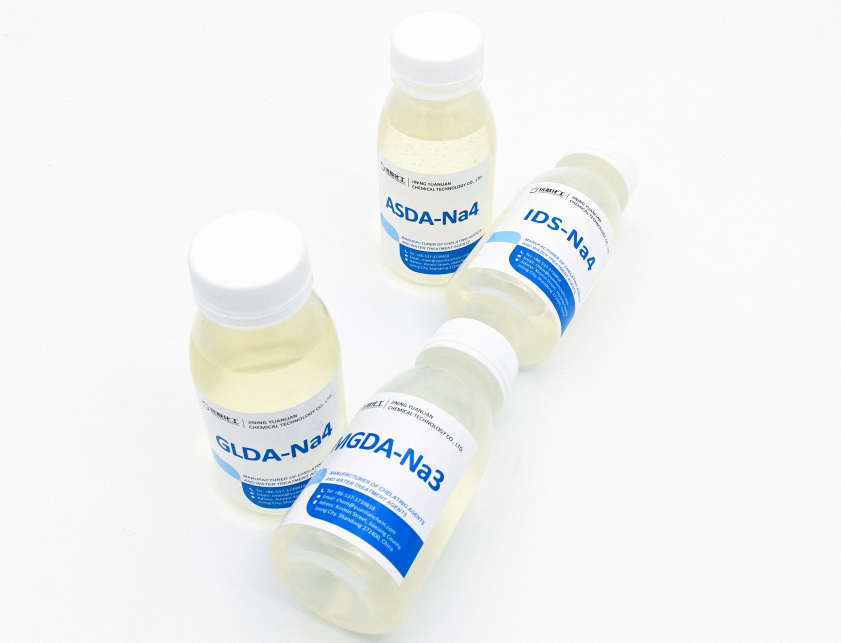
The amino-acid and peptide-derived chelants sit at the gentle end of the scale. GLDA-Na4, made from fermented L-glutamic acid, shows low acute oral and dermal toxicity and is not a skin sensitiser of concern in routine handling. MGDA-Na3 behaves similarly. PASP-Na, a polyamino acid, also shows low mammalian toxicity. IDS-Na4 and ASDA-Na4, both aspartic-acid based, follow the same pattern. EDDS-3Na, the biodegradable cousin of EDTA, shares EDTA's low mammalian toxicity while shedding its persistence. None of these require the alarm-level handling controls that older petrochemical chelants sometimes do.
The table below summarises the practical handling picture across the range. Always confirm against the current safety data sheet for the specific grade and concentration, because pH and impurities shift the detail.
|
Chelant |
Oral / dermal toxicity |
Skin / eye |
Typical CLP stance |
|
GLDA-Na4 |
Low |
Mild; not a sensitiser of concern |
Usually no acute hazard label |
|
MGDA-Na3 |
Low |
Mild irritation at most |
Usually no acute hazard label |
|
PASP-Na |
Low |
Low |
Usually unclassified for acute effects |
|
IDS-Na4 |
Low |
Low |
Usually unclassified for acute effects |
|
ASDA-Na4 |
Low |
Low |
Usually unclassified for acute effects |
|
EDDS-3Na |
Low |
Low |
Usually unclassified for acute effects |
What happens in the water
Ecotoxicity is where biodegradable chelants earn their place. EDTA binds metals so tightly that it can mobilise heavy metals in sediments and fails to break down; regulators and retailers treat it with caution. The plant-based chelants discussed here biodegrade through OECD 301 tests — typically more than 60 per cent mineralisation within 28 days — and show lower toxicity to algae, daphnia and fish at use concentrations. That combination, biodegradable and low in aquatic toxicity, is what lets a detergent carry an EU Ecolabel or a Nordic Swan mark, and what keeps a formula off a retailer's restricted-substance list.
Reading the CLP classification
In the EU, hazard communication runs under the CLP Regulation (EC) No 1272/2008, which aligns with the UN Globally Harmonised System. The safety data sheet for each chelant lists the classification: hazard statements (H-codes), precautionary statements (P-codes) and any pictogram. A low-hazard chelant may carry no H-statement at all, or only minor ones such as H319 (causes serious eye irritation) at high active content. When you reformulate, the chelant's classification feeds into your product's own SDS and label. Choosing a chelant with a light classification reduces the downstream labelling burden on your finished good.
Why this matters before you change spec
Two practical payoffs follow. First, a cleaner safety profile shortens the internal review: environment, health and safety teams sign off faster when the active carries no acute hazard and the ecotoxicity data is strong. Second, it strengthens the product dossier you show to tenders, retailers and eco-label bodies, where sustainability scoring now affects supplier selection. The move from a persistent chelant to a biodegradable one is rarely a like-for-like swap on paper, but on the safety axis it is usually a step in the easier direction.
Frequently asked questions
Are biodegradable chelants suitable for leave-on personal care? Several — GLDA-Na4, MGDA-Na3 and EDDS-3Na — carry established INCI names and fall under the EU Cosmetics Regulation (EC) 1223/2009. Final-product safety still depends on the full formula and concentration, so review the cosmetic-specific dossier and the INCI status for your market before commitment.
Do I still need a safety data sheet if the chelant is "mild"? Yes. An SDS is required for chemical supply in the EU regardless of hazard level; it carries the transport, handling and emergency information your team and your customer need.
Will switching chelant change my product's CLP label? It can. The new active's classification replaces or supplements the old one in your formula's hazard sum. Run the recalculated SDS before reprinting labels.
How do I verify a supplier's safety claims? Request the current SDS and the certificate of analysis, and check the substance identity against the REACH registration or Only Representative evidence. Independent verification beats a marketing sentence.
Talk to the application laboratory
Yuanlian Chemical supplies GLDA-Na4, MGDA-Na3, PASP-Na, IDS-Na4, ASDA-Na4 and EDDS-3Na under ISO 9001 controls, with full safety data sheets, technical data sheets and per-batch certificates of analysis for European import. For the documentation set behind a specification change, write to [email protected] or call +86-537-3739818. Tell us your target product and current chelant, and we will put together the SDS, CoA and starting formulation notes on the first reply.
Explore the product centre for safety data and grade options across the biodegradable chelant range.
Yuanlian Chemical specializes in the production of polyaspartic acid (PASP),tetrasodium iminodisuccinate(IDS), GLDA, MGDA etc. with stable quality and excellent quantity!

Contact us