



-

- 2026-08-26
MGDA-Na3 and the Phosphate-Free Shift: A Buyer's Guide
Every automatic dishwasher tablet sold in Europe changed twice in the past decade. First the phosphate went, capped by the EU at 0.5 per cent from January 2017. Then the replacement became standard practice, and in most formulations that replacement is MGDA-Na3. This guide explains the shift in plain terms and walks a buyer through what matters when sourcing trisodium methylglycinediacetate for a phosphate-free product line.
The Regulation That Changed Dishwashing
Phosphate from detergents ends up in rivers and lakes, where it feeds algae and depletes oxygen. The Detergents Regulation (EC) No 648/2004, amended in 2012, cut phosphate in consumer dishwasher detergents to 0.5 per cent, with effect from January 2017. Sodium tripolyphosphate, the builder that carried the cleaning load for decades, had to leave the formula.
Formulators needed a builder that holds calcium and magnesium in hot, alkaline water without phosphorus. MGDA-Na3 was the molecule that fitted the job, and it has stayed in the role since.
What MGDA-Na3 Is and How It Replaces STPP
MGDA-Na3 is the trisodium salt of methylglycinediacetic acid, CAS 164462-16-2, with the INCI name Trisodium Methylglycine Diacetate. It is made from the amino acid alanine. The molecule binds magnesium more strongly than most chelators, and its performance is strongest above pH 8, which is exactly where a dishwasher runs.
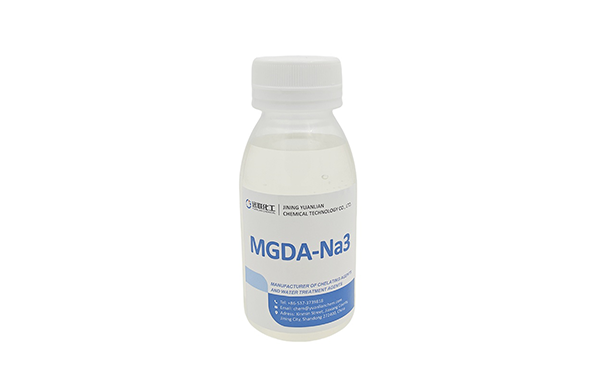
The substitution ratio is one to one by builder function, not by weight. STPP typically ran at 20 to 35 per cent of a phosphate-era tablet; MGDA-Na3 runs at 15 to 30 per cent because it binds more metal per gram. Water hardness and the rest of the formula decide the exact figure, and a fifty-cycle dishwasher test settles it faster than a spreadsheet.
Where MGDA-Na3 Earns Its Place
Automatic dishwashing is the main application, in tablets, powders and rinse aids. The molecule holds magnesium and calcium in the hot, alkaline cycle, so glass comes out clear and cutlery stays free of film.
Hand dishwashing liquids use it for the same reason at lower concentration. Laundry formulations turn to MGDA-Na3 for magnesium control, and it interferes less with enzymes than older builders, so protease and amylase keep working in the same wash. Industrial and institutional cleaning uses it in descalers, floor cleaners and degreasers, with the added benefit that effluent phosphorus stays low.
Matching the Dose to European Water Hardness
Europe is not one market when it comes to hardness. Parts of southern England run at 200 to 300 ppm CaCO₃. Much of Germany sits between 15 and 25 °dH, which is hard to very hard. Spain and southern France are similar. The Nordic countries are mostly soft.
The dose follows the map. A tablet aimed at Munich water needs more MGDA-Na3 than one aimed at Stockholm, and the difference shows up in the 15 to 30 per cent range. A supplier's technical team should be able to discuss your target regions and adjust the recommendation, rather than sell you a single formula for the whole continent.
Compliance and Documentation
Three regulations shape the paperwork. REACH (EC) No 1907/2006 requires registration and safe-use communication down the supply chain. CLP (EC) No 1272/2008 sets classification and labelling rules, including the safety data sheet. The Detergents Regulation (EC) No 648/2004 governs label disclosure of the chelating agent within its concentration band.
Beyond the legal minimum, EU Ecolabel criteria for detergents restrict EDTA and reward readily biodegradable chelators, and the Nordic Swan follows the same direction. MGDA-Na3 passes OECD 301 testing for ready biodegradability, which keeps the door open under those schemes. Ask the supplier for the OECD 301 report and a safety data sheet in the language you need before committing to a trial.
|
Property |
MGDA-Na3 |
|
INCI name |
Trisodium Methylglycine Diacetate |
|
CAS number |
164462-16-2 |
|
Active content |
40–47% (liquid grades) |
|
pH (as supplied) |
10–12 |
|
pH stability range |
2–13.5 |
|
Strength |
Highest above pH 8, hard water |
|
Biodegradation |
OECD 301, ready |
Sourcing from Yuanlian Chemical
Yuanlian Chemical has produced MGDA-Na3 since 2015 at its plant in Shandong Province. The company is ISO 9001 certified, holds high-tech enterprise status, and runs an annual capacity above 12,000 tonnes across its chelating agent range. Every shipment carries a Certificate of Analysis, and batch records can be audited by the customer or a third party.
The normal first step is a specification sheet and a one-kilogram sample for a bench trial. The order review then confirms the grade, packaging and lead time against your forecast, so the material arrives when your production line needs it, not after.
FAQ
Is MGDA-Na3 the same as STPP?
No. STPP is an inorganic phosphate builder; MGDA-Na3 is an organic, amino-acid-based chelating agent. They serve the same builder function in the formula, but MGDA-Na3 is phosphate-free and biodegradable.
What percentage of a dishwasher tablet is MGDA-Na3?
Typically 15 to 30 per cent by weight. The exact figure follows the water hardness the product targets, with soft-water regions at the lower end and hard-water regions above 300 ppm at the upper end.
Does MGDA-Na3 work in low-temperature washes?
Yes. Its magnesium binding does not depend on heat, and it supports enzyme performance in cool wash cycles, which is why cold-wash laundry formulations include it.
Is it compliant with EU detergent rules?
It is phosphate-free, readily biodegradable under OECD 301, and its use aligns with the Detergents Regulation and with the direction of EU Ecolabel and Nordic Swan criteria. The supplier should provide the relevant documentation with each shipment.
What documentation do you supply for import?
A Certificate of Analysis per batch, a safety data sheet in the required language, and batch traceability records. REACH registration status for the relevant tonnage band is confirmed during the order review.
Can I order a sample before committing?
Yes. One-kilogram samples are available with the specification sheet, and the technical team can discuss dosage and regional hardness before you place an order.
Making the Switch
The phosphate-free shift is settled policy in Europe, and MGDA-Na3 is the builder most formulators reached for when they made the change. For specifications, samples or a quotation, contact [email protected] or call +86-537-3739818. Full product details are available at the company website: https://www.yuanlianchem.com
Yuanlian Chemical specializes in the production of polyaspartic acid (PASP),tetrasodium iminodisuccinate(IDS), GLDA, MGDA etc. with stable quality and excellent quantity!

Contact us