



-

- 2026-08-31
MGDA-Na3 Product Profile: Chemistry, Specification and Performance Data
A formulator opening a new dishwasher or laundry project meets MGDA-Na3 early, usually as the builder listed in the first few lines of a competitor's specification. The molecule has carried that role in phosphate-free dishwashing since the EU restriction, and its technical profile is worth knowing in full rather than in fragments. This article collects the MGDA-Na3 data in one place: the chemistry, the physical properties, the chelation behaviour, the grades and the regulatory position.
The Molecule in Brief
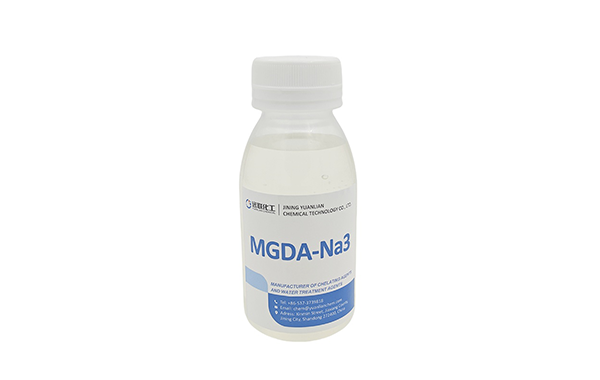
MGDA-Na3 is the trisodium salt of methylglycinediacetic acid, CAS 164462-16-2, INCI name Trisodium Methylglycine Diacetate. It is built from alanine, one of the simplest amino acids, and belongs to the same aminopolycarboxylate family as GLDA. The acetate arms wrap around metal ions and hold them in solution; the difference from GLDA lies in the emphasis of the binding. MGDA-Na3 favours magnesium, holds it strongly above pH 8, and keeps that performance in the hot, alkaline conditions of a dish cycle.
Physical and Chemical Properties
|
Property |
Typical Value |
|
INCI name |
Trisodium Methylglycine Diacetate |
|
CAS number |
164462-16-2 |
|
Appearance |
Clear, light yellow liquid |
|
Active content |
40–47% (grade dependent) |
|
pH (as supplied) |
10–12 |
|
Density |
~1.25 g/cm³ |
|
Water solubility |
Exceptionally high, above 500 g/L |
|
pH stability range |
2–13.5 |
|
Thermal stability |
Suited to high-temperature dishwashing |
|
Biodegradation |
OECD 301, readily biodegradable |
The pH stability window runs from 2 to 13.5, which covers acidic descalers at one end and the strongly alkaline wash bath at the other. The thermal stability is the property dishwashing relies on: the molecule keeps its grip through cycles at 50 to 70 °C, conditions in which some chelators lose performance.
Chelation Performance
MGDA-Na3 binds magnesium and calcium together, with the strongest performance above pH 8, exactly where automatic dishwashers run. In a wash bath at pH 11 to 12.5, hardness ions from the water supply would otherwise form white film on glass and spotting on cutlery; the chelator keeps them in solution instead. The magnesium binding is the property that set MGDA apart when STPP left the formula, and it remains the reason the molecule leads the dishwasher segment.
A typical dishwasher tablet carries MGDA-Na3 at 15 to 30 per cent by weight. The dose follows water hardness: soft-water regions use the lower end of the range, and regions above 300 ppm hardness use the upper end. The same relationship applies in liquid products at lower concentration.
MGDA-Na3 also holds up alongside enzymes. Modern detergents carry protease and amylase for stain removal, and some builders strip the calcium those enzymes need to work. MGDA-Na3 interferes less than older chelators, so the builder and the enzymes share the wash bath without working against each other. In laundry this is the difference between a formula that cleans and one that only claims to.
Grades and Forms
MGDA-Na3 is supplied as a clear, light yellow aqueous solution, with the standard offering around 40 to 47 per cent active content. Grades differ by active level and packaging, and the exact values for each batch are recorded on the Certificate of Analysis. Drums and IBCs are the usual formats for European shipments.
Biodegradation and Ecotoxicology
MGDA-Na3 meets the ready-biodegradability threshold under OECD 301 testing. It contains no phosphorus and no NTA-type chelators, so a phosphate-free formulation stays phosphate-free at the ingredient level. Aquatic toxicity testing reports low acute values, which keeps the environmental file straightforward for brands that have to answer retailer questionnaires.
Regulatory Status and Compliance
Under REACH (EC) No 1907/2006 the substance is registered for the relevant tonnage bands, with status confirmed at the order review. Under CLP (EC) No 1272/2008 it is commonly not classified as hazardous for aquatic or human health. In detergents, the molecule aligns with the Detergents Regulation (EC) No 648/2004, and its profile fits the direction of EU Ecolabel criteria, which restrict EDTA and favour readily biodegradable chelators.
Handling and Storage
Store MGDA-Na3 in sealed original containers, away from direct sunlight, at roughly 5 to 40 °C. Liquid grades generally keep for 12 months or longer under sealed packaging, with the recommended shelf life stated on the specification sheet. The transport classification is confirmed in section 14 of the safety data sheet.
If a delivery has been exposed to freezing during winter transport, thaw the container slowly at ambient temperature, mix or roll it to homogenise, and check the appearance before use. A single freeze-thaw cycle does not damage the product; repeated cycles should be avoided.
FAQ
What is MGDA-Na3?
MGDA-Na3 is the trisodium salt of methylglycinediacetic acid (CAS 164462-16-2), a biodegradable aminopolycarboxylate chelating agent used primarily in automatic dishwashing, laundry and cleaning products.
Which metals does MGDA-Na3 bind?
Magnesium and calcium, with the strongest performance above pH 8. The magnesium binding is what sets it apart in the dishwashing segment.
What pH range does MGDA-Na3 work in?
The pH stability window runs from about 2 to 13.5, covering acidic descalers through to strongly alkaline wash baths.
Is MGDA-Na3 phosphate-free?
Yes. The molecule contains no phosphorus and no NTA-type chelators, and it meets ready-biodegradability under OECD 301 testing.
Which grade should I order?
The standard offering is a 40 to 47 per cent liquid grade. The exact active content and packaging are confirmed during the order review against your formula.
What documentation do you provide?
A Certificate of Analysis per batch, a current safety data sheet in the required language, the OECD 301 report and REACH registration status for the relevant tonnage band.
Building the Technical File
The MGDA-Na3 profile rests on test results that can be requested and filed: the OECD 301 report, the Certificate of Analysis and the safety data sheet. For the specification sheet, the technical data pack and a sample for bench trials, contact [email protected] or call +86-537-3739818. Full product details are available at the company website: https://www.yuanlianchem.com
Yuanlian Chemical specializes in the production of polyaspartic acid (PASP),tetrasodium iminodisuccinate(IDS), GLDA, MGDA etc. with stable quality and excellent quantity!

Contact us