


-

- 2026-09-01
Gypsum Defoamer Buying Guide: Types, Dosing and Checks
Air is the quiet enemy of a gypsum product. It enters the mix with the raw material, gets pulled in by high-shear mixing, and leaves its mark on the finished board, slab or skim coat as pinholes, voids and weak spots. A gypsum defoamer is the standard answer, but buying one is not the same as buying a sack of cement additive. The products differ by chemistry, carrier and response time, and the difference shows up on the line, not on the spec sheet. This guide walks a buyer through the types on the market, the dosing logic and the checks that separate a working product from a trial that goes nowhere.
Why Gypsum Foam Is a Problem
Gypsum slurry is a wet, sticky system that traps air easily. The stucco carries entrained air from grinding and calcination. High-speed mixers pull in more. Additives such as retarders, superplasticisers and cellulose ethers change the surface tension and can stabilise the bubbles once they form.
The result shows up in four ways. Surface pinholes mar board and skim coats. Internal voids weaken the section. In self-levelling compound, air bubbles rise to the surface during flow and leave craters after set. And in any product, a foam-laden slurry packs less solid material per volume, which drags density and strength down together. A gypsum defoamer collapses those bubbles early so they do not survive to the surface.
The Main Types of Gypsum Defoamer
The market divides into four chemistries, and each has a character of its own.
Polyether defoamers are the workhorses for water-based gypsum systems. They disperse well in the slurry, tolerate the alkaline pH of gypsum mixes, and rarely disturb the interface between the gypsum and its paper or substrate. Their weakness is temperature sensitivity: performance can fade if the slurry runs hot.
Silicone defoamers break foam aggressively at low dose, which makes them attractive where foam load is high. The trade-off is compatibility. Silicone can affect wetting and adhesion in some systems, so it has to be tested against the specific paper, substrate or coating in use.
Polyether-modified siloxanes sit between the two. They combine the foam-breaking strength of silicone with the water compatibility of polyether, which is why many plants use them as a first choice for board lines and self-levelling compounds.
Mineral oil defoamers are the low-cost option. They work, but they carry a higher risk of surface oiling and are usually limited to applications where the surface is not painted or coated.
What to Check in the Specification
A defoamer specification is shorter than a chelating agent's, but four numbers matter.
Active content tells you how much of the product is actually working. Two products can look the same in a drum and differ by a factor of three in actives. The viscosity gives a rough read on handling and pumpability, especially for dosing by metering pump. The carrier system, water or oil, decides how the product behaves when it meets the slurry and whether it can be diluted. And the storage temperature range matters on a site that keeps drums outdoors in winter.
Ask for the safety data sheet as well. It settles the transport classification, which in some regions decides whether the shipment travels as general cargo or as a hazardous load, and that difference lands on the freight invoice.
Dosing and How to Add It
Most gypsum systems run a gypsum defoamer at 0.1 to 0.5 per cent of the dry binder weight, with the exact figure set by trial. Foam load, mixer type and the rest of the admixture package all move the number, so the specification value is a starting point, not a target.
The addition point matters as much as the amount. Adding the defoamer to the mix water before the gypsum makes the bubbles break before they form. Adding it late, into an already foamed slurry, relies on the product fighting an existing foam blanket, which is harder and less reliable. Powder forms can be pre-blended into the dry mix; liquid forms are most reliably metered into the water or the mixer inlet.
A common mistake is over-dosing. A defoamer is not a foam sponge that works harder with more. Excess product can itself destabilise the slurry, cause surface defects or affect the bond between gypsum and facing materials. The right dose is the smallest one that holds the surface clean.
Buying from a Supplier That Understands Gypsum
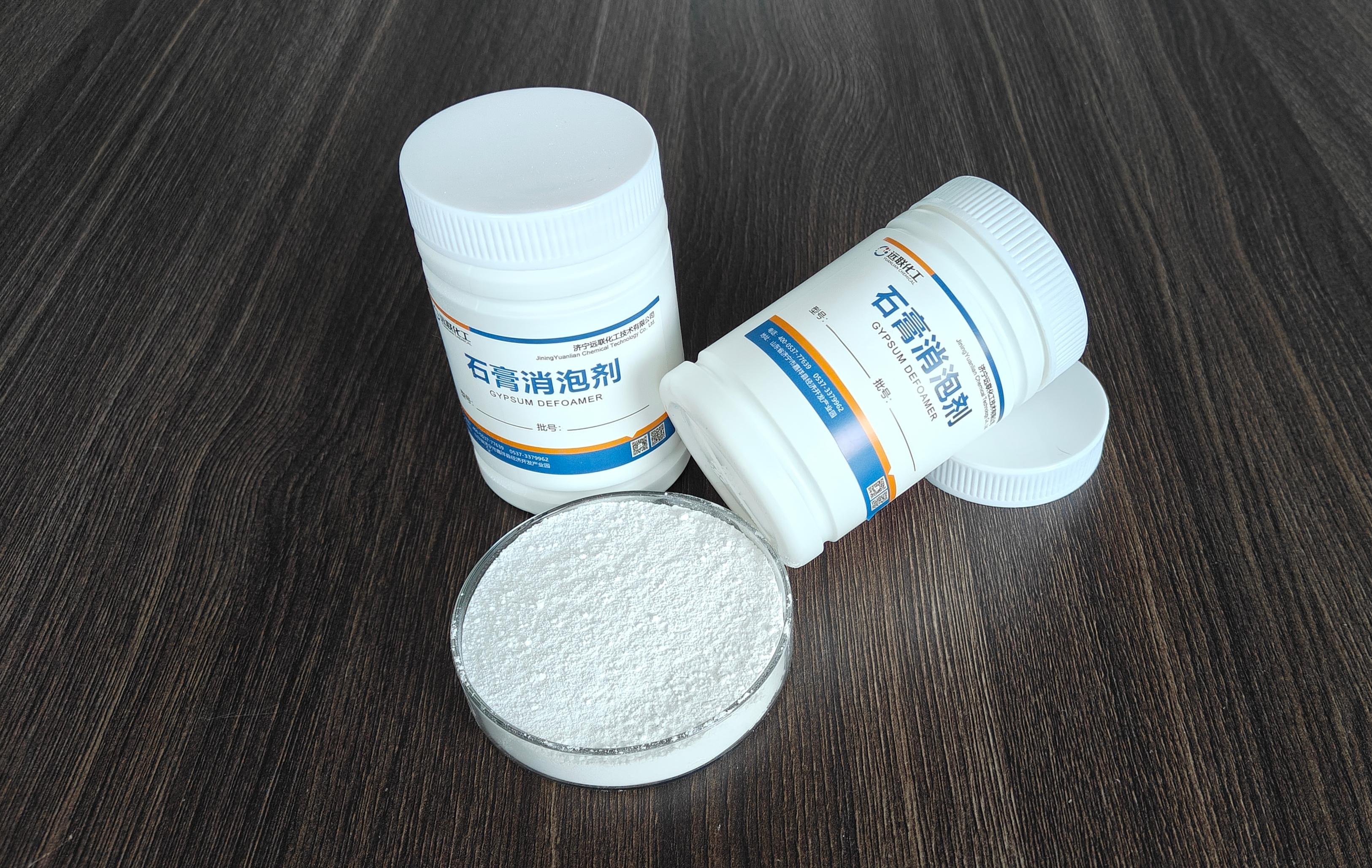
A gypsum defoamer is bought on performance, and performance is only confirmed on the buyer's line. The supplier that shortens the trial is the one that sends a small sample with dosing guidance, answers questions about compatibility with the rest of the admixture package, and supplies a Certificate of Analysis with each batch so the production team knows what arrived.
Yuanlian Chemical supplies gypsum defoamer grades to board, plaster and self-levelling producers, backed by the same documentation discipline as the rest of its additive range. Grades, active content and packaging are confirmed at the order review against the buyer's system.
FAQ
What is a gypsum defoamer?
A defoamer is a chemical that breaks air bubbles in gypsum slurry so they do not surface as pinholes, voids or craters in the finished product.
Which type of gypsum defoamer is most common?
Polyether and polyether-modified siloxane types are the most common in water-based gypsum systems, balancing foam-breaking strength with compatibility.
How much gypsum defoamer should I use?
Typically 0.1 to 0.5 per cent of the dry binder weight, adjusted by trial against your mixer, raw material and target surface quality.
When should the defoamer be added?
Before the foam forms: with the mix water or pre-blended into the dry mix. Adding it to an already foamed slurry is less reliable.
Can I use a silicone defoamer in gypsum board?
Silicone works well at low dose, but it must be tested against the paper bond and coating performance, because it can affect wetting in some systems.
What documentation should I request?
The safety data sheet, a Certificate of Analysis per batch, and the active content and carrier specification for the grade you are buying.
Starting the Trial
The shortest route to a working gypsum defoamer is a small sample, your own line conditions and a clear target surface. For grades, dosing guidance and a trial sample, contact [email protected] or call +86-537-3739818. Full product details are available at the company website: https://www.yuanlianchem.com
Yuanlian Chemical specializes in the production of polyaspartic acid (PASP),tetrasodium iminodisuccinate(IDS), GLDA, MGDA etc. with stable quality and excellent quantity!

Contact us