



-

- 2026-09-02
Polyaspartic Acid (PASP) in Water Treatment: A Practical Guide
Cooling water is one of those utilities nobody thinks about until something goes wrong. Scale builds up on heat-exchanger surfaces, thermal efficiency drops, and the energy bill creeps up month after month. Polyaspartic acid — usually shortened to PASP — has become one of the more useful tools available to water treatment chemists dealing with exactly that problem.
PASP is a water-soluble polymer built from aspartic acid units. What sets it apart from the conventional scale inhibitors sitting on most plant shelves is that it biodegrades readily, which matters a great deal in the EU, where discharge limits on phosphorus keep getting tighter.
This guide walks through where PASP earns its keep, how it behaves in cooling towers and boilers, and the practical points worth knowing before you switch.
What is polyaspartic acid?
PASP belongs to a family of chemistry called polyamino acids. Think of it as a synthetic protein: a chain of aspartic acid molecules linked end to end. In water treatment it is usually supplied as the sodium salt, a pale-yellow to amber liquid that dissolves completely and blends easily with other treatment products.
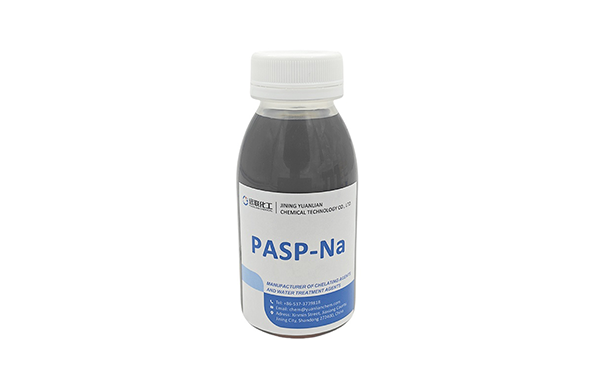
The molecule carries carboxyl groups along its backbone, and those groups do the actual work. They latch onto calcium and magnesium ions before those ions can settle out as scale. It is the same charge-based mechanism that phosphonates and polyacrylates rely on, except the structure happens to be one that bacteria can break down.
How PASP behaves in a cooling tower
In an open recirculating cooling system, water evaporates and the dissolved solids left behind become steadily more concentrated. Calcium carbonate is the usual culprit. As the water passes through the heat exchanger and warms up, the solubility of calcium carbonate drops, and it begins to crystallise on the hot metal surfaces.
A threshold inhibitor such as PASP works at very low concentration — typically a few parts per million of active polymer. It does not need to remove the calcium. It simply interferes with crystal growth, keeping the scale in a form that stays suspended and is then carried away with the next blowdown.
One property operators tend to appreciate is tolerance. PASP holds up in high-hardness, high-alkalinity water where simpler phosphate treatments struggle. It also disperses iron oxide and other suspended solids, which keeps fouling down and heat transfer up — two things that show up directly in the monthly energy bill.
Typical dosing
As a rough starting point, cooling water programmes dose PASP at 2–10 ppm of the active ingredient, adjusted to cycles of concentration and makeup-water quality. It is common to blend it with a corrosion inhibitor — often a zinc- or molybdate-based product — because PASP on its own is a modest corrosion inhibitor rather than a complete answer.
Boiler water and RO systems
Outside the cooling tower, PASP turns up in a few other places:
- Boiler feed water, where it controls hardness scale at the higher temperatures that defeat ordinary phosphonates.
- Reverse osmosis plants, as an antiscalant that slows barium sulphate and calcium carbonate fouling of membranes.
- Closed-loop heating and chilled systems, where its low dosage and long-term stability are useful.
Each of these is a different operating environment, and the dosing logic changes with it. That is precisely why competent suppliers run jar tests and pilot trials before committing a plant to a new programme, rather than selling off a data sheet.
Why biodegradability is the deciding factor
This is where PASP has genuinely shifted the conversation. Conventional phosphonates are stable molecules. Once they leave the plant in the blowdown, they linger in rivers and lakes, and the phosphorus they carry feeds algal blooms. European regulators have been pressing on this for years, and discharge permits now commonly set phosphorus ceilings that phosphonates make hard to meet.
PASP degrades. Depending on the test method, it typically achieves well above 60% degradation in standard OECD 301 biodegradation screens, and the breakdown products are ordinary amino acids rather than anything persistent. For a site chasing an EU Ecolabel or a tightened environmental permit, that single difference can outweigh a dozen performance metrics.
There is a trade-off to be honest about. PASP is not a drop-in replacement for every phosphonate in every system. It works best within a defined pH and temperature window, and the economics shift at very high hardness. A competent supplier will tell you where it fits and where it does not, rather than promising it cures everything.
Points to check before switching
A few practical questions worth asking before moving a system to PASP:
- What is the makeup water hardness and alkalinity profile?
- What phosphorus discharge limits does the current permit set?
- Does the existing corrosion inhibitor remain compatible?
- Will the supplier run a pilot or side-stream trial first?
Frequently asked questions
Is PASP safe to handle?
The sodium salt is low in acute toxicity and non-flammable, though standard PPE — gloves and eye protection — is sensible as with any concentrated chemical.
What concentration should I dose?
2–10 ppm active is the common range for cooling water, but always follow jar-test results and the supplier's recommendation for your specific water chemistry.
Does PASP replace phosphonates completely?
In many cooling programmes it can, but systems with extreme hardness or unusual temperatures may still need a blended approach.
Is it compatible with chlorine or bromine?
PASP is generally tolerant of the halogen oxidisers used in cooling towers, but confirm with the supplier for your specific regime.
Conclusion
Polyaspartic acid has moved from a niche curiosity to a standard option in European water treatment, largely because it solves the scale problem without creating a phosphorus problem downstream. The performance is solid within its operating window, the dosing is straightforward, and the environmental case is difficult to argue against.
If you are running a cooling tower or boiler programme and the discharge permit is getting harder to meet, PASP is worth a serious look — ideally with a supplier who will back it up with jar tests and on-site trials rather than a brochure.
Yuanlian Chemical specializes in the production of polyaspartic acid (PASP),tetrasodium iminodisuccinate(IDS), GLDA, MGDA etc. with stable quality and excellent quantity!

Contact us