



-

- 2026-09-02
Polyaspartic Acid vs Phosphonates: A Water Treatment Comparison
Ask a water treatment chemist what they reach for to stop scale, and for thirty years the answer was predictable: a phosphonate. PBTC, HEDP, ATMP — the acronyms are familiar to anyone in the trade. They are cheap, effective at tiny doses, and forgiving in the field.
The problem is what happens after they do their job. Phosphonates are built to resist breakdown, and that persistence is exactly why they now face regulatory pressure across the EU. Polyaspartic acid offers the same kind of threshold inhibition without the phosphorus, and a growing number of plants are making the switch. This article compares the two honestly — performance, chemistry, cost, and the regulatory picture.
How the two chemistries work
At the molecular level, a phosphonate and a PASP chain do something similar: they bind calcium and magnesium through charged groups, poison crystal growth, and keep scale in suspension. The difference is the backbone.
Phosphonates are small molecules held together in part by a carbon-phosphorus bond that is exceptionally stable. That stability is why they perform so well under stress — high temperature, high hardness, oxidising conditions — and also why they persist in the environment.
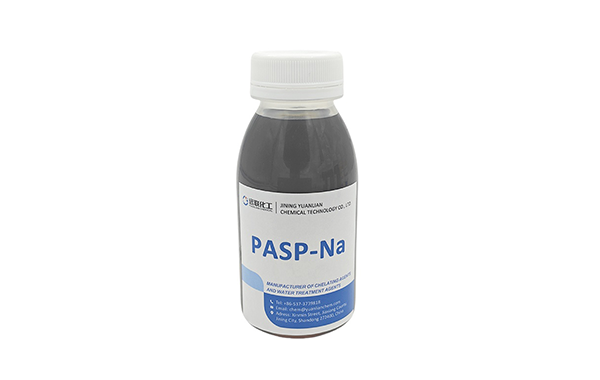
PASP is a longer polymer carrying carboxyl groups. It achieves threshold inhibition through the same crystal-distortion principle, and it adds a dispersant effect for suspended solids. The price for that extra capability is a slightly narrower operating window in some systems, and a touch higher dose in the most aggressive water.
Performance: where each one wins
A fair comparison breaks down by application rather than a blanket "one is better":
- High-hardness, high-alkalinity cooling water: both work; PASP often tolerates the alkalinity better than phosphate-based treatments, though a strong phosphonate like PBTC remains hard to beat for raw calcium carbonate control.
- High-temperature systems: phosphonates still hold an edge in very hot loops; PASP performs well in conventional cooling ranges and boilers up to moderate pressures.
- Fouling and iron control: PASP's dispersancy gives it the advantage where iron oxide and suspended silt are the main problem.
- Stability in oxidising conditions: closer than often assumed; both classes need compatibility checks against chlorine and bromine regimes.
The honest summary is that PASP is not a performance downgrade across the board. It is a different profile, and the choice depends on which problem dominates the system.
The environmental arithmetic
Here the comparison stops being close. Phosphonates contribute phosphorus to the receiving water. That phosphorus feeds algal growth, and the EU's Water Framework Directive, together with national discharge permits, has been squeezing phosphorus limits for years. Some member states now effectively require phosphorus-free programmes for new permits.
PASP is readily biodegradable — typically over 60% in OECD 301 testing — and degrades into amino acids rather than accumulating. For a site applying for an EU Ecolabel, or one facing a tightened permit, this converts directly into operating freedom. It is hard to put a price on a permit you can actually meet.
There is also a subtler point. Because PASP is derived from aspartic acid, its supply chain carries less of the legacy petrochemical association attached to some conventional inhibitors. That matters to buyers whose own customers are starting to ask about the chemistry in the product.
Cost: sticker price versus total cost
On a per-kilo basis, a conventional phosphonate is usually cheaper than PASP. But the purchase price tells only part of the story:
- Dose rate: PASP doses are typically a touch higher, narrowing the gap more than the raw price suggests.
- Blowdown treatment: if the site pays to remove phosphorus before discharge, the phosphonate programme carries a hidden cost PASP avoids.
- Permit risk: a non-compliance fine, or the cost of retrofitting a treatment stage, dwarfs any per-kilo saving.
Once those are counted, the "cheap" phosphonate often stops looking cheap — which is why total-cost comparisons tend to favour PASP on European sites with tight permits.
Regulatory direction
The trend is one-directional. The EU's stance on phosphorus in freshwater has only hardened, and REACH is steadily increasing scrutiny of persistent substances. Phosphonates are not banned — it is important not to overstate this — but the compliance burden around them grows each cycle. PASP sits on the right side of that trend.
Which should you choose?
It rarely has to be all-or-nothing. Many programmes now run a hybrid: PASP as the backbone scale inhibitor, a small phosphonate reserve for the most aggressive zones, and a corrosion inhibitor chosen for compatibility. The pragmatic move is to test rather than assume — run a side-stream trial with your own water chemistry and let the data decide.
Frequently asked questions
Is PASP a direct phosphonate replacement?
In many cooling programmes, yes. In extreme hardness or very high temperature, a blended or phosphonate-reserved approach is still common.
Does PASP contain any phosphorus?
No — the molecule is nitrogen- and oxygen-based, which is the whole point of the switch.
How quickly does PASP biodegrade?
It readily passes OECD 301 screening, typically above 60% in 28 days; the exact figure depends on the specific grade and test method.
Will I need to change my corrosion inhibitor?
Possibly. PASP is often paired with zinc or molybdate inhibitors, so compatibility should be checked with the supplier.
Conclusion
Polyaspartic acid has not rendered phosphonates obsolete, and it would be wrong to suggest it has. What it has done is give water treatment professionals a credible, biodegradable option for the large share of cooling systems where phosphorus discharge is now the binding constraint. In that space, the comparison is increasingly one-sided — not on raw performance, but on the total cost of operating a programme the regulator will actually allow.
Yuanlian Chemical specializes in the production of polyaspartic acid (PASP),tetrasodium iminodisuccinate(IDS), GLDA, MGDA etc. with stable quality and excellent quantity!

Contact us