



-

- 2026-09-04
Choosing a Gypsum Defoamer for a Full Additive System
A defoamer rarely works alone. In a modern gypsum formulation it sits alongside a plasticiser, a retarder, a thickener and sometimes an air-entraining agent, and every one of those additives has an opinion about air. That is why a gypsum defoamer that performs well in one product fails in another that looks almost identical. The difference is not the defoamer. It is the company it keeps.
Air Is Often a Gift From Another Additive
First, know who is making the bubbles. Air in the slurry comes from just two places:
- The stucco itself and the mixer, as particles wet out and high-shear vortexing pulls air in mechanically.
- The other additives. Superplasticisers lower surface tension so air films break less readily; protein-based retarders can foam on their own; cellulose and starch ethers hold bubbles in a more viscous paste.
When the additives are the source, a stronger gypsum defoamer treats the symptom while the formulation keeps making foam. Isolate the cause by mixing the stucco with clean water, then adding each additive one at a time, and watch where the foam appears.
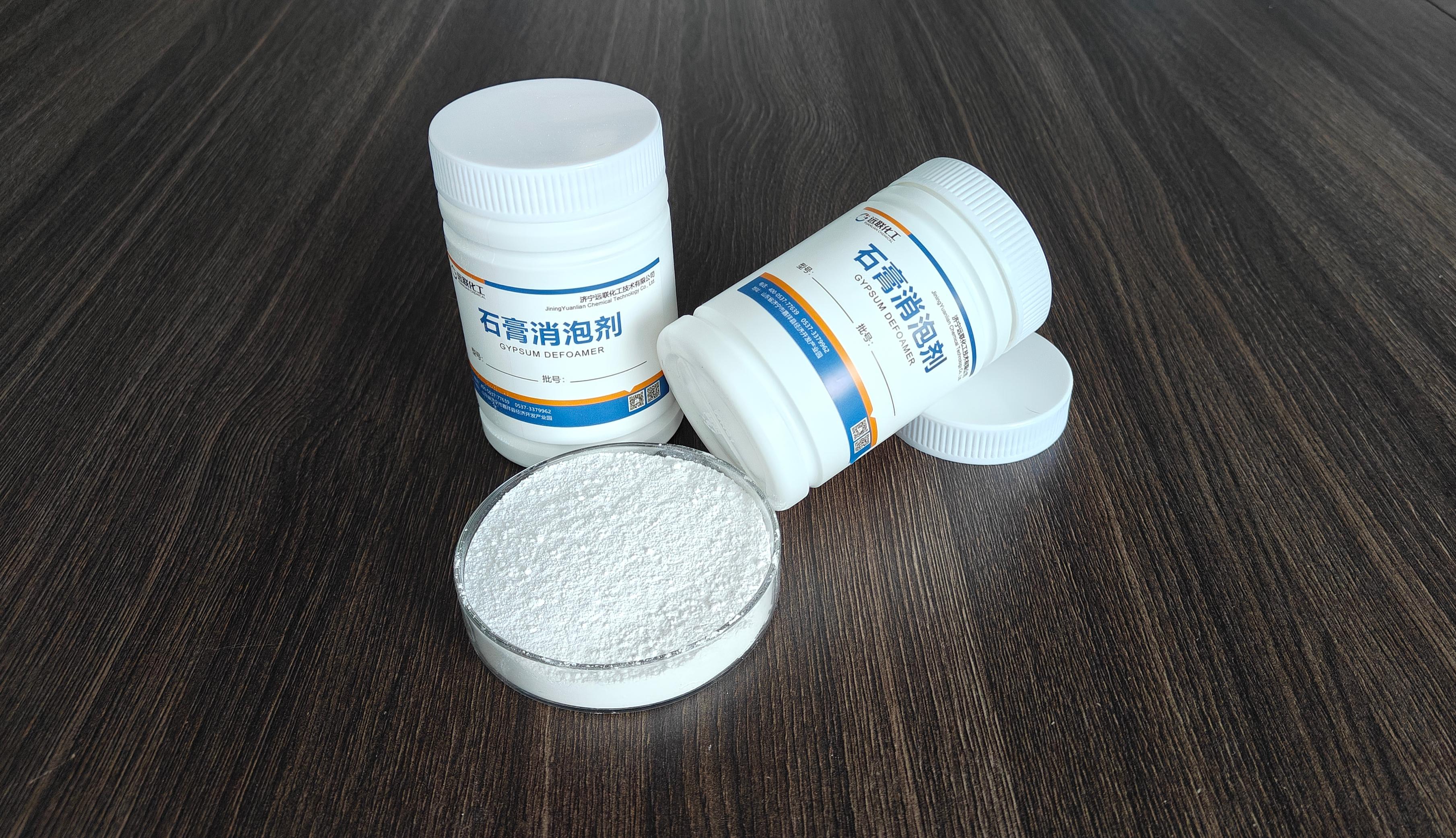
The Interactions That Matter
Superplasticiser and defoamer. Polycarboxylate dispersants foam little but stabilise the fine bubbles that do form. The trap runs the other way too: an aggressive defoamer can interfere with the dispersant, and slurry flow drops. The answer is a dose that clears the surface without pulling the flow table value down.
Retarder and defoamer. Amino-acid retarders stay fairly quiet in the mix. Protein-based and some organic-acid retarders are more surface-active and will need a higher defoamer dose or a stronger chemistry. Watch the set time when you change either product: a large overdose can nudge the setting curve, so re-run the Vicat test when you switch brands.
Thickener and defoamer. Cellulose ether gives the bubble film a tougher skin that ordinary mineral-oil defoamers struggle to break. A system that foams only after the thickener goes in usually responds to a change of type - polyether or silicone-polyether grades - rather than to a higher dose of the same product.
Air-entraining agent and defoamer. Self-levelling compounds and machine-applied plasters sometimes entrain air deliberately, and an air-entraining agent fights a defoamer by design. This is the one combination with a genuinely narrow window: fix the entraining product first, then titrate the defoamer against a measured air content, not against the look of the surface.
Powder or Liquid: Carrier Choice Changes the Interaction
The carrier decides when and where the defoamer can act, which often matters more than the price per kilogram. A powder grade suits dry-mix plants: it blends with the dry ingredients, adds no water and keeps for months in the bag, but it needs even distribution through the blend, since a lumpy carrier leaves oily patches on the surface later. A liquid grade gives finer control on wet lines: it meters into the mix water or after mixing and acts almost at once, at the cost of the water it adds and the pump calibration a continuous line demands.
A powder that works in a dry-mix plaster can disappoint on a wet-mix line because it reaches the slurry too late to stop foam forming. Match the carrier to your process, not to the catalogue.
The Addition Point Decides More Than the Dose
A defoamer must be present while the bubble film is forming; added later, it can only break the bubbles it reaches. The three practical points behave very differently:
- Into the mix water. The lowest effective dose, and the standard route for liquid grades, since the defoamer is in the film-forming liquid before air arrives.
- Pre-blended into the dry mix. Suits powder grades, giving continuous suppression through mixing at a slightly higher dose than the water route.
- Added at the outlet or on the surface. Rescues surface foam and pinholes but does nothing for air trapped inside the body.
If pinholes and internal voids appear together, one addition point will not fix both: use a small dose in the water and a second, smaller one later in the process. Dose until the surface is clean and wet density normal, then stop.
When the Defoamer Itself Causes Problems
Too much of a good additive shows up in four recognisable ways: oily patches on the dried surface, usually from an overloaded oil-based carrier; cratering, where a drop of concentrated defoamer pushes the surface film aside; a sudden loss of flow as the dose rises, pointing at interference with the superplasticiser; and a drifting set time, rare at normal doses but seen with surface-active retarders.
Usually the dose, carrier or addition point is wrong for that formulation - lower the dose or switch carrier before abandoning the chemistry, and re-test the whole system, not just the foam height.
A Short Compatibility Trial Before Full Scale
A compatibility trial is not the same as a foam trial: one asks whether the surface clears, the other whether the rest of the formulation still works. Run both on the same batch of stucco - measure wet density and air content, record flow spread with and without the defoamer, cast a small board and count pinholes after set, check the Vicat set time, and re-read the surface after 24 hours, when oil-based carriers finally show up as stains. Skipping that last step is how a product that looks fine at the mixer fails on the pallet.
Buying From a Supplier Who Tests in Combination
When you evaluate a supplier, ask what their product does next to a polycarboxylate dispersant, a cellulose ether and your retarder - not in plain water. A supplier who asks about your full additive list and your wet density target is reading the problem correctly; one who answers only with a price and a datasheet is not.
Shandong Yuanlian Chemical supplies powder and liquid defoamers for gypsum board, plaster and self-levelling lines, and its technical team works from your full formulation rather than a generic sheet. Send your additive list to [email protected] or call +86-537-3739818 for a starting grade, dose and addition point, plus a sample batch for the trial above. Product details are available at www.yuanlianchem.com.
FAQ
Can one defoamer cover all our gypsum products?
Rarely. Dry-mix plaster, board slurry and self-levelling compound differ in carrier, shear and additive load, so each usually needs its own grade, dose or addition point.
Foam got worse after we changed superplasticiser. Why?
The new dispersant stabilises air films differently; re-balance the defoamer against it rather than assuming the old dose transfers.
Does a gypsum defoamer affect setting time?
At normal doses, no. If the set time drifts, check the dose against a surface-active retarder before blaming the defoamer.
Yuanlian Chemical specializes in the production of polyaspartic acid (PASP),tetrasodium iminodisuccinate(IDS), GLDA, MGDA etc. with stable quality and excellent quantity!

Contact us