



-

- 2026-09-09
MGDA-Na3 Grades, Packaging and Supply: Buyer's Guide
Trisodium methylglycine diacetate reaches a buyer in a handful of physical forms, and the choice between them usually has less to do with chelation chemistry than with what happens afterwards — on the filling line, in the warehouse, and at the customer's goods-inward desk. Getting the form and the pack right at enquiry stage avoids most of the friction that turns up later in a supply relationship.
The forms MGDA-Na3 is traded in
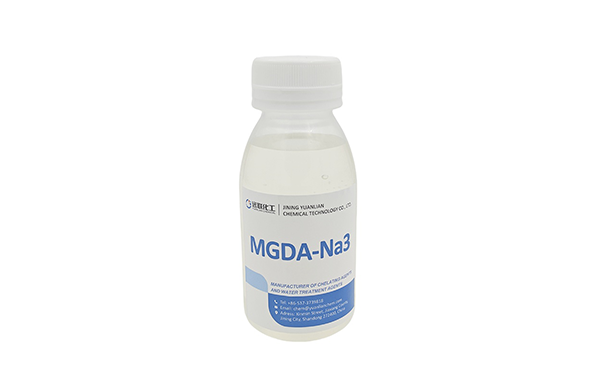
Aqueous solution is the workhorse of the market. A clear, light yellow liquid, typically supplied somewhere between 40 and 47 per cent active content, with the balance water and process salts. It pumps, it meters, it blends into a liquid detergent without a dissolution step, and it suits almost every detergent and industrial cleaning application. If you are not sure which form you need, this is likely the one.
Solid grades — spray-dried powders and agglomerated granules — exist for dry blending. IBCs and drums of solution are heavy to move and carry a lot of water; a solid grade removes that weight and lets a blender dose MGDA-Na3 straight into an automatic dishwashing powder or tablet premix alongside the rest of the dry components. The trade-offs are dissolution rate, dust during handling, and a higher cost per kilogramme of active.
For most European buyers currently running liquids, the practical question is not whether solids exist but whether their volume justifies the extra handling and the separate quality checks a dry grade brings. Solid MGDA is hygroscopic enough that packing integrity and moisture control start to matter in a way they do not for a solution.
Matching the form to what you make
|
What you manufacture |
Form that tends to fit |
The deciding factor |
|
Heavy-duty liquids and liquid laundry |
Solution, standard active |
No dissolution step needed |
|
Automatic dishwashing tablets and powder |
Solid, or solution agglomerated in-house |
Moisture budget in the tablet |
|
All-in-one gel packs |
Solution, with a clarity check |
Interaction with the gel structure |
|
Industrial and institutional concentrates |
Solution at higher active |
Transport cost per kilogramme |
|
Acidic descalers |
Solution, checked for low-pH clarity |
Solubility at the target pH |
|
Small-batch speciality lines |
Solution in drums |
Lower minimum volume per pack |
The right column is the one worth talking through with a supplier's technical team, because it is where the format-specific failures come from. Gel-pack clouding and tablet caking are both problems that show up long after the chelation performance has been confirmed.
Choosing an active content
Within the solution grades, active content is the main lever. A higher active grade costs more per kilogramme as supplied and less per kilogramme of chelation work, and needs less warehouse volume for the same capacity. But it is also more sensitive in cold storage: more concentrated solutions sit closer to their saturation point, so a cold night in an unheated tank farm can start crystallisation or raise viscosity enough to slow a pump.
Two practical rules follow. Buyers with heated storage can take the higher active grade and its freighting advantage. Buyers whose drums will sit in an unheated yard through a Continental winter should either take the lower active grade or plan to warm the material before transfer.
Whatever you choose, fix the value and its tolerance in the enquiry. A quoted range across a product family is not a commitment to a grade — the same point is made in How to Specify GLDA-Na4: A Buyer's Purchase Checklist, and it applies to MGDA-Na3 in exactly the same way.
Packaging and what it does to landed cost
Freight is charged on volume and weight, and MGDA-Na3 is mostly water by mass at typical concentrations. The packaging decision is therefore a cost decision more than a convenience one.
|
Pack |
Typical use |
Notes for the buyer |
|
200–250 kg drums |
Trials, small series, multi-SKU plants |
Easy to move; higher cost per kg and drum disposal to budget |
|
1,000–1,250 kg IBC |
Regular production volumes |
Lower handling cost per kg; needs a tipping or pumping point |
|
Flexitank in a 20 ft container |
Single-product high volume |
Uses the whole container; single destination only |
|
Bulk road tanker or vessel |
Regional distribution hubs |
Requires tank storage and a pump-out facility |
Ask two questions alongside the pack choice: who owns the empty packaging under your local rules, and what the drum or IBC return arrangement is. In several member states the packaging waste obligation sits with the importer, which changes the economics of drums against IBCs in a way the unit price does not show.
Storage, shelf life and cold behaviour
MGDA-Na3 keeps well in closed original packaging away from extremes of temperature, and the shelf life is stated on the technical data sheet for the grade. Three things shorten it in practice.
Contamination after opening. A part-used IBC left open to the yard collects dust and microorganisms. Draw from closed systems where you can, and reseal immediately.
Contact with incompatible materials. Strong oxidising agents and strong acids change what is in the drum. Keep the chelant in its own allocated space.
Extended cold. Freezing episodes can produce haze or sediment that does not always redissolve readily. Warm and mix thoroughly before sampling, and record the temperature excursion.
An ordering sequence that saves time
- Enquiry with the detail fixed. Form, active content, volume per year, pack size, delivery point and Incoterm.
- Documentation before the quotation. Safety data sheet, technical data sheet and a recent certificate of analysis from a shipped batch. See Importing Chelating Agents into the EU: REACH Compliance for the full list.
- Sample, typically one to five kilograms. Enough for bench work, not enough to hide sampling bias.
- Bench trial against your incumbent at your pH and water hardness, using the endpoint you actually care about.
- Plant trial, then first commercial order, followed by contract volumes with an agreed tolerance and a named analytical method for each line.
Buyers who compress steps 2 and 3 usually lose the time back later, because documentation gaps surface at customs rather than at the bench.
Frequently asked questions
Which active content should I start with?
Start with the standard grade, then adjust once you know how your storage behaves in winter. Changing active content later is easy; changing it mid-contract is not.
Can I get MGDA-Na3 in powder form?
Solid grades are available in the market for dry blending. Volume, dust handling and tablet moisture budget decide whether they suit you, and the minimum quantities are usually higher than for solution.
What is the typical minimum order?
Enquiries usually start at drum quantity for evaluation and move to IBC or container lots for contract supply. Ask for the figure for your specific pack rather than assuming a standard applies.
How long does delivery to Northern Europe take?
Allow for production scheduling, port handling and inland haulage. A supplier who has shipped your route before will quote a realistic door-to-door figure and name the port.
Does the form change the compliance paperwork?
The REACH and CLP obligations attach to the substance, so they follow the form. Transport classification and packaging waste rules can differ between solution and solid, so check both.
Should I qualify a second pack size?
If you run multiple sites with different throughput, yes. Mixing drum deliveries at a small plant and IBC deliveries at the main works is normal.
Get the pack and the grade right first time
Yuanlian Chemical supplies MGDA-Na3 as an aqueous solution across standard active contents, with other formats discussed case by case, and supports European buyers with certificates of analysis, safety documentation and landed-cost comparisons by pack size. Tell us your annual volume, storage conditions and delivery point and we will quote both the grade and the packaging that suit the way you work. Write to [email protected] or call +86-537-3739818.
Grade data, typical active contents and packaging options are listed in the Yuanlian Chemical product centre.
Yuanlian Chemical specializes in the production of polyaspartic acid (PASP),tetrasodium iminodisuccinate(IDS), GLDA, MGDA etc. with stable quality and excellent quantity!

Contact us