



-

- 2026-09-07
Chelating Agent Cost in Use: Reading Price Beyond the Drum
Two quotations for the same chelant can sit 20 per cent apart and still end up costing almost the same amount once the product is made. Buyers see a price per kilogramme on a drum; formulators see a dose rate in a recipe. Reconciling the two is where most of the avoidable spend in a chelant contract hides.
This article sets out a method for comparing biodegradable chelants on what they cost to use, not what they cost to buy, and flags the cost lines that never appear on a supplier's quotation.
Three numbers sit behind every chelant price
A chelant quotation tells you the price of a solution. What you actually buy is the chelating power in that solution. Three figures convert one into the other.
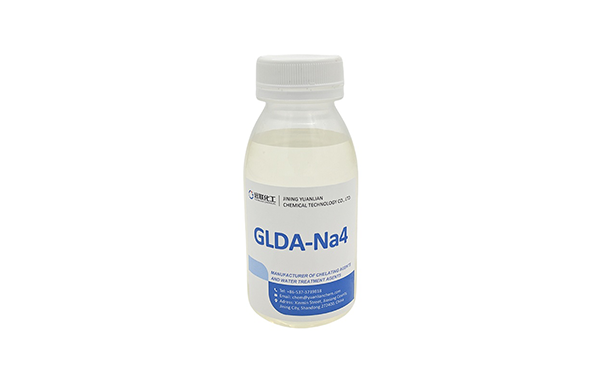
Active content. Most liquid chelants are supplied as aqueous solutions — GLDA-Na4 commonly around 47 per cent, MGDA-Na3 around 40 per cent, PASP-Na around 40 per cent, with grades varying by producer. The remainder is water and process salts.
Dose rate. How much active is needed to hold the metal load in your system. This depends on hardness, pH, temperature and which metal you are binding, so it is a property of your formulation rather than of the molecule alone.
Performance under your conditions. A chelant that holds calcium well at pH 12 but loses iron at pH 4 is not a like-for-like swap in an acidic cleaner, whatever the datasheet says.
Multiply the first two and you have cost per unit of chelation work. Ignore the third and that number will mislead you.
Dose rate: where the difference actually appears
The larger correction comes from the bench. Chelants differ in how much they need to reach the same endpoint.
GLDA-Na4 binds calcium strongly across a wide pH range and often reaches a given water-softening target at a lower dose than a weaker calcium binder. MGDA-Na3 holds its own in alkaline builders and in automatic dishwashing, where the relevant endpoint is scale prevention over a full cycle rather than a titration number. PASP-Na works at low dose as a scale modifier in circulating water, where its job is to distort crystal growth rather than to carry metal stoichiometrically. IDS-Na4 has a particular affinity for iron, which matters more in pulp, textile and some industrial cleaning applications than in hard-water softening.
What this means in practice: a chelant that costs 15 per cent more per kilogramme of active and needs 20 per cent less of it is cheaper in the formula. The only way to know is to run both to the same endpoint in your own system, at your pH, with your water.
The costs that never reach the quotation
Procurement comparisons usually stop at the raw material line. A few others move with the choice of chelant.
Rework and rejected batches. A chelant that holds metals through a hot fill or a hard-water dilution step removes a category of failure. One rejected batch costs more than a year of the price difference on most mid-volume contracts.
Wastewater and sludge. Persistent chelants can carry metals through treatment and complicate discharge consent. A readily biodegradable chelant reduces that burden, which is part of why detergent manufacturers moved the way they did.
Labelling and documentation. A chelant with a lighter CLP classification can lower the labelling burden on your finished product and shorten internal sign-off. See Importing Chelating Agents into the EU: REACH Compliance for the documentation side.
Supply continuity. Reformulation triggered by a discontinued grade is expensive. Contracted volumes and a second qualified source have a value that sits outside the price per kilogramme.
A comparison you can run in a week
A fair trial needs a defined endpoint rather than a general impression.
- Fix the endpoint. Calcium carbonate chelation value, scale mass on a coupon, turbidity after a hard-water challenge, or colour stability in a peroxide system. Pick one and measure it the same way for every candidate.
- Fix the conditions. Use your production water, your pH and your temperature. Hardness is the variable that most often changes the ranking between two chelants.
- Sweep the dose. Run three levels for each candidate, not one. The interesting comparison is the dose at which each reaches the endpoint, not the performance at an equal dose.
- Include your incumbent as a control. Otherwise you are measuring the test, not the candidate.
- Convert to cost per unit of endpoint. Multiply the qualifying dose by the cost per kilogramme of active and rank on that figure.
Analytical methods for step 1 are covered in How to Measure Chelation Performance in the Laboratory, which walks through the titration and the interpretation traps.
Frequently asked questions
Is a higher active content always better?
For freight and storage, usually. For handling, not always — very concentrated grades can be more viscous, more prone to crystallisation in cold storage, and harder to pump. Match the grade to your plant.
Why do two suppliers quote different actives for the same product?
Production route and neutralisation differ, and some grades are standardised for a particular application. Compare on the certificate of analysis rather than on the product name.
Does a biodegradable chelant always cost more?
Per kilogramme of active, often yes, and the gap has narrowed as capacity has grown. Per unit of performance the picture is frequently closer, and the downstream lines above can shift it further.
How much does hardness change the result?
Enough to change the ranking. A chelant that wins in soft water can lose in 300 ppm CaCO₃ water. Always test at the hardness of your production site.
Should I qualify a second supplier?
For any chelant that runs continuously, yes. The cost of qualifying a second source is small compared with the cost of an unplanned reformulation.
Get the numbers before you commit
Yuanlian Chemical supplies GLDA-Na4, MGDA-Na3, PASP-Na, IDS-Na4, ASDA-Na4 and EDDS-3Na with declared active content on every certificate of analysis and technical support for dose-optimisation trials. Send us your water analysis, pH and target endpoint and we will return a starting dose, the cost-per-active comparison against your incumbent, and samples for bench evaluation. Write to [email protected] or call +86-537-3739818.
Grade specifications, typical active content and packaging options are listed in the Yuanlian Chemical product centre.
Yuanlian Chemical specializes in the production of polyaspartic acid (PASP),tetrasodium iminodisuccinate(IDS), GLDA, MGDA etc. with stable quality and excellent quantity!

Contact us