



-

- 2026-09-15
GLDA-Na4 for Water Treatment: Scale and Deposit Control
In European industrial water systems, the constraint is rarely the chemistry of the chelating agent on its own. It is the mixture of calcium, bicarbonate, silicate and suspended solids that arrives with make-up water, process leakage and the weather. A cooling tower in a Mediterranean summer pulls in dust and concentrates minerals until the water in the sump looks nothing like the water that entered. GLDA-Na4 earns its place in this work because it holds calcium in solution across the pH band these systems run at, and because it breaks down in the environment rather than accumulating downstream.
Where water systems lose control
Cooling towers concentrate dissolved solids as water evaporates and only pure vapour leaves the stack. Boiler feedwater must stay clean on the tube walls or efficiency falls within weeks. Process water in pulp, textile and metal-washing lines carries metal ions that precipitate, stain or foul surfaces. The common thread in all three is the same: metal cations drive scale and deposits.
Calcium and magnesium form carbonate and sulphate scale. Iron, manganese and copper catalyse reactions, leave coloured deposits and shorten equipment life. A treatment programme that ignores these cations is treating the symptom, not the cause.
What GLDA-Na4 does in the water
GLDA-Na4 keeps calcium and magnesium in solution through a combination of chelation and threshold or crystal-distortion action. That suppresses calcium carbonate, calcium sulphate and silicate scale before it can settle on heat-exchange surfaces. It also binds iron, manganese and copper that would otherwise catalyse fouling or leave stains.
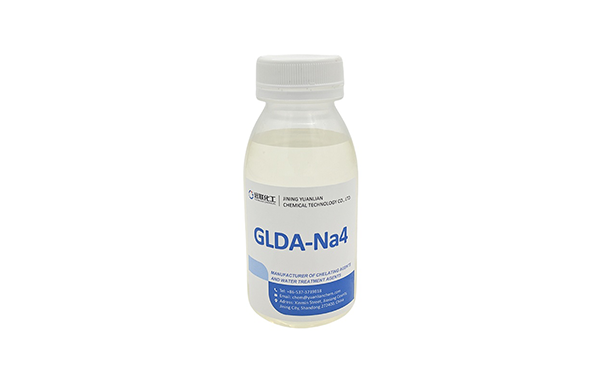
It performs across the alkaline pH range typical of cooling and boiler water, which is where many older chelants lose strength. It is not, on its own, a corrosion inhibitor. In practice it is blended into a programme that may include phosphonates, zinc or molybdate, where each component covers a different failure mode. The molecule and its behaviour in water are described in more detail on the technical site at https://www.yuanlianchelating.com.
Compatibility with oxidising biocides
Open cooling systems rely on chlorine, bromine or peracetic acid to control biofilm. GLDA-Na4 tolerates these oxidisers better than some alternatives, but free chlorine at high dose and long contact will slowly degrade any organic chelant. The practical rule is to confirm the oxidiser tolerance data from the supplier and run a side-by-side before committing a full dose.
A short bench screen with your actual biocide concentration tells you more than a generic data sheet. Record the chelant residual after the contact time your system uses, not the contact time printed on the biocide label.
Dosing and monitoring
Recirculating cooling systems commonly run GLDA-Na4 in the low milligrams per litre range, set by hardness, cycles of concentration and the existing programme. Once-through and batch systems follow different logic and need their own basis. Over-dosing adds cost without improving control and increases the organic load sent to discharge.
Monitor with a calcium or Langelier-style index and, where deposits matter, with weighted coupons. Deposit weight on a coupon after a fixed run is a more honest measure than a clean tube on inspection day. Keep a margin in the dose for seasonal swings in make-up water quality.
Boiler and steam systems
In boiler feedwater treatment, chelants keep iron, copper and aluminium from depositing on tubes during steam generation. GLDA-Na4 is one option among several, and the grade must suit boiler duty. Local boiler-water chemical approvals vary by country and by pressure class, so confirm the grade and the supporting documentation before trial.
It is worth stating plainly what the chelant does not do here: it supports deposit control, it does not replace a full boiler-water programme, and it does not address oxygen or pH control. Those remain separate duties in the treatment plan.
EU regulatory framing
Request the REACH registration status and, for non-EU supply, the Only Representative details from the seller. GLDA-Na4 itself is not a biocide, but products co-formulated with biocides fall under Regulation (EU) 528/2012 and carry their own obligations. Where the chelant is used in a cleaning-associated water stream, the Detergents Regulation (EC) 648/2004 may apply to the formulation.
The environmental profile supports discharge discussions: GLDA-Na4 is readily biodegradable under OECD 301 methods. Local permits still govern what may leave the site, and those permits, not the biodegradation figure, set the limit.
What to ask a supplier
A useful enquiry for water-treatment grade asks for the REACH number, the active content and the impurity profile, especially iron and chloride. Ask for oxidiser-tolerance data tied to your biocide, and for compatibility information with the programme you already run. A sample for a coupon or deposit-weight test turns a specification into evidence.
Also ask whether the grade is screened for the metals that matter in your system. A chelant supplied with its own trace-iron load is working against itself in a water where iron control is the whole point.
Frequently asked questions
Can GLDA-Na4 replace a phosphonate programme? Often it is blended with phosphonates rather than replacing them. Phosphonates bring threshold action and, in some cases, corrosion benefit that a chelant does not. The two are complementary in many cooling programmes.
Is it suitable where water contacts food equipment? That depends on the grade and on local food-contact approvals. Confirm the specific grade and the relevant documentation with the supplier before use in such lines.
Does the solution freeze in winter storage? The aqueous solution can thicken or partially crystallise in cold weather. Storage above the supplier's stated minimum temperature keeps it homogenous; a gentle warm-up restores it if it has been cold.
How do I set a starting dose? Base it on hardness and cycles of concentration, then confirm with a coupon or deposit test under your real operating conditions rather than copying a figure from another site.
Work with a documented source
Yuanlian Chemical supplies GLDA-Na4 with a certificate of analysis and the documentation European buyers need for QA and customs. To run a trial on your system, write to [email protected] or call +86-537-3739818, and link through to the product centre at https://www.yuanlianchem.com for the current grade list and technical dossier.
Yuanlian Chemical specializes in the production of polyaspartic acid (PASP),tetrasodium iminodisuccinate(IDS), GLDA, MGDA etc. with stable quality and excellent quantity!

Contact us