



-

- 2026-09-21
Chelating Agents for Leather Processing: A Buyer's Guide
A tannery in Tuscany runs a crust leather that passes every physical test and still comes back from the customer with grey bloom on the pale blue. The lab finds copper at a few parts per million in the dye bath. Nobody added copper on purpose. It arrived in the water, in the salt, and from the worn stainless fittings, and nothing in the process was tying it up.
That is the usual story in leather. Metal control is treated as a finishing problem, then the fix is a re-dye that costs more than the hide. This note is about stopping more of it earlier, which molecule fits a tannery, and how to buy the thing without discovering the gap on a rejected lot.
Where the metal comes from
Hide is a loaded raw material. Salted and wet-blue stock carries iron and copper from curing and from the equipment it has touched; the process water adds calcium and magnesium; chrome from tanning, and the lime and sulphide of the beamhouse, each bring their own load. By the time the leather reaches dyeing, stray metal is everywhere:
- Iron and copper catalyse colour shifts and leave dark or grey stains on light leather.
- Calcium and magnesium react with anionic auxiliaries and dull the handle.
- Chrome that is poorly complexed wastes material and shows as loose or uneven grain.
A chelating agent does not remove the metal from the hide. It holds it in a ring so it cannot react with the dye, the fatliquor or the grain. The difference between held and free is the difference between a shade that matches the board and a complaint.
What it does in the beamhouse
Soaking, liming and deliming set the base. The water used here is rarely soft, and the salts in cured hide add more. A chelating agent in the soak and the delime keeps calcium and iron from interfering with the enzymes and the reliming, so the pelt opens evenly and the subsequent steps start clean.
The payback shows in the beamhouse before it shows anywhere else. Leather that enters tanning with less free metal takes the chrome more evenly, which means less retanning later to cover the fault. Plants that control the metal at the front end feed cleaner stock to every downstream bath.
What it does in tanning and retanning
Chrome tanning is the part where metal control pays hardest. Masking the chrome with a chelating agent keeps it soluble and evenly distributed through the pelt, so the leather fills and the grain stays tight. Poorly masked chrome drops out as uneven uptake, and the tanner spends retanning chemicals trying to hide it.
In retanning and fatliquoring, the same logic applies. Free iron or copper in the bath stains the light shades and ties up anionic fatliquors; held metal lets the auxiliaries do their job at the dose on the recipe. A tanner who measures the bath metal and doses to it gets a level result from the same drum, not a different one each week.
What it does in dyeing and finishing
Dyeing is where stray metal becomes visible. A few parts per million of copper can pull a pastel toward grey; iron speckles the surface and resists correction. The chelating agent keeps those ions in solution through the dye cycle, so the shade that leaves the dye house matches the one on the colour standard.
Finishing compounds have the same sensitivity. A clear or pale finish that picks up iron from the water or the mill shows as a yellow cast that the customer reads as ageing. Holding the metal through the coat keeps the finish clean. This is where a copper-selective molecule earns its place, not as a bulk hardness builder but as a targeted stain preventer on pale and white leather.
Which molecule, which job
- GLDA-Na4 and MGDA-Na3 cover most of the house: beamhouse, retanning support and the equipment wash. Both hold calcium, magnesium and iron across the pH and temperature a leather process runs, and both biodegrade under OECD 301, which matters when the effluent is audited.
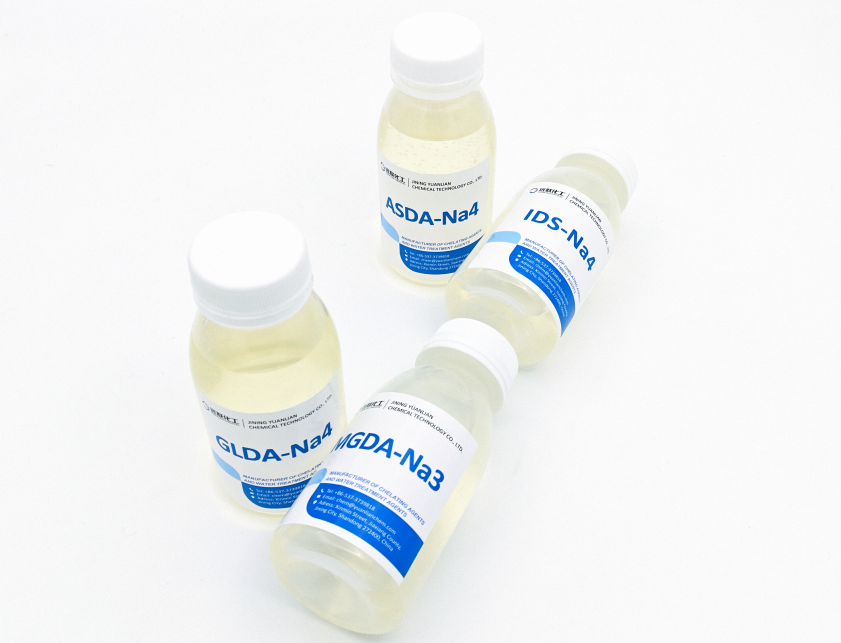
- IDS-Na4 earns its place where copper and iron selectivity drives the fault — pale crust and white finishes where a stray part per million stains the shade. Used as a bulk builder it is the wrong tool.
- EDTA has a long history in tanneries. Its persistence and the questions it raises under restricted-substance programmes are why many plants are reviewing it. The swap is not one-for-one; re-balance the dose and screen before you commit.
Effluent and the audit reality
Leather effluent is watched closely in Europe. ZDHC and brand-restricted-substance lists, local discharge permits, and the REACH status of every input mean the chelant is judged not only on the bath but on what leaves the site. A molecule that breaks down under OECD 301 methods is easier to defend in a discharge permit discussion than one that accumulates.
The biodegradation figure does not set the limit; the permit does. But a supplier who can show an OECD 301 report for the exact grade, with the test reference, turns a claim into a record you can hand to the environmental function. Treat that document as part of the purchase, not a nice-to-have.
What to put in the purchase specification
- Active content stated as supplied and per gram of active, because the two are not the same figure and quotes that hide behind one of them cause arguments later.
- Iron, copper and chrome limits in ppm. A chelant that arrives carrying the very metal it was meant to remove is selling the problem back to you.
- Residual intermediate by a named method, not "passes spec."
- Effect on shade, confirmed by your own dye check on the actual leather, not the supplier's data sheet.
- Biodegradability by OECD 301, with the test reference, where the effluent is part of your permit.
The certificate of analysis should name the test method for every line. A CoA that says "leather grade" without a method or a metal figure is a label, not a quality record.
Questions to put to a supplier before ordering
- What is the active content as supplied and per gram of active, and which method defines it?
- What are the iron, copper and chrome limits, and do you test every batch or by composite?
- Can you show an OECD 301 biodegradability report for the exact grade?
- What packing is available — drum, IBC, bag-in-box — and what does that do to landed cost per kilogramme?
- What is the realistic lead time to a named European port, and do you hold stock for repeat orders across the season?
Frequently asked questions
Will a chelating agent remove the stain already in the leather? It prevents new staining by holding the metal; it does not strip what is already fixed in the grain. Run a screened trial on the bath chemistry, then adjust the process rather than re-dyeing the fault.
Can I replace EDTA gram for gram in a tannery? Usually not one-for-one. Start from your bath metal, screen at pilot, and adjust the dose. The active masses differ, so dose on active, not on weight.
Does it affect the dye uptake? Indirectly, by holding iron and copper so they cannot dull or shift the shade. Measure the dyed leather colour before and after a trial rather than trusting the claim.
Is the dose the same across the season? No. Water hardness and hide salt move with the raw material, so tie the dose to a metal check and revisit it as the intake changes.
How do I screen a new grade without stopping the line? Dose it into one drum at your real bath metal, track the shade and the handle, then scale to a partial lot before full conversion.
Chelating agents are low-cost insurance against rejected pale leather, but only if the grade is matched to the metal and the supplier can prove both the chemistry and the effluent profile. For the wider selection across molecules, the technical library carries the method detail on copper and iron selectivity, and our notes on metal-surface cleaning cover the equipment wash side.
Yuanlian Chemical specializes in the production of polyaspartic acid (PASP),tetrasodium iminodisuccinate(IDS), GLDA, MGDA etc. with stable quality and excellent quantity!

Contact us