



-

- 2026-09-29
Phosphorus-Free Water Treatment: PASP Under Tighter EU Rules
Across Europe, the conversation around industrial water treatment has shifted from "does it work" to "what does it leave behind". Phosphorus is the element that changed the question. Utilities, food and beverage sites and municipal operators are all reading discharge permits that name a total-phosphorus ceiling, and a treatment programme that once passed now fails the audit. Sodium polyaspartate, known in specifications as PASP-Na, is one of the polymers that answers the performance need and the phosphorus need at the same time. This article looks at why that combination is moving it onto more European buyer shortlists, and what a procurement team should weigh before switching.
The phosphorus question that will not go away
Phosphorus is plant food, which is exactly the problem once it reaches a river. A small excess in a slow-moving water body feeds algal blooms that strip oxygen and tip the ecosystem out of balance. Regulators across the EU have treated this for years through the Urban Wastewater Treatment Directive and the Nitrates Directive, and the pressure has not eased. Many national permits now set total-phosphorus limits in the low milligrams per litre, and some catchments apply stricter local targets where the receiving water is already stressed.
For a site running a phosphonate-based programme, that ceiling is a direct constraint. Every kilogram of HEDP or PBTC added to control scale also adds phosphorus to the blowdown, and the effluent budget has to absorb it. The chemistry works; the permit may not.
Where the limits are moving
The direction of travel is consistent. Revised urban-wastewater rules tighten secondary treatment and extend coverage, while the push for nutrient-neutral industry keeps phosphorus on the agenda at permitting time. Operators who plan a programme today are often asked to show how it will look under the next round of limits, not only the current one. That forward view changes purchasing: a chemical that is compliant now but phosphorus-heavy becomes a liability the moment the ceiling drops.
A site that can show a phosphorus-free or phosphorus-reduced treatment file carries an easier conversation with its regulator and its own environmental management system. For groups reporting under corporate sustainability commitments, the nutrient load of a treatment chemical is now part of the story, not a footnote.
What a phosphorus-free programme actually changes
Moving away from phosphonate does not mean giving up scale control. It means choosing a molecule that holds calcium, magnesium, barium and sulphate in check without carrying phosphorus into the water. Sodium polyaspartate does this through threshold inhibition and dispersion: it distorts the early crystal so it cannot grow, and it keeps fine particles suspended so they leave with the blowdown rather than plastering the heat-exchange surface.
The practical change for the plant is modest. The dose point, the monitoring and the blowdown routine stay familiar. What drops out is the phosphorus line on the effluent balance, and with it a recurring permit risk. In cooling towers, boilers and membrane loops the polymer already works across the common failure modes, so the switch is often a substitution within an existing programme rather than a rebuild.
Why sodium polyaspartate fits the moment
PASP-Na is a polymer built from aspartic acid, an amino acid found in nature, and that origin shows in its environmental file. It reaches ready-biodegradability under OECD 301B testing, breaking down through standard biological treatment rather than persisting in sediment. It carries no phosphorus and no NTA-type chelator, so a programme based on it adds nothing to the nutrient load it was meant to reduce. Aquatic toxicity sits low, which keeps it clear of the acute-hazard flags that worry ecotoxicity reviewers.
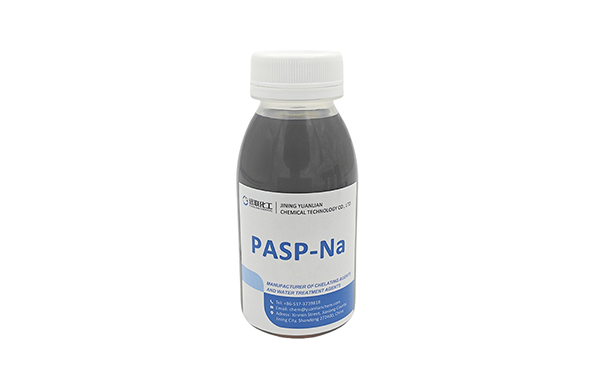
That combination is why the polymer appears in specifications written for sites under ISO 14001 or aiming for an EU Ecolabel claim. It answers the audit question at the same time as the performance question, and for a buyer shortlisting candidates, that double answer removes a line of objection. For the background on metal selectivity across the biodegradable set, the technical library carries the detail: https://www.yuanlianchelating.com
Reading the trade against phosphonate and polyacrylate
No single molecule wins every job. Phosphonates control hardness efficiently and stay stable at high temperature, which keeps them in boiler and high-heat roles. Polyacrylates disperse well and cost less, but they largely resist breakdown and accumulate where the discharge is counted. PASP-Na lands between: a closed environmental file with scale performance that covers most cooling, boiler and membrane duties.
The honest trade is price and temperature ceiling. Polyacrylate remains the lower-cost default; phosphonate holds where heat is severe; PASP earns its place where the nutrient load and the persistence question decide the purchase. A site under a total-phosphorus limit rarely keeps phosphonate on its own, and a site facing an audit rarely keeps polyacrylate without a note in the file. The polymer answers both without a second argument.
A practical route to a shortlist
A switch does not need to be a leap. Start with one tower, one boiler or one membrane train, hold the dose, and log the make-up water and the blowdown phosphorus alongside the prior programme. The polymer should show its value in fewer cleans, a flatter nutrient line and a stable fouling trend, not in a single dramatic number.
Set the review window before the trial and agree the switch criterion with the plant. A trial that ends with "it seemed fine" teaches nothing; one that ends with a recorded fouling trend and a phosphorus balance either justifies the change or stops it cleanly. Keep the retained-sample record so any later question starts from a known batch.
What to ask a supplier
Before the first drum, ask for the OECD 301B biodegradability report, the safety data sheet and a batch certificate that names the test method for each limit, not only the value. Confirm the active content with tolerance, the molecular-weight or viscosity band, the residual monomer limit and the heavy-metal profile. A specification that names the distribution protects you from two drums at the same per-cent behaving differently.
Ask too about the phosphorus and NTA content explicitly, because a free-from claim only means something when it is written on the document. Full product details and the supporting files are available at the company website: https://www.yuanlianchem.com
Frequently asked questions
Does PASP-Na contain phosphorus? No. The polymer carries no phosphorus and no NTA-type chelator, so a treatment programme built on it adds nothing to the phosphorus load of the discharge.
Will it replace a phosphonate in a boiler? In many low- to mid-pressure programmes it can take the dispersant role, but where high temperature and hard scale dominate, the phosphonate may still be needed. Confirm against your feed-water specification.
Is it biodegradable? Under OECD 301B it reaches ready-biodegradability, breaking down through standard biological treatment rather than persisting in the environment.
How do I trial it without disrupting the plant? Start with a single tower, boiler or membrane train, hold the dose, and compare the fouling trend and blowdown phosphorus with the prior programme over an agreed window.
A phosphorus-free programme is a chemical choice and a permit choice at once. For the OECD 301B report, the specification sheet and a sample for bench evaluation, contact [email protected] or call +86-537-3739818. Full product details are available at the company website: https://www.yuanlianchem.com
Yuanlian Chemical specializes in the production of polyaspartic acid (PASP),tetrasodium iminodisuccinate(IDS), GLDA, MGDA etc. with stable quality and excellent quantity!

Contact us