



-

- 2026-10-12
PASP in Industrial Water Reuse: a Practical Buyer's Guide
Closing loops on water has moved from a nice-to-have to a routine operating decision across European industry. As freshwater abstraction tightens under the Water Framework Directive and discharge consent becomes harder to secure, more plants run cooling towers, boilers and process loops on reclaimed or recycled water. The catch is that reused water carries a heavier load of calcium, phosphate, silica and suspended solids than the mains supply it replaces. Sodium polyaspartate (PASP-Na) is one of the tools that lets a recycle loop stay clean without the persistence problems of older antiscalants. This guide sets out where it fits, what grade to ask for, and the trial steps that stop a water-reuse project from stalling.
Why reclaimed water changes the chemistry
A cooling tower fed on secondary effluent or a treated process stream is not the same system as one fed on softened mains water. The recycle stream concentrates dissolved salts as water evaporates, and it arrives with more phosphate, more organic matter and more fine particulate than a fresh supply. That combination drives calcium carbonate, calcium phosphate and calcium sulphate scale, and it feeds biofilms that hold the scale in place. A programme built for clean make-up water simply does not translate to a reclaimed supply, and the first sign of trouble is usually a loss of heat-exchange efficiency or a blocked strainer rather than a dramatic failure.
What PASP-Na does in a recycle loop
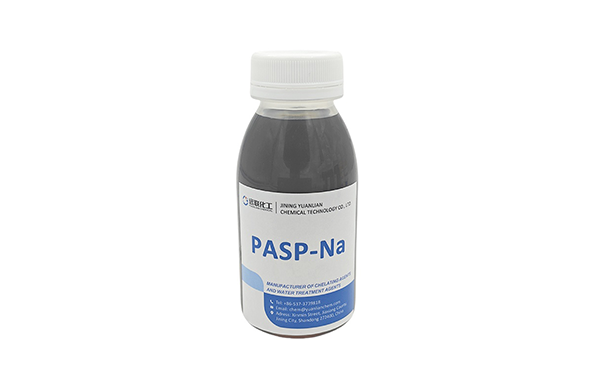
Sodium polyaspartate works by a threshold effect. At low use levels it interferes with the ordered growth of scale crystals so they stay small and stay in suspension instead of locking onto a heat surface. The same carboxylate backbone disperses fine particulate and helps keep biofilms from binding to metal. Because the polymer is readily biodegradable and contains no phosphorus, it does not add to the nutrient load that already makes reclaimed water awkward to discharge. That matters in a loop where every additive ends up in the blowdown and, eventually, in the sewer or the environment.
Cooling towers running on reclaimed make-up
The cooling tower is the most common place a reuse programme meets scale. With reclaimed make-up, the concentration factor is limited by phosphate and silica as much as by hardness, so the programme has to control scale at lower cycles than a soft-water tower would allow. PASP-Na, used alongside a suitable oxidising biocide, helps hold calcium carbonate and calcium phosphate in check so the tower can run at a useful concentration factor without fouling the fill. Buyers typically specify the 40% active liquid and tune the dose to the make-up analysis rather than to a fixed rule, because reclaimed water varies far more than mains supply.
Membrane systems on secondary effluent
Reverse osmosis and nanofiltration are often the step that turns a waste stream into reusable water, but the membrane is also the step most exposed to scaling. Calcium carbonate, calcium sulphate and silica all foul a membrane surface, and a reclaimed feed is richer in each than a typical borehole supply. PASP-Na is used as an antiscalant ahead of the membrane, where its threshold action keeps scale from nucleating on the element. It is chosen partly because it tolerates the wide pH swings of a reuse train and because it does not add phosphate that would later complicate the concentrate stream. A small bench test on the actual feed settles the dose far better than a generic table.
Keeping clarifiers and separators clean
Reuse trains carry more suspended solids than fresh systems, and those solids settle where they should not. PASP-Na disperses fine particulate so it stays carried in the flow and reports to the separator instead of building a scale-like deposit on pipes and tanks. In a membrane bioreactor or a clarifier upstream of reuse, that dispersancy supports a steadier flux and fewer manual cleanings. The effect is quiet: the plant simply holds its performance through swings in the incoming load that would otherwise mean a cleaning shutdown.
PASP against phosphonate and polyacrylate
The two additives most often compared with PASP-Na are phosphonates and polyacrylates. Phosphonates are strong scale inhibitors but carry phosphorus, which is precisely the nutrient plants are trying to keep out of their discharge. Polyacrylates disperse well and are cheap, yet they are slower to biodegrade and can build up in a closed loop. PASP-Na lands between them: phosphorus-free, readily biodegradable, and with enough dispersant strength to keep a recycle loop tidy. Where a tender asks specifically for a non-phosphorus, biodegradable programme, it is often the straightforward fit.
Choosing the grade and the active content
Most buyers work with the 40% active sodium salt in liquid form, because it pours, doses and mixes without heating. For a loop that is dosed continuously, the liquid is the natural choice; for a seasonal or intermittent system, the same grade in a smaller pack keeps storage simple. The decision that actually moves performance is the molecular-weight band, because dispersancy and scale inhibition trade off against each other as the chain length changes. A supplier that states the molecular-weight distribution on the certificate of analysis saves a buyer the trouble of finding out the hard way which band was shipped.
What to put in the specification
A useful specification names the active content, the molecular-weight band, the pH of the solution, the residual monomer and the colour. Residual monomer is the line suppliers most often skip, yet it is the one that tells you whether the batch was made and finished cleanly. The colour and clarity of the liquid are a quick visual check on whether the material has begun to break down in storage. Asking for all of these on the certificate of analysis, rather than accepting a bare assay, is the difference between a repeatable programme and one that drifts batch to batch.
Running a trial without a surprise
A water-reuse trial should start in the lab, not on the live loop. A few jars of the actual reclaimed water, dosed across a range of PASP-Na levels and held at the loop temperature, show whether scale and dispersion behave as expected before a drop goes into the plant. From there, a side-stream or a single tower gives a low-risk look at real conditions. Measure the concentration factor, the fill pressure and the blowdown quality weekly, and keep the make-up analysis current, because reclaimed water moves with the season and the upstream process.
What to ask a supplier
Before committing a contract, ask for the biodegradation data, the molecular-weight distribution, the residual monomer figure and a reference from a plant running reused water. Ask whether the grade is stable through the temperature and pH your loop sees, and whether the supplier can hold a consistent band across deliveries. A supplier that hands over this set without a chase is easier to keep than one that needs coaxing for every line, and in a reuse programme consistency matters more than a slightly lower headline price.
Frequently asked questions
Does PASP-Na add phosphorus to my discharge? No. The polymer contains no phosphorus, so it does not contribute to the phosphate load that limits many reuse discharges.
Can it replace my existing phosphonate programme entirely? In many reclaimed-water loops it can take over the scale role, though the biocide and the phosphate control are separate decisions that depend on your consent.
Will it work on silica scale? PASP-Na is strongest on carbonate, phosphate and sulphate scales; silica needs its own control strategy and should be assessed on the feed analysis.
How do I confirm the dose? Start with a jar test on your actual reclaimed water, then confirm on a side-stream before full commissioning.
Plan your reuse programme with a partner that understands the chemistry of recycled water. Visit the product centre at yuanlianchem.com for specifications, certificates and sample requests, or write to [email protected] to discuss your make-up analysis.
Yuanlian Chemical specializes in the production of polyaspartic acid (PASP),tetrasodium iminodisuccinate(IDS), GLDA, MGDA etc. with stable quality and excellent quantity!

Contact us