



-

- 2026-10-13
Chelating Agents in Pharmaceutical Water and Cleaning
Pharmaceutical and biotech plants hold their water to a standard that few other industries match, and the metal in that water is one of the quiet variables that can move a result. Calcium and magnesium scale the stills and the distribution loops, iron and copper catalyse the oxidation that degrades the product and the cleaning agent, and trace metal in a process stream can change an active or a culture. A chelating agent is part of how these sites keep metal under control, but in a GMP environment the grade and the paper matter as much as the chemistry. This guide sets out where a chelant fits in pharma water and cleaning, which grades suit the expectation, and the documentation a site should hold before a change.
Where pharma plants use a chelating agent
The uses fall into three groups. The first is purified-water and WFI generation and distribution, where the chelant limits scaling on evaporators, stills and loop surfaces and keeps the metal from catalysing degradation. The second is clean-in-place and clean-out-of-place of vessels, filters and fill lines, where it frees the surfactant and lifts the mineral and metal film that plain alkali leaves behind. The third is the process stream itself, where an active or a fermentation benefits from controlled metal during a sensitive step. Each use carries a different purity and documentation bar, and the grade chosen for a still is not automatically the right grade for a product-contact clean.
Metals that compromise purified water and WFI
Calcium and magnesium are the scaling metals, and they are the ones that force the still off-line for descaling. Iron is the catalysis risk: at trace level it drives the oxidation that browns a solution and ages a sensitive active. Copper comes from fittings and from any shared utility water, and it is similarly active at low concentration. Manganese films slowly and is easy to miss. A metal panel on the feed and on the loop, taken at commissioning and then periodically, shows which metal the chelant must answer, and the answer should match the measured load rather than a generic assumption about the plant.
Choosing a grade that fits GMP expectations
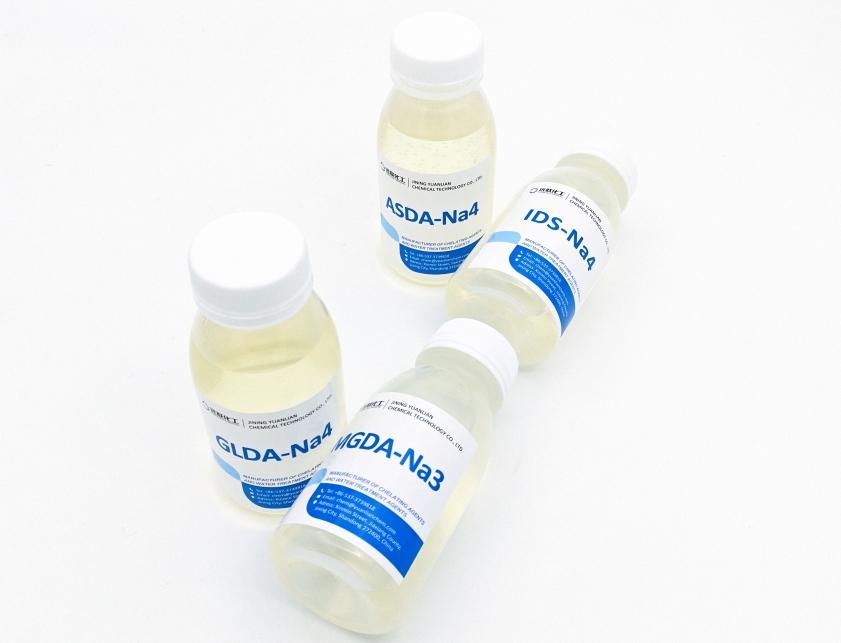
Pharma sites weigh a chelant on three things: the metal it controls, the purity and by-product profile, and the documentation behind the grade. The amino-acid chelants such as GLDA-Na4 and MGDA-Na3 suit many cleaning and water uses because they reach high biodegradation in standard tests and carry a low aquatic-toxicity profile, which helps with the discharge and the environmental side of a site licence. For any product-contact or water-for-injection step, the deciding factor is whether the grade and the supplier can support the site's quality system, not the chelant's strength alone. A site should confirm the applicable status and the impurity limits for the intended use with its own quality function before the first drum.
Cleaning validation and residue limits
A chelant used in CIP becomes a potential residue, and the validation has to account for it. The site sets an acceptable residual limit for the cleaning agent, then proves through swabbing or rinse sampling that the process holds below it across the validation batches. The chelant's certificate of analysis and its known breakdown behaviour feed that calculation, so a grade with a clear, named impurity profile and a documented degradation path is far easier to validate than one with gaps. Dosing to need, rather than to a comfortable margin, keeps the residue burden low and the validation simpler.
Use in API and biotech process streams
In active pharmaceutical ingredient and biotech streams, metal at the wrong moment changes a reaction or a culture. A chelant added at a defined step can hold catalytic iron and copper through that step without entering the final isolation if the process is designed that way. The choice of molecule and the point of addition are process-specific and belong in the development file, supported by the supplier's impurity and stability data. Treating the chelant as a process reagent, documented like any other, is what keeps it inside the quality system rather than outside it.
Interaction with passivation and CIP
Stainless passivation and chelant cleaning are related but distinct steps. A chelant lifts the mineral and metal film from a surface; passivation rebuilds the chromium layer that resists corrosion. Used together, the chelant prepares the surface so the passivation takes, and a clean loop stays clean longer. The point to watch is compatibility with the rest of the CIP caustic and the rinse: the chelant should be confirmed in a bench trial at the intended concentration and temperature, because the caustic and the contact time, not the chelant, set the cleaning window.
Documentation GMP sites should hold
The paper is the difference between a smooth audit and a difficult one. A supplier should provide the grade specification, the certificate of analysis with named test methods, the heavy-metal and residual-solvent limits appropriate to the use, and any applicable status or support file for the market. For a product-contact or water-for-injection grade, sites often ask for a drug master file or its equivalent and a composition disclosure down to the restricted substances. Holding that set before the first delivery turns the chelant from a variable into a controlled input.
Common mistakes in pharma cleaning
The first mistake is choosing a chelant on strength alone and discovering the documentation gap at validation. The second is assuming a cleaning dose that works on one line transfers to another with different water and soil. The third is overdosing to be safe, which raises the residue burden and lengthens the rinse validation. The fourth is skipping the bench trial against the actual caustic and temperature, which hides an incompatibility until it shows up on a swabbing result. A defined trial, against the real cleaning matrix, prevents all four.
Frequently asked questions
Do amino-acid chelants suit WFI loops? They suit many water and cleaning uses, but the grade and its documentation must fit the site's quality system; confirm the applicable status with your quality function.
How do I set the cleaning residue limit? The site sets an acceptable residual for the agent and proves it by swabbing or rinse sampling across validation batches.
Will it help passivation? It prepares the surface by removing mineral and metal film, so the passivation that follows takes more reliably.
Which metal should I measure first? Iron and copper, because both catalyse degradation at trace level; then calcium and magnesium for scaling.
Closing note
Chelants support pharmaceutical water and cleaning by keeping metal dissolved, catalysis low and surfaces clean, but the grade and the documentation decide whether they fit a GMP site. For specifications, certificates of analysis and sample quantities, visit the commercial site at https://www.yuanlianchem.com, and read the technical notes on yuanlianchelating.com for the chemistry behind the grades.
Yuanlian Chemical specializes in the production of polyaspartic acid (PASP),tetrasodium iminodisuccinate(IDS), GLDA, MGDA etc. with stable quality and excellent quantity!

Contact us