



-

- 2026-10-15
MGDA-Na3 for Agrochemical and Fertiliser Formulators
European agriculture runs under tightening nutrient and environmental rules, and the inputs that support a crop are now judged as much on what they leave behind as on what they do in the tank. MGDA-Na3 (trisodium methylglycine diacetate) has moved into crop-input formulations as a biodegradable chelating agent that keeps micronutrients soluble and protects active ingredients from metal-catalysed breakdown. This guide sets out where it fits for an agrochemical or fertiliser formulator, what grade to specify, and the compliance points worth keeping on file.
Why crop inputs need chelation
Most European soils are not short of total nutrients; they are short of nutrients the plant can reach. Iron, manganese, zinc and copper precipitate or convert to unavailable forms within hours of application, especially in calcareous and alkaline soils. Meanwhile trace metals in the tank or in hard water catalyse the breakdown of pesticides and of sensitive actives. A chelating agent holds those metals in a plant-available, stable form, which is why it sits in foliar feeds, micronutrient lines and adjuvant packages rather than as a standalone input.
Where MGDA-Na3 earns a place
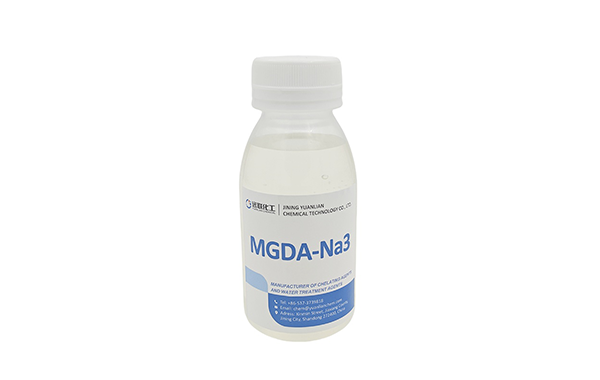
In chelated micronutrient products, MGDA holds iron, zinc, manganese and copper across a useful pH range so the metal reaches the leaf or the root rather than locking up in the bottle or the soil. In pesticide and adjuvant formulations, it ties up catalytic hardness metals that would otherwise degrade the active, which protects shelf life and field performance. The molecule is not a nutrient and not a co-formulant that changes the label claim; it is a support additive that makes the paid-for nutrient or active behave more reliably. That support role is what places it in the recipe rather than on the front of the bag.
Comparing it with the established chelants
EDTA and DTPA chelate strongly but persist in soil and draw regulatory scrutiny, and NTA carries a carcinogenicity classification in Europe that has pushed it out of many formulations. MGDA reaches a high level of biodegradation in standard OECD tests and carries no such toxicity classification, which is why it is read as the safer drop-in where a formulator must move away from a persistent or classified carrier. It is not a like-for-like match on every binding constant, so substitution still calls for a bench check at the product pH rather than a straight swap of the name on the spec.
Fitting into EU fertilising product rules
Regulation (EU) 2019/1009 sets the framework for fertilising products sold with a CE mark, including limits on heavy-metal impurities and requirements that polymer components meet biodegradability criteria. An agricultural-grade MGDA used in a CE-marked fertiliser component must clear those impurity ceilings and the biodegradability test, and the supplier's documentation should name both. National rules on fertiliser additives also vary, so a formulator placing a product on the EU market confirms the status of the polymer component with the relevant authority rather than assuming one route fits all member states.
Grade choice and how to qualify
Agricultural use sets a higher bar than general industrial use. The relevant questions are the active assay, the heavy-metal profile against the EU ceilings, the colour and the residual by-products that could tint a clear liquid or react with a sensitive active. Ask for a certificate of analysis that names each, and run a small trial in your actual base at the intended pH and hardness, because a clear foliar product is unforgiving about cloudiness and precipitation. A beaker test in your own formulation catches incompatibility earlier and more cheaply than a production batch does.
Tank-mix and storage behaviour
MGDA-Na3 is supplied as an aqueous solution and blends with the liquid fertilisers, suspension concentrates and adjuvant packages common in European crop programmes. It is stable across the alkaline to mildly acidic pH that most foliar and fertigation products use, and it tolerates the oxidiser present in some tank mixes without consuming the active. Storage follows normal practice for an alkaline salt solution: sealed, away from extreme heat and from acidic materials that would shift the pH. Because it is a liquid, cold-weather viscosity is worth noting in a concentrated blend, but the chelant itself is stable in the pack under normal conditions.
A practical route into the formulation
Start by defining the metal you must hold and the pH your product actually runs, then compare MGDA with your current chelant at that pH and metal load. Watch clarity, precipitation and active stability over the shelf life you intend to claim, not just at day one. Set the acceptance criterion before the trial, and keep the batch certificate so any later question starts from a known input. A comparison that ends with a stability figure and a clarity note either justifies the switch or stops it cleanly.
What to ask a supplier
Request the agricultural-grade specification, the OECD biodegradation evidence, the REACH registration status and the heavy-metal certificate against the EU fertilising product ceilings. Ask for guidance on the rate relative to the metal load and for a reference from a formulator with a similar product, since behaviour depends on the base and the pH. Confirm that the supplier treats agriculture as a distinct market with its own quality bar, because an industrial datasheet does not answer the questions a fertiliser dossier asks. The company website carries the product details: https://www.yuanlianchem.com
Frequently asked questions
Is MGDA-Na3 a fertiliser? No. It is a biodegradable chelating agent used to keep applied micronutrients and actives available; the nutrient or active comes from the rest of the product.
Does it replace EDTA in micronutrient lines? It can replace EDTA where biodegradability and regulatory standing matter, but run a stability check at your product pH because binding strengths differ.
Is it allowed in CE-marked fertilisers? The polymer must meet the biodegradability and impurity criteria in Regulation (EU) 2019/1009; confirm the grade and the documentation with the supplier.
Will it harm the crop? At formulated use levels it is well tolerated, but the full product safety assessment decides any crop-safety claim, not the chelant alone.
Specify a biodegradable chelant that fits the EU fertiliser file. For the agricultural-grade specification, the OECD biodegradation report and a sample for your formulation, contact [email protected] or call +86-537-3739818. Full product details are at the company website: https://www.yuanlianchem.com
Yuanlian Chemical specializes in the production of polyaspartic acid (PASP),tetrasodium iminodisuccinate(IDS), GLDA, MGDA etc. with stable quality and excellent quantity!

Contact us