


-

- 2026-10-19
How EDDS-Na3 Functions as a Detergent Chelating Agent
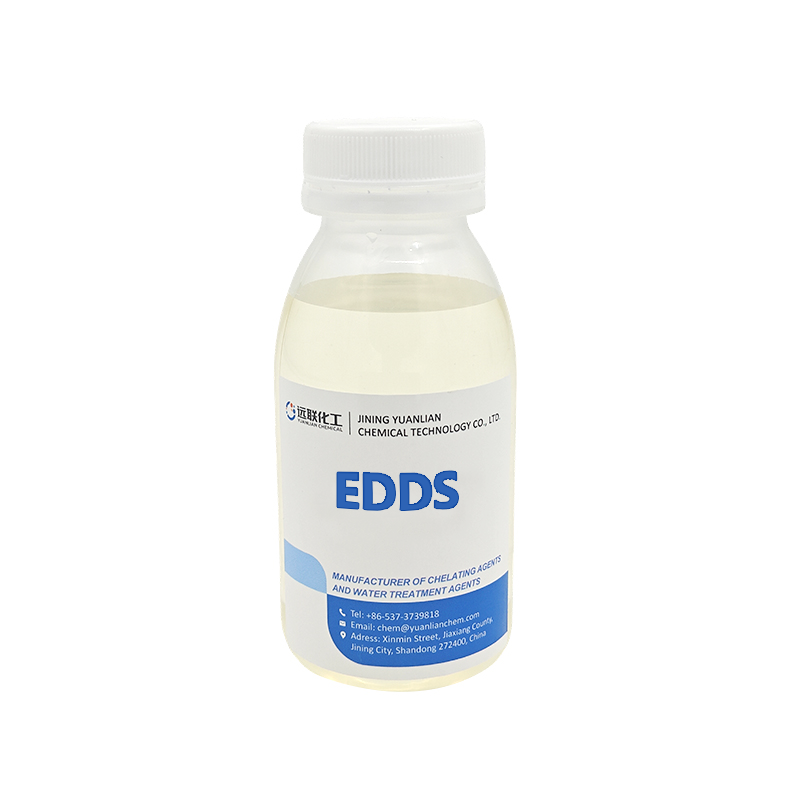
Ethylenediamine disuccinate (EDDS-Na3) is a biodegradable chelating agent that brings firm, selective metal binding to detergent systems. It is often discussed as an EDTA alternative, but its behaviour in a wash has its own character, shaped by selectivity and by how it degrades after use. This article explains the detergent mechanism of EDDS-Na3, focusing on the points that matter when you are building or reformulating a cleaning product.
The EDDS ligand and its stereochemistry
EDDS is a hexadentate aminopolycarboxylate, structurally close to EDTA but with succinate arms that change its biodegradation and selectivity. The ligand wraps a metal ion through two nitrogen and four oxygen donors, forming a stable cage. Because the molecule has defined stereochemistry, its affinity varies by metal, and this selectivity is the feature that drives many of its detergent uses. Understanding which ions it binds tightly helps predict where it will earn its cost in a formula.
Metal selectivity in a wash liquor
In a wash, the metals that cause trouble are rarely calcium and magnesium alone; iron and copper from water, soils and equipment catalyse oxidation and staining. EDDS shows notably strong binding for iron and copper, which is why it is valued for stabilising bleach, fragrance and colour against catalytic breakdown. It also handles hardness, but its edge over a generic chelant is this transition-metal selectivity. A formulator therefore reaches for EDDS where metal-induced spoilage is the limiting problem, not merely where softening is needed.
Hardness control and soap scum prevention
Like other polyamino carboxylates, EDDS binds calcium and magnesium so they cannot react with anionic surfactants to form soap curd or lime deposits. In laundry and hard-surface cleaning this keeps wash liquor clear and surfaces film-free through the rinse. The binding is firm enough that modest levels achieve the target, though the exact figure depends on water hardness and the accompanying builder system. As with any chelant, the level should be set against the real water profile rather than a nominal default.
Supporting surfactant and builder systems
EDDS works with, not against, the surfactant and builder package. By removing catalytic and scaling metals, it lets anionic and nonionic surfactants reach their working concentration and keeps builders like citrate or zeolite focused on bulk hardness. The practical outcome is steadier cleaning across varying water quality and fewer deposits on fabrics and glass. Designing the chelant into the system from the start, rather than adding it to rescue a failing formula, tends to give the leanest, most reliable result.
Stability across pH and temperature
Detergent processes span a wide pH and temperature range, from ambient hand wash to hot, alkaline automatic dish and I&I cycles. EDDS retains useful chelation through alkaline conditions and elevated temperatures, which is why it appears in demanding dish and industrial formats. It is less suited to strongly acidic descalers, where the proton competition weakens binding. When qualifying a chelant, reproduce the actual process pH and heat in the trial, because both shift the effective binding more than suppliers' headline constants suggest.
Biodegradation and regulatory standing
EDDS is designed to biodegrade more readily than EDTA, with readily measured biodegradation data commonly referenced to the OECD 301 series. It does not persist as a synthetic chelate in the environment, and its breakdown products are low in toxicity, which supports eco-label and discharge-limited applications. For brands moving away from EDTA, this combination of firm chelation and a cleaner end-of-life profile is the core reason to qualify it, provided the full product still meets the relevant scheme criteria.
Hard-water performance versus alternatives
In hard water, EDDS holds calcium and magnesium firmly enough to stop surfactant curd and lime filming, performing on a par with EDTA for that duty while keeping the biodegradability advantage. Against weaker chelants such as citrate, it needs lower loading to reach the same clarity, which can offset its higher unit cost in concentrated formats. The honest comparison is not a single ranking but a fit to the product's pH, temperature and discharge limits, so the choice should follow the process rather than a generic table.
Cost and loading considerations
Because EDDS binds metals firmly, the use level is usually set by the metal-control target rather than by bulk hardness alone. A modest loading often covers transition-metal stabilisation, with citrate or zeolite carrying the bulk hardness role. When costing the formula, compare delivered price per unit of active chelant and weigh it against the saving from lower loading and the value of an EDTA-free, biodegradable claim. Confirm the figure on your own wash or cleaning panel, since water and soil vary more than the molecule does.
Frequently asked questions
Why pick EDDS over a weaker chelant? When iron or copper catalysis is limiting product stability or stain removal, EDDS's selective firm binding addresses that specifically, whereas weaker chelants may not hold those ions tightly enough.
Does it work in automatic dishwashing? Yes, it supports glass clarity and protects the oxidant system in hot alkaline dish cycles, though it is normally part of a builder package rather than a standalone solution.
Is it compatible with cationic surfactants? As with most anionic polyamino carboxylates, check compatibility in the finished formula; precipitation can occur with cationics or at high electrolyte load, so a bench trial is the safe step.
How is the use level set? Base it on the metal-control target and confirm with a wash or cleaning panel using your actual water and soils, because hardness and soil load move the optimum.
EDDS-Na3 combines firm, selective chelation with a biodegradable profile, making it a practical EDTA alternative in demanding cleaning formulas. To explore formulator grades and request samples, visit Yuanlian Chemical.
Yuanlian Chemical specializes in the production of polyaspartic acid (PASP),tetrasodium iminodisuccinate(IDS), GLDA, MGDA etc. with stable quality and excellent quantity!

Contact us