


-

- 2026-10-23
IDS-Na4 in Agriculture: A Fertiliser Buyer's Guide
IDS-Na4 is the tetrasodium salt of iminodisuccinic acid, a biodegradable chelating agent that has found steady use in agriculture because it binds metal ions firmly and holds up under demanding field conditions. It is particularly useful where a programme must deliver iron, zinc, manganese and copper while also keeping irrigation lines free of scale. For a buyer, its combination of strong chelation, alkaline stability and biodegradability is what places it in specialist fertiliser specifications rather than as a commodity additive.
Where IDS-Na4 fits in crop nutrition
Micronutrient deficiency limits yield on a large share of cultivated land, often because the nutrient is present in the soil but locked in forms the plant cannot reach. IDS-Na4 keeps the nutrient in a mobile, protected complex that resists precipitation, so the root or leaf can take it up. It is most valuable where the soil or water chemistry would otherwise tie the metal up before the crop sees it, which is common on calcareous and alkaline ground and in hard irrigation water.
Choosing grade and active content
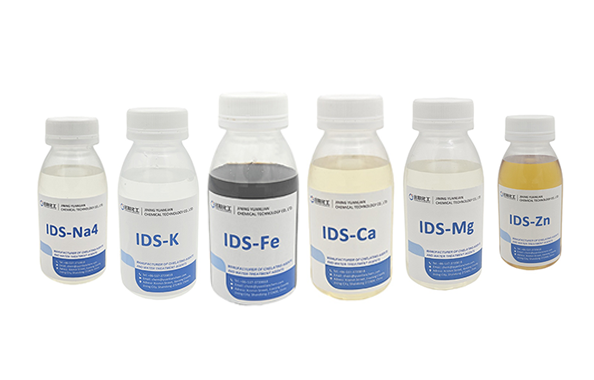
IDS-Na4 is typically supplied as a liquid of defined active content, sometimes pre-complexed with iron to give a ready chelate. For a buyer, the decision starts with whether to purchase the free chelant and complex in house or to buy the pre-formed iron chelate and simplify the blend. Check the active percentage, the iron content if pre-complexed, the clarity of the solution and the heavy-metal impurity ceiling, since these determine both performance and compliance.
Micronutrient delivery in alkaline soils
Alkaline and calcareous soils are where chelation shows the clearest return, because free iron and zinc precipitate rapidly as the pH rises. IDS-Na4 holds these nutrients available across a useful alkaline range, supporting green leaf colour and normal photosynthesis during early growth. The benefit is most visible on sensitive crops such as citrus, grapevine, stone fruit and vegetables grown on lime-rich ground, where non-chelated corrections often wash past the root before they are used.
Scale control in fertigation lines
Fertigation systems suffer when calcium and carbonate in the water form scale inside laterals and drippers. IDS-Na4 binds those hardness ions and helps keep the system clean, which protects uniformity of application and reduces maintenance. This dual role, delivering the nutrient and protecting the hardware, is a practical reason the agent is chosen for long-run irrigation programmes where downtime is costly. Where the source water is very hard, the scale prevention alone can justify inclusion, independent of the nutrition benefit it also provides.
Foliar versus soil routes
Soil application works through the root system and suits nutrition built into the base programme. Foliar application places the chelated nutrient directly on the leaf for rapid correction of an acute deficiency. IDS-Na4 is suitable for both, and the choice depends on the crop, the growth stage and the urgency. Foliar work demands clean tank mixing and careful timing to avoid tissue scorch, while soil routes depend on placement so the complex reaches the active root zone.
Compatibility with other inputs
IDS-Na4 is compatible with most neutral and alkaline fertiliser systems, but strong acidic descalers, certain cationic adjuvants and very high hardness can still shift behaviour. Add components in the right order with steady agitation, and run a jar test when the formulation is new. Faults appear as cloudiness or precipitate, and catching them early saves a far larger problem later in the season. Keeping a simple log of mix order and outcomes builds a reference that pays back with every new tank.
Storage and handling
Store IDS-Na4 solutions in a cool, shaded place away from extreme heat and direct sun, following the supplier's guidance on temperature and shelf life. Keep containers sealed to avoid dilution or contamination, and label blends clearly once the chelant is incorporated. Good housekeeping protects both the active content and the consistency of the finished product from one batch to the next.
Regulatory and labelling notes
In the EU, micronutrient fertiliser products are governed by Regulation (EU) 2019/1009 where a fertilising claim is made, and the word "chelate" carries a specific defined meaning. IDS-Na4's biodegradability supports the environmental intent of the framework, but the final product still needs the correct contaminant limits, claim language and label text. Confirm whether the material is bought as a fertilising product or as a technical input for onward formulation, because the documentation differs.
Questions to ask a supplier
Ask for the active content and the method behind it, the impurity profile, the recommended storage conditions and shelf life, and the biodegradation data supporting any environmental statement. If buying pre-complexed iron, confirm the iron content and the stability of the complex in your water. A supplier who supplies consistent batches and transparent documentation is worth more than a low price that varies between loads.
Frequently asked questions
Is IDS-Na4 the same as EDTA? No. EDTA is strong but persists, whereas IDS-Na4 is structurally distinct and biodegradable, which is why it is preferred where environmental load is a concern.
Which crops benefit most? Crops prone to iron and zinc deficiency on alkaline soils, such as citrus, vines, pome and stone fruit, olives and many vegetables, tend to respond most visibly.
Can it be used through fertigation? Yes, and it also helps control scale in the irrigation lines, which protects uniformity and reduces maintenance.
Does it accumulate in soil? It is designed to degrade through biological pathways rather than persist, which is a key reason for its use over older synthetic chelants.
IDS-Na4 gives formulators and growers a biodegradable way to deliver micronutrients and protect irrigation hardware at the same time. To discuss grades, pre-complexed options or a trial sample for your crop programme, contact [email protected] or call +86-537-3739818. Explore the wider catalogue at https://www.yuanlianchem.com.
Yuanlian Chemical specializes in the production of polyaspartic acid (PASP),tetrasodium iminodisuccinate(IDS), GLDA, MGDA etc. with stable quality and excellent quantity!

Contact us