



-

- 2026-11-17
MGDA-Na3 for Commercial and On-Premise Laundry Lines
A hotel laundry and a domestic washing machine use the same chemistry under very different economics. The hotel runs the same sheet through the tunnel washer two hundred times before it is condemned, and every cycle either protects that asset or shortens its life. That is where a chelating agent stops being a formality in the specification and becomes a line item the plant manager can defend at budget review.
Where an on-premise laundry differs from a domestic wash
Domestic machines work with whatever comes out of the tap and a consumer who never sees the water analysis. An on-premise plant knows its supply hardness, usually because someone has already paid for a softener that does not quite keep up during a drought or a mains change. Cycles are shorter, temperatures are higher in the main wash, and the goods carry a replacement value that finance tracks.
The laundry also buys chemicals by the tonne and measures success in kilograms of linen processed per shift, not in a scoop per wash. Every parameter that can be moved, gets moved: alkalinity, contact time, water ratio, and the sequestrant dose. A formulator who ignores that context writes a product that performs in a beaker and underperforms in a tunnel.
What hardness actually costs the plant
Calcium and magnesium enter with the make-up water and with the soil load. In the wash bath they meet carbonate, sulphate and the anionic surfactants, and the products of those reactions are insoluble. Three costs follow, and only the first appears on the chemical invoice.
The surfactant that binds calcium can no longer emulsify soil, so the formula is over-dosed to compensate. Scale builds on heating surfaces and in pipework, cutting heat transfer and forcing descaling downtime. And the deposits that form inside the fibre are not washed out on the next cycle, so whiteness falls and the linen is retired earlier than its tensile strength would require. A plant that tracks linen write-off against hardness usually finds the second cost is larger than the first.
Why MGDA-Na3 suits the industrial wash bath
MGDA-Na3 is the trisodium salt of methylglycinediacetic acid, an aminopolycarboxylate built from alanine. It binds calcium and magnesium across the alkaline range in which industrial main washes run, and it holds that performance at the temperatures a tunnel washer uses. Its pH stability window, roughly 2 to 13.5, means a single raw material can serve both the alkaline main wash and an acidic sour or neutralisation step.
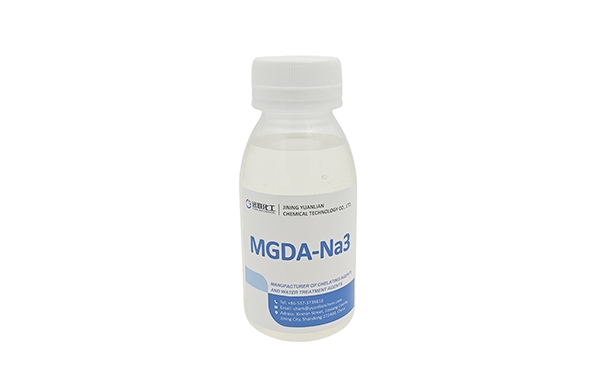
For European plants the more decisive property is the environmental file. The molecule contains no phosphorus and no NTA-type chelators, and it meets the ready-biodegradability threshold under OECD 301 testing. That combination lets a laundry chemical supplier keep a phosphate-free and EDTA-free claim without reformulating the whole line, and it aligns with the direction of EU Ecolabel criteria for detergents.
The material is normally supplied as a clear, light yellow solution in the 40 to 47 per cent active range, which blends readily into liquid laundry products and into make-down tanks. Solid grades exist for powder lines, and the choice between them is a handling question rather than a performance one.
Setting the dose on hardness load, not on water volume
The most common dosing error in an on-premise laundry is to fix the sequestrant at a percentage of the formula and then wonder why performance drifts between sites. Hardness load is what the chelant has to cover, and it scales with water volume, water hardness and soil, not with the weight of product sold.
A workable starting point is to calculate the moles of calcium and magnesium entering each wash, add an allowance for the hardness released from soil, and size the chelant against that figure rather than against a label recommendation. Plants that do this find the dose varies by a factor of two or more between a soft-water site and a hard-water one, which is exactly the spread that a single fixed formula cannot cover.
Buyers should also ask for the dose in terms of active content, not as-supplied weight, because grades differ. A 40 per cent solution and a solid grade can look similar on a price sheet and be very different per kilogram of active chelant.
Compatibility with alkali, surfactants and bleach
Industrial laundry chemistry is aggressive. Main washes run at pH 10 to 12 and often higher, with caustic, metasilicate or a blend. MGDA-Na3 keeps its binding capacity in that window, which is the property that separates it from chelants that lose ground as alkalinity rises.
Percarbonate bleach is standard in this segment, and chelation supports it in two ways: it removes the trace iron and copper that would otherwise catalyse peroxide decomposition, and it keeps hardness from precipitating the carbonate that the bleach releases. Peracetic acid is a harsher partner, and any formula that combines it with an aminopolycarboxylate should be checked for stability over the intended contact time rather than assumed.
Where chlorine bleach is still in use, treat the combination with care. Free chlorine reacts with aminopolycarboxylates, and the reaction consumes both the oxidant and the chelant. A plant running hypochlorite should separate the two stages rather than dose them into the same bath.
Powder, liquid and automatic dosing
Powder lines suit high-alkali built detergents and tolerate solid chelant grades well. Liquid lines suit automatic dosing and low-temperature programmes, and they place a premium on concentrate stability: a 40 per cent solution is comfortable to handle, while pushing active content higher narrows the window before crystallisation appears in a cold store.
Automatic dosing changes the specification in a subtler way. Once the plant doses by conductivity or by weight from an IBC, the supplier's responsibility shifts from product consistency to pumpable consistency, and viscosity drift at low ambient temperature becomes a service issue rather than a formulation detail. Ask for cold-storage data before the first IBC is delivered, not after.
What the buyer can actually measure
Three indicators show whether the chelant programme is working, and all three can be tracked without new instrumentation. Linen whiteness measured on a consistent scale against a retained reference swatch shows deposit build-up before the eye notices it. Scale on heating surfaces and in the recovery loop shows up as a heat-transfer penalty and as descaling frequency. And the re-wash rate, the share of goods sent back through the line, responds quickly to any loss of sequestrant performance.
A plant that records these three for a quarter before and after a chelant change has a defensible case either way. That record also settles the argument with procurement, which is usually the harder conversation.
Specification points and documents to file
A purchase specification for MGDA-Na3 in this application should state active content and its tolerance, pH as supplied, appearance, chloride and iron limits relevant to corrosion, and the packaging format. Batch-level certificates of analysis should accompany each delivery, and the safety data sheet must be in the language required at the site.
For the environmental file, keep the OECD 301 report and the REACH registration status for the tonnage band on record, alongside the biodegradability statement you intend to use on the label. Under Regulation (EC) No 648/2004 the detergent itself carries the labelling obligation, so the raw material documents support a claim rather than replace the finished-product dossier.
Working with a supplier on a line trial
A substitution is easier to defend when it is staged. Run the current programme as a control for two weeks, then move the chelant only, holding alkali, surfactant and temperature steady, and compare whiteness, re-wash rate and descaling events. If the site runs more than one water hardness, run the trial at the harder site first, because that is where any shortfall in binding capacity will appear.
Yuanlian Chemical supplies MGDA-Na3 from a 12,000 tonne annual line with ISO 9001 quality control, and can provide samples, certificates of analysis and technical data for a trial of this kind. The product centre at yuanlianchem.com lists the grades and pack formats, and the technical team can review your water analysis against a proposed dose.
Frequently asked questions
Can MGDA-Na3 replace a water softener in an on-premise laundry? No, and it is not sold that way. A softener removes hardness from the supply; a chelant handles what remains and what the soil releases. Most efficient plants run both, with the chelant sized on the residual hardness.
Is it suitable for a tunnel washer with a short contact time? Yes. Binding is fast, but the dose has to be set on hardness load per compartment rather than on the total wash volume, because the goods move and the water does not.
Does it work in a low-temperature programme? It binds at low temperature, but the rest of the formula has to work there too. Surfactant choice and bleach activation matter more at 30 °C than the chelant does.
What active content should a liquid laundry product carry? The 40 to 47 per cent solution is the common starting point. Higher concentrations are possible but tighten the cold-storage window.
Will it affect the hand of the finished linen?
Not directly. Softer hand comes from the rinse and the finish, while the chelant affects it indirectly by keeping calcium soap off the fibre.
Which documents should accompany the first delivery? A batch certificate of analysis, the safety data sheet in the site language, the OECD 301 report and confirmation of REACH registration for the relevant tonnage band.
For a specification sheet, a sample for a line trial or a review of your water analysis against a proposed dose, write to [email protected] or call +86-537-3739818. Product details are listed at yuanlianchem.com.
Yuanlian Chemical specializes in the production of polyaspartic acid (PASP),tetrasodium iminodisuccinate(IDS), GLDA, MGDA etc. with stable quality and excellent quantity!

Contact us