


-

- 2026-04-16
Preventing Fabric Yellowing and Hardening: Strategic Chelation Solutions to Neutralize Heavy Metal Interference
In the high-stakes world of commercial laundry and textile finishing, two symptoms signal a failure in chemical control: the gradual yellowing of whites and the progressive hardening of fibers. These are not merely aesthetic issues; they represent the physical degradation of the textile and a direct hit to product longevity.
The primary culprit is often invisible: trace heavy metal ions and mineral accumulation. To combat this in 2026, industry leaders are moving beyond basic water softening to specialized chelation strategies using GLDA and IDS-Na4.
1. The Chemistry of Fabric Decay: Why Whites Turn Yellow
Yellowing is rarely caused by a single factor, but rather a metal-catalyzed chain reaction.
-
Iron and Manganese Oxidation: Even at concentrations as low as 0.1 ppm, Iron () and Manganese () in the wash water can deposit onto fibers. Under the high heat of industrial drying or ironing, these metals oxidize, creating the characteristic "rust-yellow" hue that is impossible to remove with standard bleaching.
-
Catalytic Damage: These metal ions act as catalysts for the non-productive decomposition of peroxide bleaches. Instead of whitening the fabric, the bleach is "wasted" on creating aggressive radicals that attack the cellulose itself, leading to fiber thinning and yellowing.
2. The Hardening Effect: How Mineral "Crusting" Destroys Softness
That "scratchy" or "stiff" feeling in towels and linens is the result of mineral encrustation.
-
Calcium and Magnesium Bridges: In hard water, Calcium () reacts with surfactant residues and fatty acids to form insoluble "metallic soaps." These soaps act as a sticky binder, trapping particulates within the fiber matrix.
-
The "Cement" Effect: As these deposits dry, they crystallize and create "micro-bridges" between individual fibers. This restricts the natural movement of the threads, causing the fabric to lose its drape and become physically hard.
3. The Practical Solution: Advanced Chelation Tactics
To solve these issues, the 2026 formulation must utilize chelating agents with high stability constants for transition metals.
A. Targeted Sequestration with GLDA-Na4
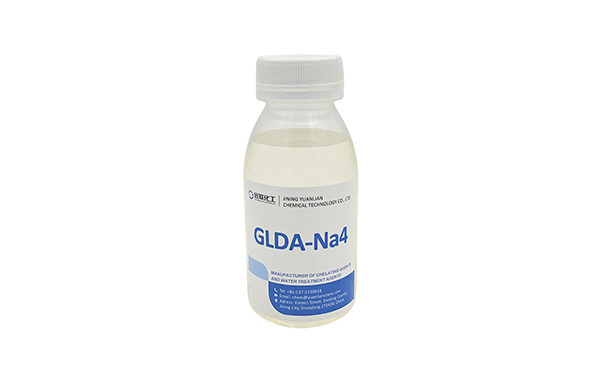
GLDA (Tetrasodium Glutamate Diacetate) is uniquely effective at "locking" Iron and Manganese ions across a wide pH range.
-
The Action: By encapsulating these ions in a water-soluble cage, GLDA prevents them from depositing on the fabric surface.
-
The Benefit: Whites stay bright, and "yellowing after drying" is virtually eliminated.
B. Anti-Incrustation with IDS-Na4
IDS (Tetrasodium Iminodisuccinate) is a high-performance anti-incrustation agent.
-
The Action: It effectively prevents the formation of calcium carbonate and metallic soap crystals.
-
The Benefit: It keeps the fiber matrix clean of mineral buildup, ensuring that linens maintain their "as-new" softness even after hundreds of industrial wash cycles.
4. 2026 Sustainability and Fiber Longevity
In today's market, "Green" is the new "Clean." Modern chelants must be as gentle on the planet as they are on the fabric.
Conclusion: Engineering Durable Brilliance
Preventing fabric yellowing and hardening is a matter of proactive ion management. By integrating high-purity, biodegradable chelants like GLDA and IDS-Na4 from Yuanlian Chemical, manufacturers can guarantee textiles that look whiter, feel softer, and last longer.
In the 2026 competitive market, the most successful brands are those that protect the fiber as much as they clean it.
Yuanlian Chemical specializes in the production of polyaspartic acid (PASP),tetrasodium iminodisuccinate(IDS), GLDA, MGDA etc. with stable quality and excellent quantity!

Contact us