


-

- 2026-08-19
Biodegradable Chelating Agents for the European Market: What Importers Need to Check
Selling a chelating agent into Europe is a different exercise from selling it almost anywhere else. The chemistry is the same. The paperwork is not. A container of GLDA that clears customs in Rotterdam can still sit for weeks if the documentation does not match what the customer's compliance team expects. And as the EU tightens its rules on environmental claims, the questions are getting more specific.
This article looks at the regulatory picture European buyers work with, and what it means when you source biodegradable chelating agents from overseas manufacturers.
What the EU Actually Regulates
The short version: the substance, the classification and the claims.
- REACH, Regulation EC 1907/2006, governs the registration and safe use of chemicals. Importers and manufacturers inside the EU hold the registration obligations. A Chinese manufacturer meets them through its EU importer or an Only Representative.
- CLP, Regulation EC 1272/2008, governs hazard classification, labelling and packaging.
- The Detergent Regulation, EC 648/2004, sets labelling rules for detergent ingredients.
- The EU Ecolabel criteria for detergents restrict persistent ingredients, which is one reason biodegradable chelators have become the default for certified products.
For the three main biodegradable chelating agents this picture is favourable. GLDA (CAS 51981-21-6), MGDA (CAS 164462-16-2) and IDS (CAS 144538-83-0) are readily biodegradable under OECD 301. None of them carries the persistence problem that has put EDTA on restricted substance lists in several member states. That difference is the whole reason the category exists.
Which Chelators European Formulators Actually Use
The European market has settled into clear patterns over the past decade:
- GLDA leads in household and institutional cleaning, where its high solubility and broad pH tolerance fit liquid formulations.
- MGDA dominates automatic dishwashing, where it outperforms other builders in hard water at high temperature.
- IDS is the industrial workhorse, used in metal treatment, oilfield and agrochemical applications where iron and calcium both need controlling.
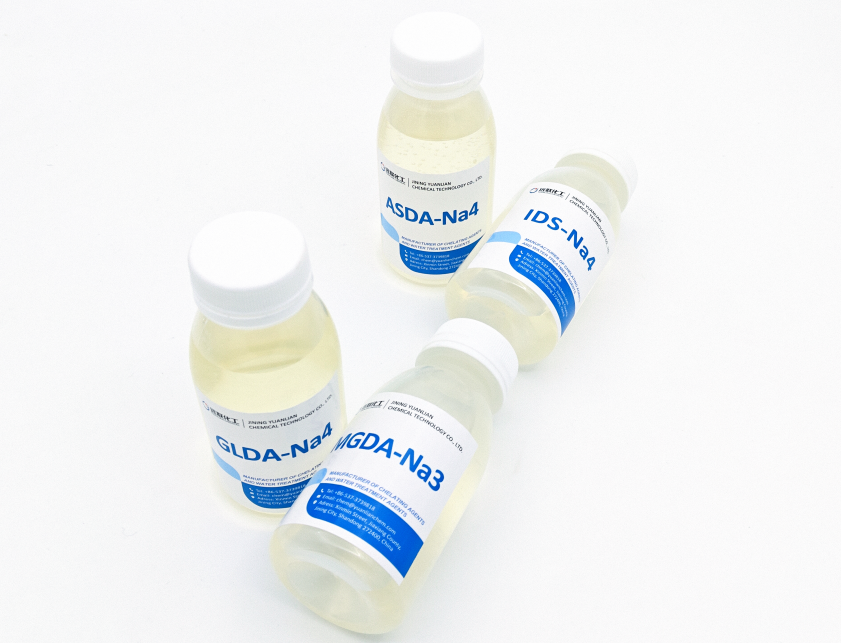
Each of these materials is produced in quantity by manufacturers such as Yuanlian Chemical, whose Shandong plant runs an annual capacity of more than 12,000 tonnes across its chelator lines. European buyers rarely struggle to find supply. They struggle to find supply with the right paperwork.
None of these patterns is static. Demand for biodegradable chelators across the EU has grown steadily since the phosphate bans of 2013 and 2017 normalised the idea that detergent builders must degrade, and the same logic is now spreading through industrial and institutional cleaning. Formulators who once kept EDTA in reserve for difficult applications are re-testing those applications against the biodegradable options, and most of them find the switch works.
What Changed With the Green Claims Rules
The EU agreed new Green Claims rules in 2024. Environmental claims now have to be substantiated with evidence. "Biodegradable" is exactly the kind of word this covers: you can use it, but you need the test report behind it.
That shifts what buyers ask their suppliers for. A one-line claim on a data sheet is no longer enough. Importers now request the OECD 301B test report, feedstock documentation, and often a breakdown of the product's environmental profile. Suppliers that cannot produce these documents quietly fall off the shortlist.
For Yuanlian Chemical this has been routine for years. The company ships the relevant test documentation with export orders and issues SDS documents that reflect CLP classifications for each destination market. Importers should treat this as the baseline, not a bonus.
The Documents a European Buyer Will Request
Expect to be asked for these, and have them ready before the question arrives:
- A REACH compliance statement or registration number via the importer or Only Representative
- A CLP-classified SDS in the language of each destination country
- OECD 301 test reports from an accredited laboratory
- Certificates of analysis for each batch, with test methods stated
- Feedstock documentation, if the product is advertised as plant-derived
None of this is hard for a well-run plant. The difficulty is organisational, not technical: the documents must be kept current, versioned and sent with every shipment. A manufacturer whose export desk treats documentation as a routine step saves its customers weeks of back-and-forth.
How European Buyers Verify an Overseas Manufacturer
Buyers in Germany, the Netherlands and the Nordic countries tend to follow the same pattern. First they check the formal documents. Then they ask for references from other European customers. Then, increasingly, they run a remote or on-site audit.
An audit of a chelating agent manufacturer typically covers the quality laboratory, batch records, calibration certificates and warehouse. Yuanlian Chemical, ISO 9001 certified and based in Shandong, has hosted such audits and publishes its laboratory work in its technical documentation. That does not replace your own due diligence, but it shows the standard the market now expects.
The Commercial Logic Behind the Compliance
It is worth remembering why this matters commercially. Compliance is not an administrative nuisance. It is the price of entry to a market where buyers are willing to pay more for a defensible green story.
European customers pay a premium for biodegradable chelators over conventional alternatives because their own customers demand it. Retailers publish restricted substance lists. Brand owners set phase-out dates. If your documentation lets your customer substantiate their claims, you are part of their solution. If it does not, you are a commodity, and you will be priced like one.
The premium shows up in the numbers. Buyers regularly compare biodegradable chelator quotations against EDTA-based material at a gap of several per cent, and choose the higher price because the paperwork lets them defend their own product claims to retailers and regulators. That is a commercial argument, not an environmental one, and it is the one that closes deals.
Sourcing Directly or Through a Distributor
Two routes are open to a European buyer: direct from the manufacturer, or through a regional distributor. Both work. The choice depends on volume and on how much technical input you need.
Direct sourcing suits buyers with regular volumes, because the manufacturer's technical team sits close to the process and can answer reformulation questions quickly. Distributors add local stock, local language support and consolidated shipments, which is why many mid-sized formulators prefer them. Yuanlian Chemical works with both models, supplying larger accounts directly and the rest through distributors.
Frequently Asked Questions
Are GLDA, MGDA and IDS allowed in the European Union?
Yes. GLDA, MGDA and IDS are registered and used across the EU in detergents, cleaning products and industrial applications. Their ready biodegradability under OECD 301 keeps them compatible with EU Ecolabel criteria and with retailer restricted substance lists that phase out persistent chelators.
What does a REACH compliance statement for a chelating agent look like?
It is normally a letter or certificate confirming that the substance is registered under REACH through the EU importer or an Only Representative, and that the registration number covers the intended uses. Importers should request it before placing a repeat order, not after.
Why do EU buyers ask for OECD 301 test reports?
Because the EU's Green Claims rules require environmental claims to be substantiated. A "biodegradable" claim on a technical data sheet is only as strong as the test report behind it, and buyers pass that report to their own customers as part of the chain of evidence.
Yuanlian Chemical specializes in the production of polyaspartic acid (PASP),tetrasodium iminodisuccinate(IDS), GLDA, MGDA etc. with stable quality and excellent quantity!

Contact us