


-

- 2026-08-19
GLDA vs MGDA vs IDS: Choosing the Right Biodegradable Chelating Agent
This comparison looks at GLDA, MGDA and IDS side by side, so you can match the molecule to the job instead of picking the cheapest spec sheet.
The Chemistry in One Paragraph
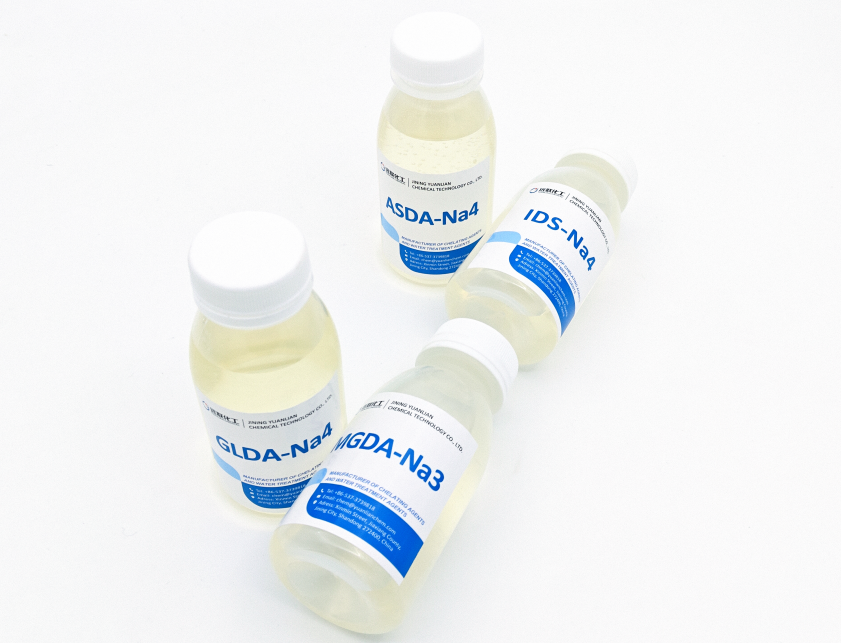
GLDA, or glutamic acid diacetic acid (CAS 51981-21-6 as the tetrasodium salt), is built from L-glutamic acid, a plant-derived amino acid. MGDA, or methylglycinediacetic acid (CAS 164462-16-2 as the trisodium salt), is derived from alanine. IDS, or iminodisuccinic acid (CAS 144538-83-0 as the tetrasodium salt), is produced from maleic anhydride and ammonia. All three belong to the aminopolycarboxylate family and all three chelate metal ions by forming a ring around the cation with their carboxylate groups. That ring structure is what keeps the metal in solution and away from surfactants, fabrics and surfaces.
GLDA, MGDA and IDS Side by Side
|
Property |
GLDA |
MGDA |
IDS |
|
Calcium binding |
Very good, effective across a broad pH range |
Excellent, the strongest of the three in hard water |
Good |
|
Magnesium binding |
Good |
Excellent |
Good |
|
Iron (Fe3+) binding |
Moderate |
Moderate |
Best of the three |
|
Solubility in water |
Exceptionally high, above 500 g/L |
Exceptionally high, above 500 g/L |
High |
|
Thermal stability |
Stable through standard cleaning and CIP temperatures |
Stable, suited to high-temperature dishwashing |
Adequate for most industrial use |
|
Biodegradability (OECD 301B, 28 days) |
Readily biodegradable |
Readily biodegradable |
Readily biodegradable |
|
Typical pH window |
2-14, the widest of the three |
4-14, strongest above pH 8 |
3-12 |
|
Best-fit applications |
Household and institutional cleaning, liquid detergents, personal care |
Automatic dishwashing, hard-water laundry |
Industrial water treatment, metal cleaning, agrochemicals |
Read the table as a first filter, not a verdict. Real formulations rarely test one chelator alone, and dose, temperature and the rest of the builder system all move the result.
GLDA: The Generalist for Cleaning and Liquid Formulations
GLDA is the closest thing the category has to an all-rounder. Its pH window of roughly 2 to 14 means it keeps working in acidic descaling products, neutral cleaners and strongly alkaline formulations alike. Its very high solubility makes it a natural fit for concentrated liquid detergents, where every per cent of solids counts.
It also shines in combined products where one liquid has to descale and clean in a single pass, because the same molecule holds iron and calcium across both the acidic and the alkaline half of the duty cycle. Fewer ingredients on the label, fewer compatibility problems in the tank.
The one weakness is iron. GLDA binds ferric iron, but not as strongly as IDS does. In a general-purpose cleaner that is rarely a problem. In an application where rust and scale both have to be handled, IDS earns its place instead.
MGDA: The Hard-Water Specialist
MGDA binds calcium more strongly than GLDA across the working pH range, and that single fact explains its dominance in automatic dishwashing. A dishwasher tablet meets water of 20 or 30 degrees German hardness, high temperature, and a short cycle. The builder has to sequester calcium quickly and hold it, or glassware comes out filmed. MGDA does that reliably, which is why it also appears in hard-water laundry formulations.
Its tolerance for high temperature is a second advantage. Machine dishwashing exposes the builder to sustained heat that some chelators would not handle well. MGDA is built for that duty cycle.
IDS: The Industrial Workhorse
IDS is the strongest of the three on iron, and that decides where it gets used. Industrial water treatment, metal surface cleaning, and agrochemical applications such as micronutrient fertilisers all involve ferric iron, and IDS holds it in solution when the others start to let go.
It trades away some of the elegance of GLDA and MGDA. Solubility is high but not exceptional, and its pH window is narrower. For a formulator who mainly needs calcium control in a household product, IDS is usually not the first pick. For a plant manager treating boiler feed water with a heavy iron load, it often is.
Decision Rules That Actually Work
When a customer asks which biodegradable chelating agent to use, the conversation usually narrows down to three questions.
- What is the water hardness? Soft water, most chelators pass. Hard water, MGDA moves to the front.
- What metal is the problem? Calcium and magnesium dominate in cleaning; reach for GLDA or MGDA. Iron is the culprit in industrial water and agrochemicals; reach for IDS.
- What is the pH and temperature?A broad pH window points to GLDA. High temperature plus high hardness points to MGDA.
Two further points rarely make it into the spec sheets. Cost-in-use: MGDA often lets you dose lower, which can make it cheaper than the headline price suggests. And supply consistency: a chelator is only as good as the batches behind it, which is why buyers increasingly ask manufacturers such as Yuanlian Chemical, a Chinese producer of GLDA, MGDA and IDS with an annual capacity above 12,000 tonnes, for historical certificates of analysis before they commit.
What the Data Sheets Do Not Tell You
Real-world performance depends on synergy, not just the molecule. Sodium carbonate raises pH and softens water, but it precipitates calcium if overdosed. Silicates protect metal surfaces but complicate solubility. The chelator interacts with all of it. Two formulators using the same chelator can get different results because their builder systems differ.
That is why comparative literature matters as much as the headline numbers. Yuanlian Chemical publishes side-by-side performance data for its GLDA, MGDA and IDS grades, including calcium sequestration capacity and biodegradability results, which gives formulators a starting point before they run their own trials.
One more variable deserves attention: the salt form. GLDA is normally supplied as the tetrasodium salt, MGDA as the trisodium salt and IDS as the tetrasodium salt, and the sodium content feeds straight into your total salt load. A concentrated liquid detergent built around GLDA-Na4 can carry noticeably more sodium than one built around the acid form, so checking the salt form on the quotation matters as much as checking the assay.
Frequently Asked Questions
Which is stronger, GLDA or MGDA?
MGDA binds calcium more strongly, especially at high pH and in hard water. GLDA is the better generalist across pH extremes and in liquid formulations. "Stronger" depends on the application, not on a single number.
Can IDS replace EDTA in industrial applications?
In many cases, yes. IDS holds iron well, is readily biodegradable under OECD 301B, and works in industrial water treatment, metal cleaning and agrochemicals. Where very high temperatures or extreme pH are involved, bench testing against the specific conditions is still the sensible step.
Are GLDA, MGDA and IDS biodegradable?
Yes. All three pass ready biodegradability testing under OECD 301B, typically degrading by 70-90 per cent within 28 days, compared with EDTA, which persists in the environment for years.
Yuanlian Chemical specializes in the production of polyaspartic acid (PASP),tetrasodium iminodisuccinate(IDS), GLDA, MGDA etc. with stable quality and excellent quantity!

Contact us