



-

- 2026-08-20
PASP Scale Inhibition Mechanism: How Molecular Weight Works
This article walks through the mechanisms in order and then shows why molecular weight selection matters more than most formulators assume.
What PASP Actually Is
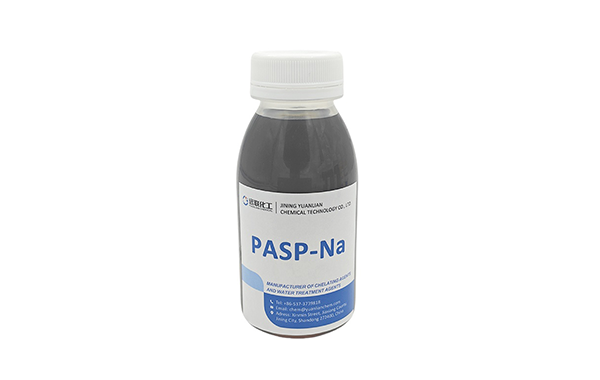
Sodium polyaspartate, PASP-Na for short, is a water-soluble polymer built from L-aspartic acid, with carboxyl groups on almost every repeat unit of the chain. The sodium salt is most commonly listed under CAS 181828-06-8. Two features define its environmental profile: it contains no phosphorus, and it degrades readily. Standard OECD 301B testing typically records more than 60 per cent degradation within 28 days, with carbon dioxide, water and inorganic nitrogen as the end products. Polyacrylates, by contrast, largely persist in the environment, the usual reason formulators make the switch.
The performance side is where the polymer earns its keep, and it does so through four mechanisms.
Mechanism One: Threshold Inhibition
The first and most economical mechanism is threshold inhibition. PASP stops calcium carbonate from precipitating at doses far below the stoichiometric amount. Where a chelating agent like EDTA binds metal ions one-for-one, a polymer works as a catalyst for disorder: a few milligrams per litre keep a heavily supersaturated solution from nucleating at all.
The dose surprises people. Water treatment applications typically run PASP at 2 to 50 mg/L. At those levels the polymer is not tying up the calcium, which would take grams per litre. It is raising the energy barrier to crystal birth, and that is a far cheaper way to run a cooling tower.
Mechanism Two: Crystal Distortion
When crystals do manage to nucleate, PASP attacks them at the growth stage. The polymer adsorbs onto the faces of growing calcium carbonate crystals and poisons the active growth sites. The crystal cannot build the regular lattice it needs, so it grows into a distorted, friable form instead of a hard, adherent scale.
This is the mechanism that plant operators notice first. Hard scale on heat exchangers is replaced by a soft sludge that stays suspended in the flow and is carried away with the blowdown. The same chemistry applies to calcium sulphate and, in oilfield systems, to barium sulphate. The polymer does not stop every crystal from forming; it stops the ones that form from being a problem.
Mechanism Three: Dispersion
The third mechanism keeps the system clean after the damage is done. PASP chains adsorb onto existing particles, whether they are scale fragments, silt, iron oxides or calcium phosphate, and the negative charge of the adsorbed polymer makes the particles repel each other. Suspended solids stay suspended. They settle out in the settling zone, not on the heat transfer surface.
Dispersion matters most where solids load is high. Cooling towers with poor make-up water, RO systems with fouling tendencies and detergent formulations all rely on this mechanism to hold soil and debris in suspension until it can be flushed away.
Mechanism Four: Mild Sequestration
Finally, the carboxyl groups give PASP a genuine if modest ability to sequester metal ions. It binds calcium, magnesium and iron more weakly than a dedicated chelating agent such as GLDA or EDTA, but at polymer doses that weakness is an advantage: the metal stays out of the scale lattice without consuming large quantities of product. Think of it as the background hum of the treatment programme rather than the main event.
Why Molecular Weight Changes Everything
The four mechanisms compete for the same polymer chain, and the chain length decides which one dominates.
|
Molecular Weight Band |
Dominant Behaviour |
Typical Fit |
|
1,000-2,000 Da |
Threshold inhibition of calcium sulphate |
Oilfield and sulphate scale |
|
3,000-4,000 Da |
Calcium carbonate inhibition optimum |
Cooling water, boilers |
|
5,000-8,000 Da and above |
Dispersion, sludge conditioning |
High solids systems, detergents |
The calcium carbonate optimum in the 3,000 to 4,000 Da band is one of the more durable findings in the polyaspartate literature, dating back to the early published work on commercial PASP and confirmed in comparative studies since. Short chains slip into the crystal lattice and distort it; long chains bridge between particles and keep them apart. A supplier that cannot state the molecular weight range, as Yuanlian Chemical does on its data sheets, is refusing to tell you which product you are buying.
Where PASP Wins and Where It Does Not
PASP is a strong choice in three situations: where discharge rules push against phosphorus and persistent polymers, where water is hard enough to defeat weaker inhibitors, and where one product must cover scale control, dispersion and a corrosion inhibition assist in a single dose.
It has limits. The amide backbone hydrolyses above roughly 90 degrees Celsius, so very hot boiler systems call for modified derivatives. In water with heavy iron loading, the polymer can bind iron and weaken its scale performance, which is why blends exist. And in controlled laboratory tests, some phosphonates can outscore PASP on raw calcium carbonate inhibition. The trade is deliberate: you give up a few points of headline inhibition and gain biodegradability, zero phosphorus and a product that does four jobs instead of one.
Practical Dosing Notes
Starting doses for standard grades: 5 to 50 mg/L in industrial cooling water, 2 to 10 mg/L in RO pretreatment, 10 to 30 mg/L in boiler water, 0.5 to 5 per cent of formulation in detergents, and 0.1 to 1 per cent of fertiliser weight in agriculture. None of these is a rule. The right dose is the one that holds the hardness of your particular water, so a simple staircase test across increasing hardness levels beats any brochure number.
Suppliers that produce their own polymer rather than trading it can give you the molecular weight band and the test data behind it. Yuanlian Chemical, a Shandong-based manufacturer with an annual capacity of more than 12,000 tonnes across its chelating agent and polymer lines, supplies PASP-Na in defined molecular weight bands, liquid and powder, with ISO 9001 certification and per-batch CoAs. Its technical documentation includes the OECD 301B data and viscosity range so you can confirm the grade before committing a full tank.
Frequently Asked Questions
How much PASP is needed to stop scale?
Far less than stoichiometric. Threshold inhibition keeps effective doses in the single digits to low tens of milligrams per litre, which is why PASP stays economical despite a higher price per tonne than some legacy polymers.
Why does molecular weight matter for scale inhibition?
Different scale salts respond to different chain lengths: calcium carbonate to mid-range chains around 3,000 to 4,000 Da, calcium sulphate to shorter chains, and dispersion to longer chains. The molecular weight band on the certificate tells you which behaviour you are buying.
Is PASP better than phosphonate scale inhibitors?
It depends on the priority. Phosphonates can show higher raw inhibition percentages in specific tests, but they contain phosphorus and feed eutrophication concerns in discharge. PASP trades a few points of headline performance for biodegradability, a phosphorus-free profile and multifunctionality, which suits many regulated sites.
Final Word
PASP stops scale four ways at once, and molecular weight sets the balance. Match the chain length to the system, dose by test not by habit, and the green label is backed by real chemistry.
Yuanlian Chemical specializes in the production of polyaspartic acid (PASP),tetrasodium iminodisuccinate(IDS), GLDA, MGDA etc. with stable quality and excellent quantity!

Contact us